
 English
 Français
 Deutsch
 Português
 Español
 русский
  한국어
한국어 العربية
 Italiano
 Indonesia
 Schweiz
 Polski
 Nederlands
 ישראל - עברית
 Perzisch
 ไทย
ไทย 日本語
日本語 ኢትዮ-አማርኛ
 Việt Nam
 Kiswahili
 Srpski
 Ελληνικά
 简体中文
简体中文Traditional Belts vs. Next-Gen Fans: The AHU Retrofit Reshaping Electronics Manufacturing Efficiency
In high-load electronics manufacturing facilities, AHU/MAU systems often operate 24/7 under demanding conditions — where airflow stability, energy efficiency, and system reliability directly impact daily operations.
Recently, Beijing Hengrui supported an AHU retrofit evaluation project for a large electronics manufacturing facility, focused on upgrading traditional belt-driven fan systems to high-efficiency EC fan grid solutions.
In this project, the original AHU systems were designed with belt-driven centrifugal fans and AC asynchronous motors.
While this type of setup has been widely used for years, long-term industrial operation often exposes several limitations:
For facilities operating continuously, even small inefficiencies can translate into significant long-term operational costs.
Instead of redesigning the entire AHU structure, the retrofit focused on replacing the original fan systems with EC fan grid configurations using backward-curved EC centrifugal fans.
The objective was straightforward:
Maintain the original airflow and static pressure requirements while improving overall system efficiency and reducing maintenance complexity.
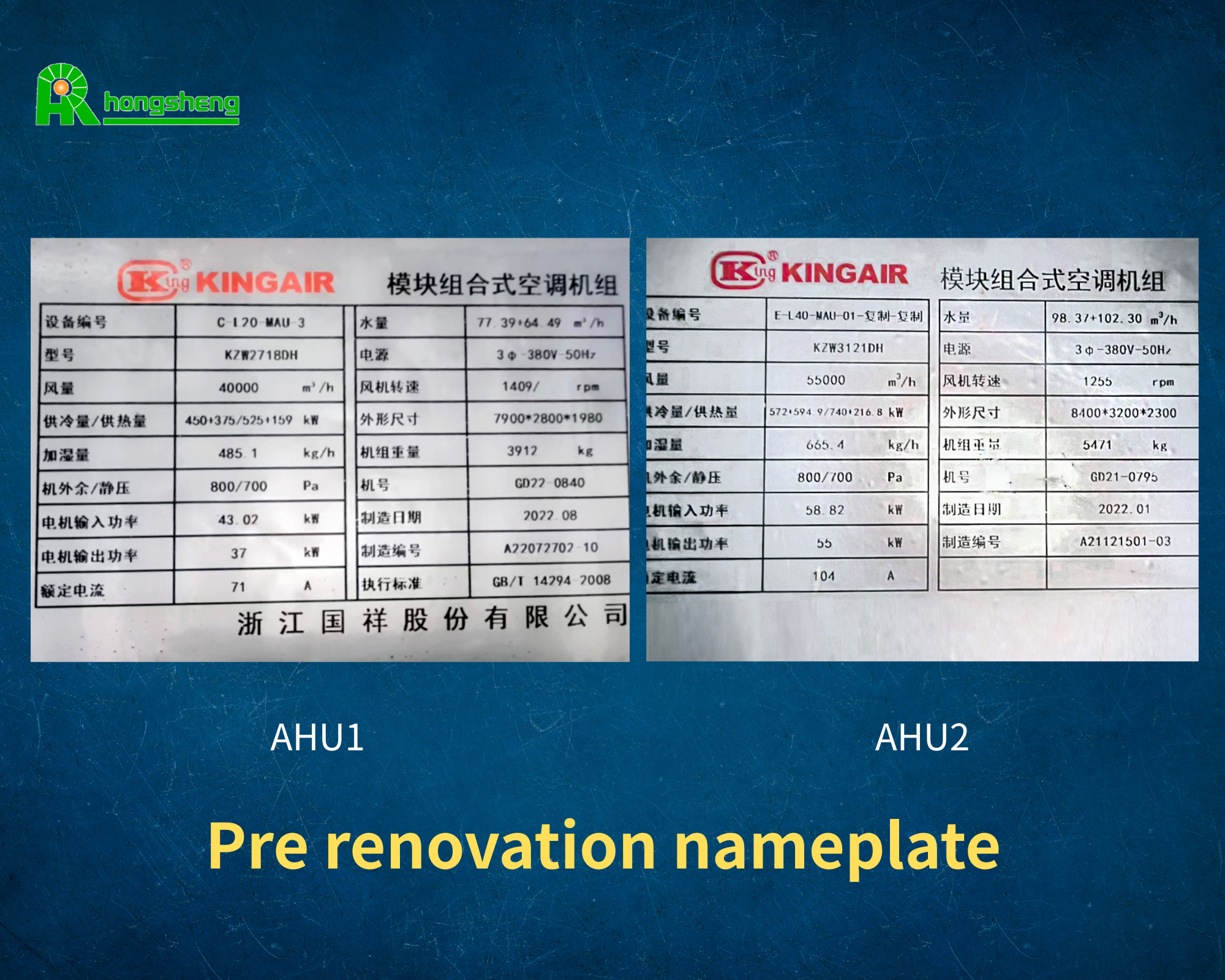
Target operating conditions included:
 |
|
Pic.1 Pre renovation air conditioning unit nameplate |
Under equivalent operating conditions, the upgraded EC fan grid systems achieved significant reductions in power consumption while maintaining the original airflow and static pressure requirements.
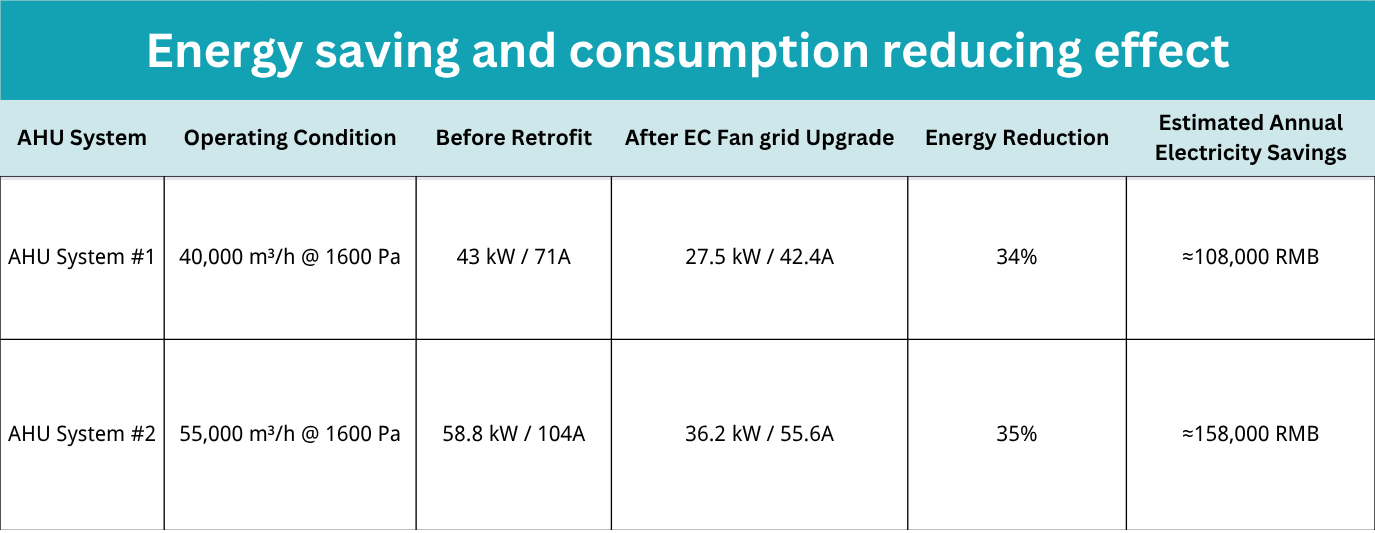 |
| Pic.2 Energy saving and consumption reducing effect |
The biggest improvement wasn’t just lower power consumption.
The EC fan grid solution also helped improve:
✔ airflow controllability
And because the system uses multiple EC fans instead of a single belt-driven structure, maintenance flexibility and redundancy are also significantly improved.
Across electronics manufacturing and other high-load industrial environments, more facilities are beginning to realize that HVAC systems are no longer just utility infrastructure.
They directly affect:
Especially as energy costs continue rising, EC retrofit projects are becoming an increasingly practical approach to modernizing existing AHU systems without complete system replacement.
Are traditional AHU systems still creating energy or maintenance challenges in your facility?
We’d be interested to hear how others are approaching:
EC fan retrofit projects,airflow optimization,or HVAC energy reduction in high-load manufacturing environments.
And if you're currently evaluating AHU upgrades or fangrid retrofit solutions, feel free to connect — always happy to exchange practical insights from real industrial projects.
 whatsapp


