
 English
 Français
 Deutsch
 Português
 Español
 русский
  한국어
한국어 العربية
 Italiano
 Indonesia
 Schweiz
 Polski
 Nederlands
 ישראל - עברית
 Perzisch
 ไทย
ไทย 日本語
日本語 ኢትዮ-አማርኛ
 Việt Nam
 Kiswahili
 Srpski
 Ελληνικά
 简体中文
简体中文Is Your Fan Really Operating at Its Best? Understanding the Hidden Risk of the PQ Curve's Unstable Region
When cooling performance falls short, many engineers instinctively suspect the fan itself.But in reality, the fan may not be the problem.We've seen many applications where excessive noise, unstable airflow, unexpected vibration, or poor cooling performance were ultimately traced back to one overlooked factor:The fan was operating in the unstable region of its PQ curve.
Understanding this region is essential—not only for selecting the right fan, but also for ensuring long-term system reliability and efficiency.
What Is the Unstable Region?
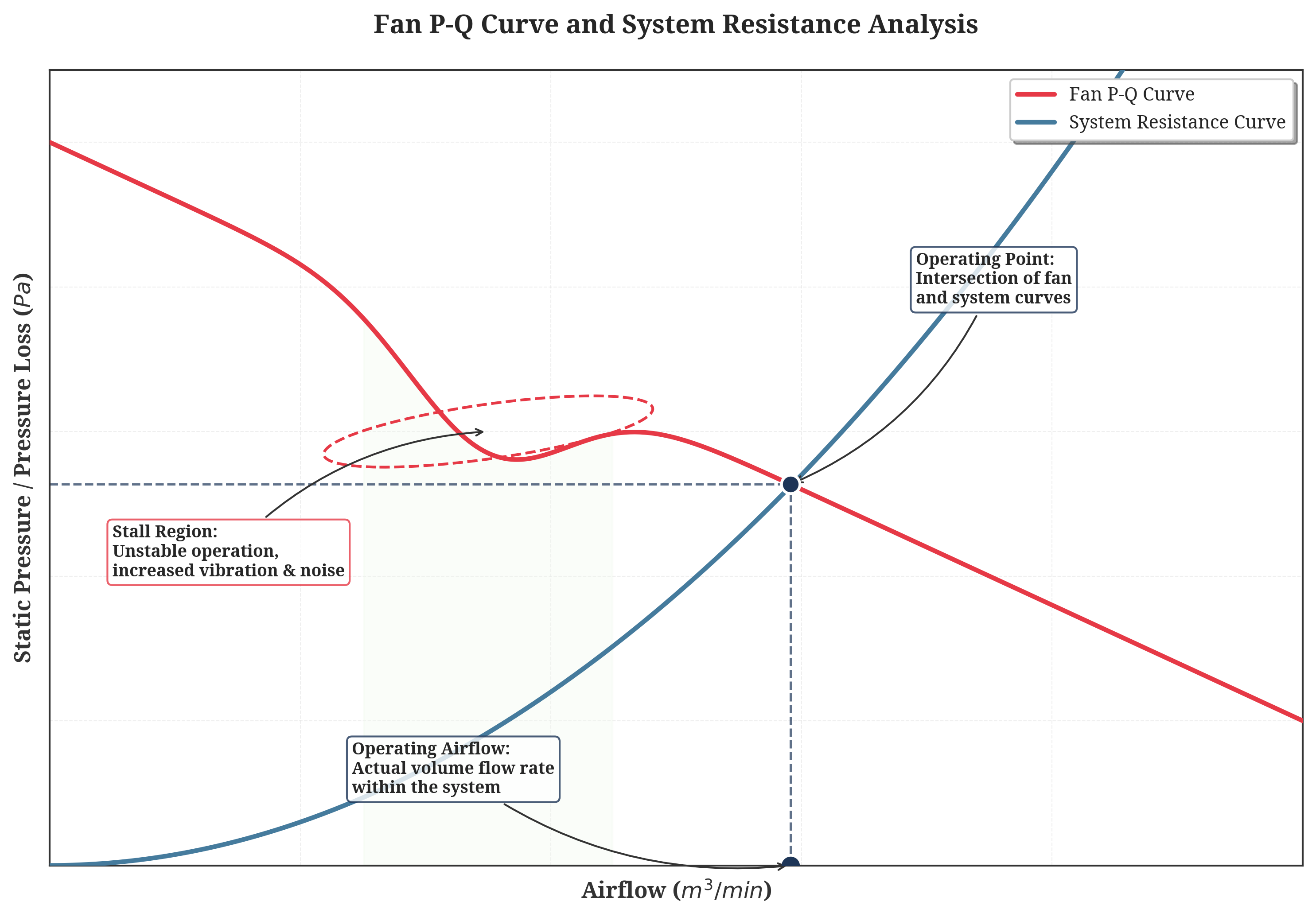
A fan's PQ (Pressure-Airflow) Curve describes the relationship between airflow and static pressure.
Under normal operating conditions, the fan should work within its stable operating region, where airflow remains predictable and aerodynamic performance is optimized.
However, when the system operating point shifts into the unstable region—typically on the left side of the PQ curve—the airflow becomes unstable.This can result in pressure fluctuations, flow separation, and even airflow reversal, reducing both cooling performance and system stability.
 |
|
Pic.1 Fan P-Q Curve and System Resistance Analysis |
The fan isn't failing—it's simply operating outside its optimal range.
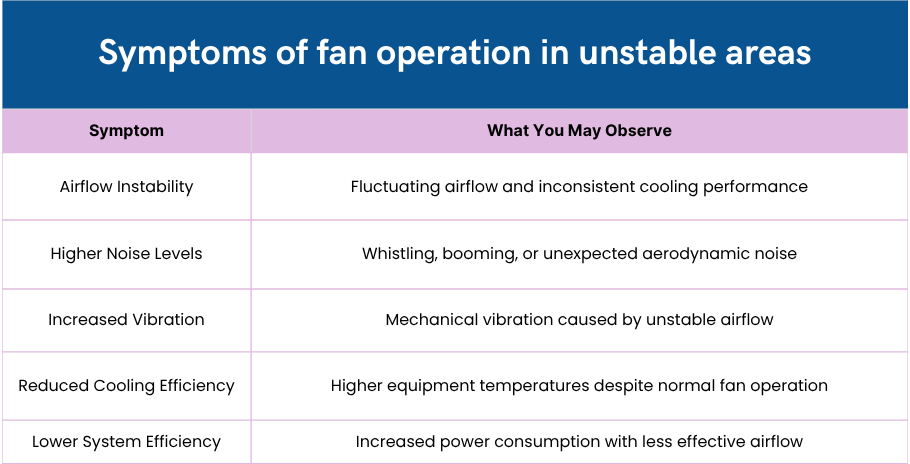
What Happens When a Fan Operates in the Unstable Region?
The effects are often visible long before a complete failure occurs.
 |
|
Pic.2 Symptoms of fan operation in unstable areas |
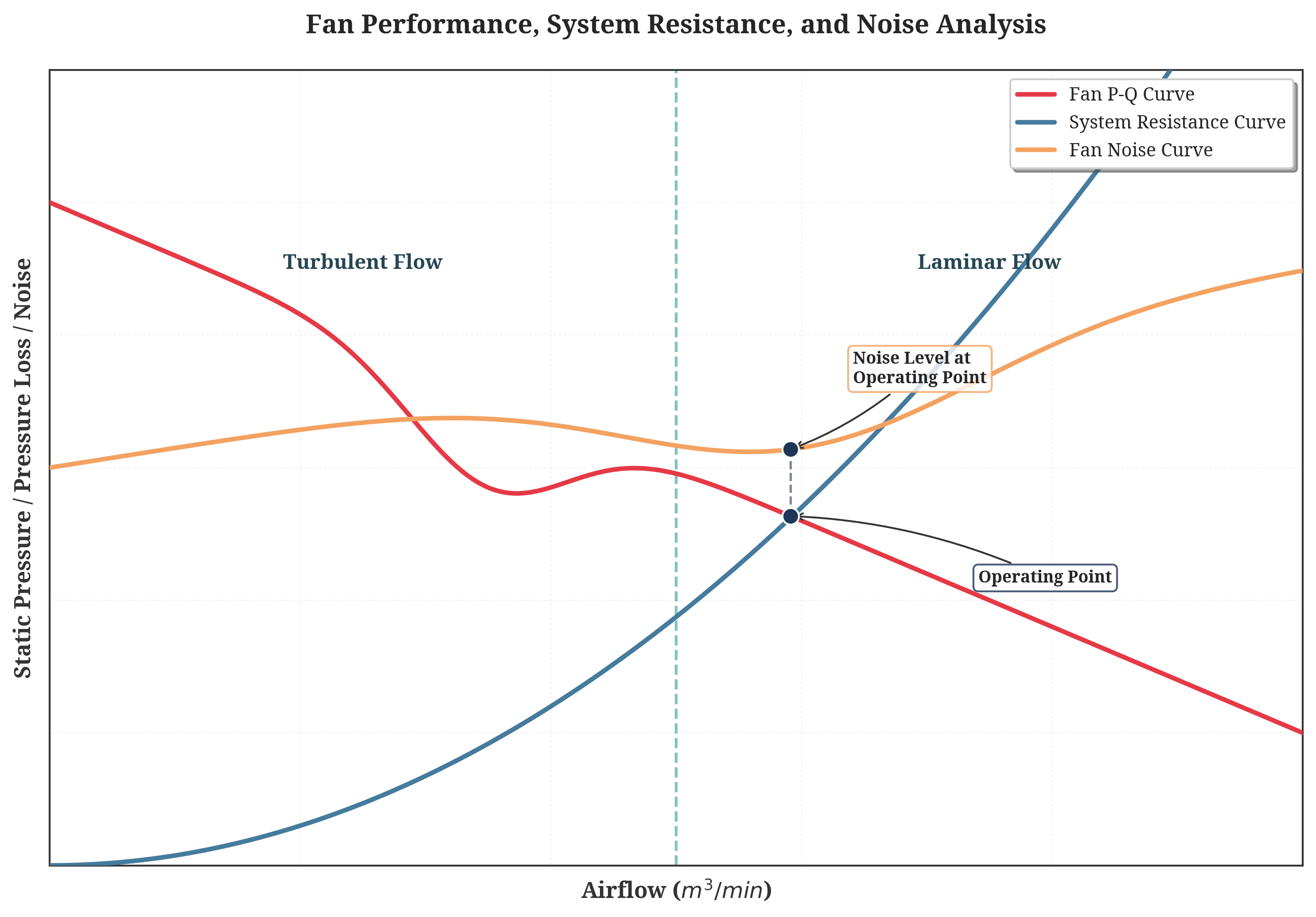
Many engineers mistakenly attribute these symptoms to fan quality, when the real issue is the operating point.
 |
|
Pic.3 Fan Performance, System Resistance, and Noise Analysis |
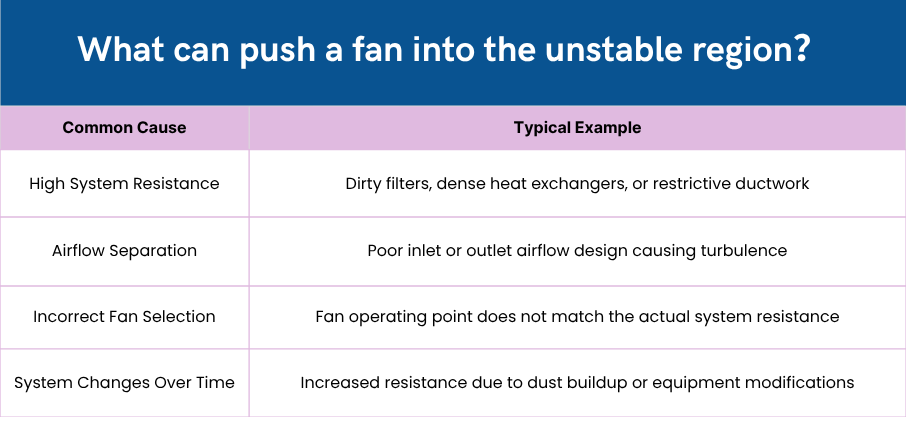
Why Does It Happen?
Several factors can push a fan into the unstable region.
 |
|
Pic.4 Factors can cause fan unstable |
In many retrofit projects, the fan itself is functioning properly—but the surrounding system has changed, moving the operating point away from the original design conditions.
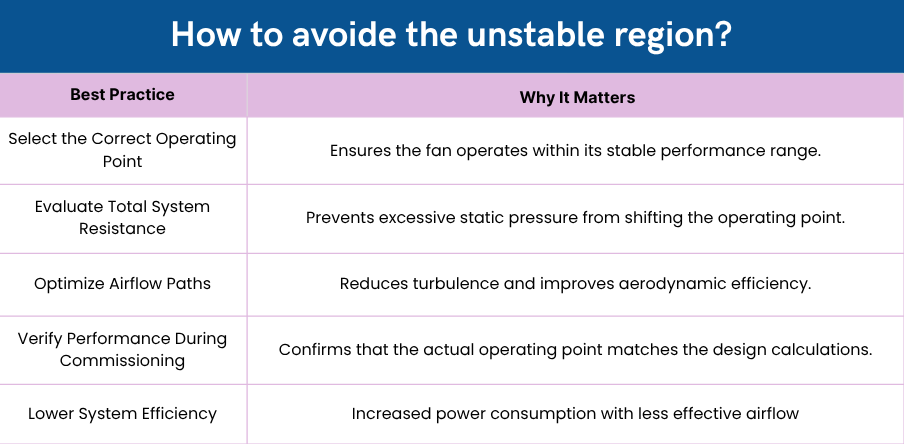
How Can Engineers Avoid It?
Avoiding the unstable region starts long before installation.
 |
|
Pic.5 How to avoide the unstable region? |
Remember:The goal isn't to select the fan with the highest airflow—it's to select the fan that operates efficiently and reliably within the actual system.
Engineering Insight
As cooling systems become more energy-efficient and compact, airflow design is becoming just as important as fan performance.
A high-performance fan cannot deliver its full potential if it is forced to operate in the unstable region of the PQ curve.
Understanding the relationship between fan characteristics, system resistance, and operating point is one of the most effective ways to improve cooling performance, reduce noise, and extend equipment life.
Industry Discussion
Have you ever encountered unexpected fan noise, airflow fluctuations, or cooling performance that didn't match the design calculations?In many cases, the root cause isn't the fan itself—it's where the operating point falls on the PQ curve.
At Beijing Hengrui, we regularly support OEMs, HVAC manufacturers, and industrial customers with fan selection, airflow optimization, and cooling system upgrades. If you're evaluating a new design or troubleshooting an existing system, we'd be happy to exchange practical engineering insights.
FAQ:
Q1: Why is my cooling fan noisy even though it is working properly?
A1:Excessive fan noise is not always caused by the fan itself. High system resistance, airflow turbulence, poor installation, or operating in the unstable region of the PQ curve can all increase noise levels, even when the fan is functioning normally.
Q2: What causes unstable airflow in an industrial cooling fan?
A2:Unstable airflow is often caused by the fan operating outside its optimal point on the PQ curve. Factors such as high system resistance, restrictive ductwork, dirty filters, or incorrect fan selection can all move the operating point into the unstable region.
Q3: How can I prevent a fan from operating in the unstable region of the PQ curve?
A3:Proper fan selection starts with evaluating the actual operating point rather than free-air performance. Matching airflow, static pressure, system resistance, and airflow path design helps ensure stable operation, lower noise, and higher cooling efficiency.
 whatsapp


