
 English
 Français
 Deutsch
 Português
 Español
 русский
  한국어
한국어 العربية
 Italiano
 Indonesia
 Schweiz
 Polski
 Nederlands
 ישראל - עברית
 Perzisch
 ไทย
ไทย 日本語
日本語 ኢትዮ-አማርኛ
 Việt Nam
 Kiswahili
 Srpski
 Ελληνικά
 简体中文
简体中文Case Study: How to Fit More Cooling Performance into Less Space
HENGRUI’s 3-Step Approach
Problem:
Solution:
Key Rule:
When Cooling Requirements Increase, But Space Keeps Shrinking
What happens when your IT equipment needs more cooling—but you have less space to work with?
This is becoming a common challenge in Edge Computing, network infrastructure, and micro data center applications.
As more IT equipment is integrated into compact cabinets, the cooling system must deliver sufficient airflow and pressure without taking up valuable space needed for servers, networking equipment, and electrical components.
A recent Vertiv SmartCabinet application provides a practical example.
The Challenge: High Cooling Capacity in a 90 mm Wide Unit
Vertiv's SmartCabinet integrates IT equipment, electrical distribution, and cooling into a single, airtight cabinet designed for Edge computing and network nodes.
The challenge was significant:
The integrated A/C unit was only 90 mm wide.
Yet it needed to provide:
In other words, the requirement was not simply to find a smaller fan.
It was to achieve high cooling performance within a very limited footprint.
The Solution: Compact Fans with High Air Performance
To address this challenge, Vertiv integrated ebm-papst AxiForce 80 fans into the cooling unit.
The compact fan design provided the performance needed while allowing the A/C unit to remain extremely narrow.
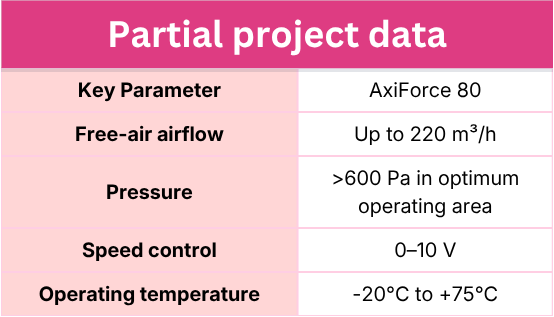
Pic.1 Partial project data
The compact footprint helped Vertiv reserve more valuable cabinet space for server and network equipment, while the fan's performance supported the required cooling architecture.
Performance Is Not the Only Requirement
Another important consideration was noise.
Because the AxiForce 80 supports 0–10 V speed control, the fan can operate at a lower speed when full airflow is not required.
This gives the system greater flexibility to balance:
Cooling performance ↔ Noise ↔ Operating conditions
Rather than simply designing for maximum airflow, the cooling system can be adjusted according to actual requirements.
The wide operating temperature range of -20°C to +75°C also provides additional flexibility for applications exposed to varying ambient conditions.
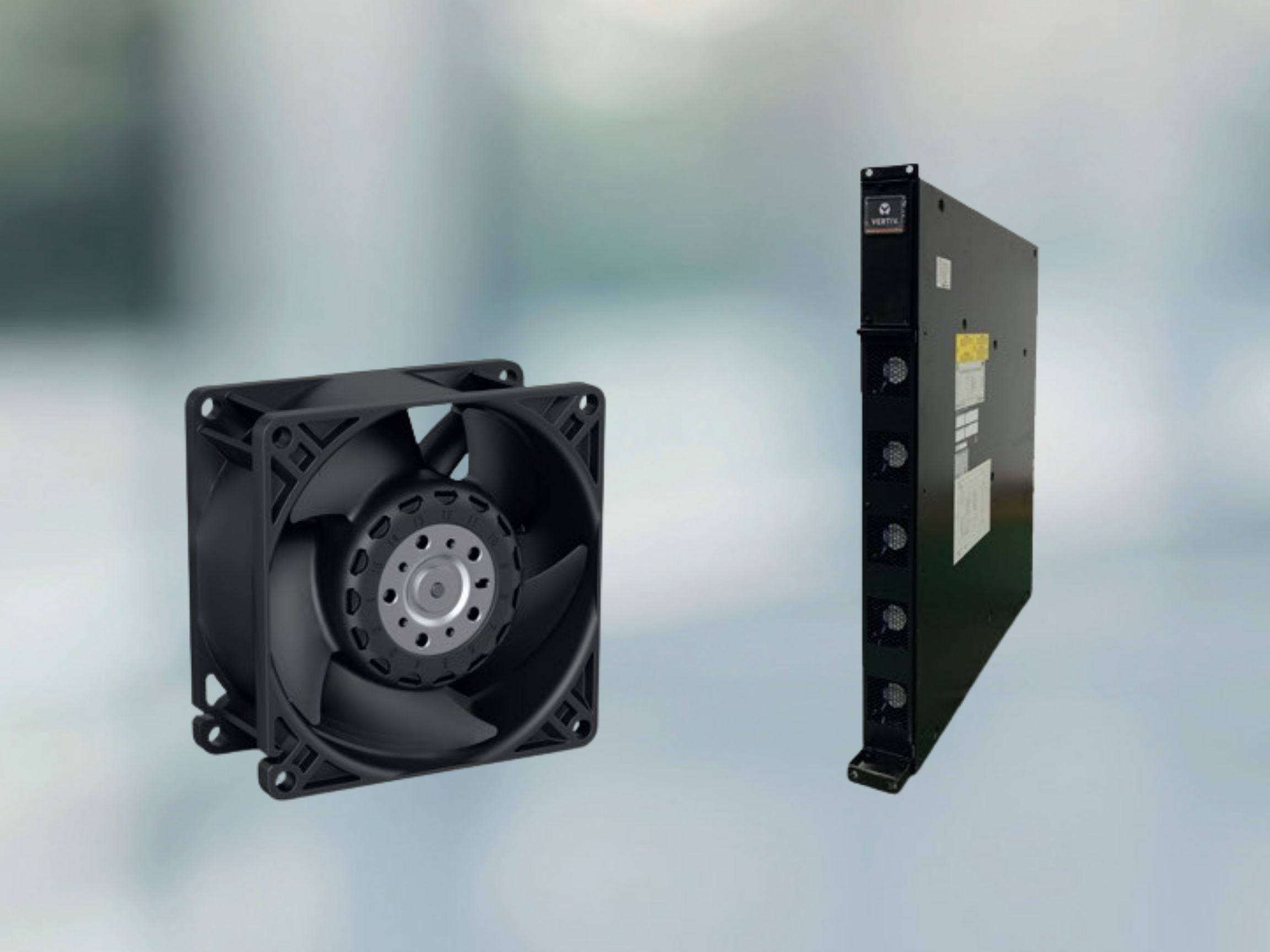
Pic.2 ebm-papst Axiforce 80
The Engineering Takeaway
This case demonstrates an important principle for compact thermal management:
A smaller fan does not necessarily mean lower cooling performance.
When airflow, pressure, dimensions, controllability, and operating temperature are properly matched, the fan can become an enabler of a more compact system architecture.
For Edge Computing and Micro Data Center applications, where every millimeter of cabinet space matters, fan selection is no longer just a component decision—it can directly influence the overall cooling design.
At Beijing Hengrui, we support Edge computing equipment manufacturers, micro data center integrators, telecom equipment manufacturers, server cabinet manufacturers, and thermal management teams with fan selection, airflow matching, and compact cooling solutions.
Working with limited installation space or high-density cooling requirements? Share your airflow, pressure, and dimensional requirements with us—we can help evaluate the right fan solution.
 whatsapp


