 English
 Français
 Deutsch
 Português
 Español
 русский
 한국어
 العربية
 Italiano
 Indonesia
 Schweiz
 Polski
 Nederlands
 ישראל - עברית
 Perzisch
 ไทย
 日本語
 ኢትዮ-አማርኛ
 Việt Nam
 Kiswahili
 Srpski
 Ελληνικά
 简体中文
EC Axial Fan Replacement: 8 Checks Before You Buy
Beijinghengrui 3-Step Approach
01 — PROBLEM
Matching dimensions and voltage does not guarantee that a replacement fan will work correctly.
02 — SOLUTION
Verify aerodynamic performance, mechanical dimensions, electrical characteristics, control interfaces, and operating conditions.
03 — KEY RULE
A successful replacement must meet the requirements of the complete equipment system, not just the original fan's basic specifications.
Replacing an EC axial fan requires more than matching its diameter and rated voltage. Differences in airflow, installation dimensions, electrical characteristics, and control interfaces can all affect compatibility.
For dry cooler OEMs, maintenance teams, and industrial buyers, what should be checked before choosing a replacement?
8 Essential Checks Before Replacing an EC Axial Fan
1. Verify Actual Airflow and Static Pressure
This is the most important step in fan replacement.
One common mistake is comparing only the maximum airflow listed in product datasheets. Maximum airflow is generally measured under free-air conditions, where external system resistance is minimal. It does not represent the airflow a fan will deliver after installation.
In real applications, airflow is affected by heat exchangers, protective grilles, louvers, ducts, and other components in the airflow path.
A replacement fan must operate at a suitable point on its pressure-flow (P–Q) curve.
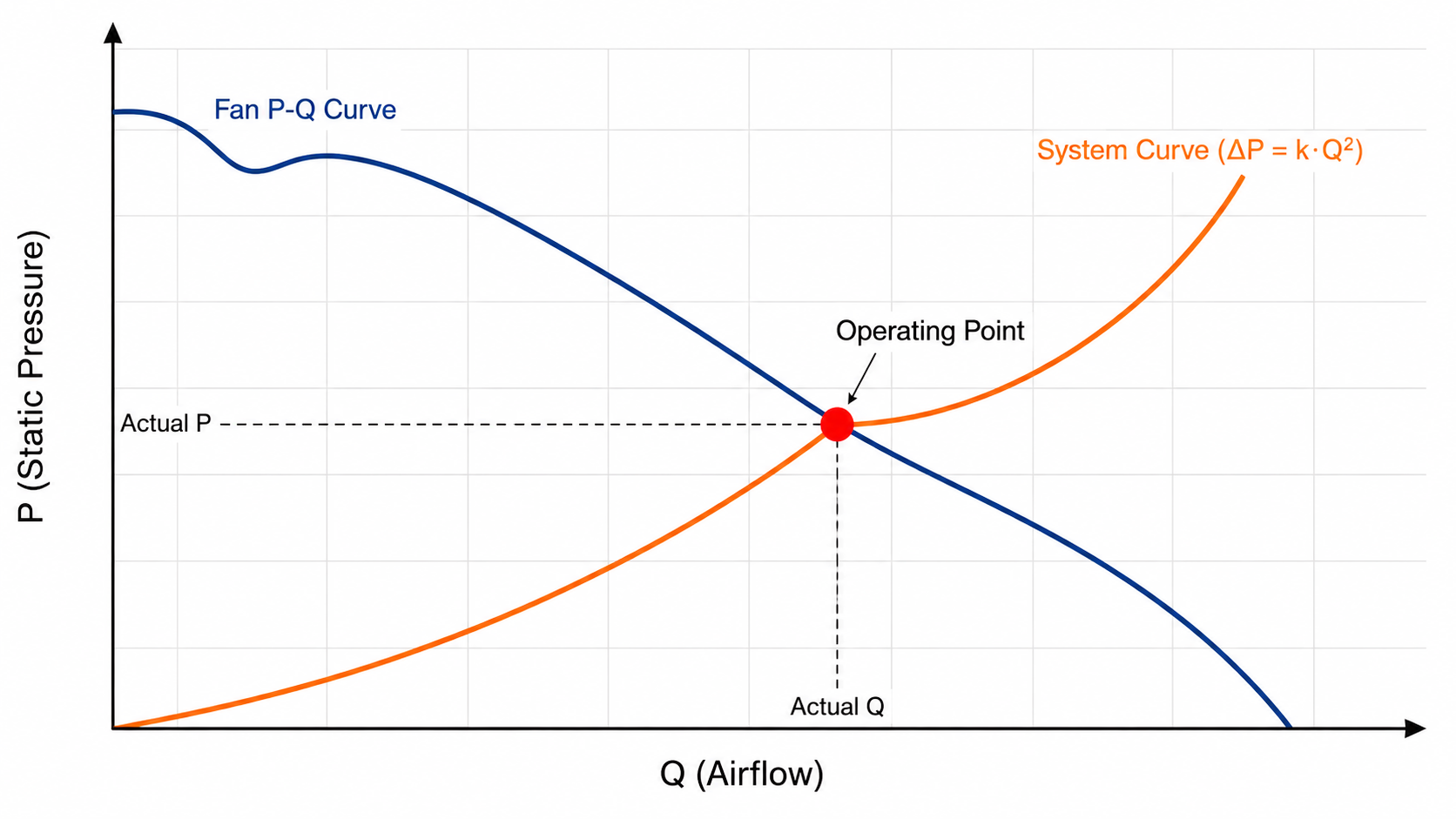
Figure1. Operating Point = Fan P-Q curve (blue) ∩ System curve (orange, parabolic ΔP = k·Q²). Project the intersection onto the X axis to read Actual Q, project onto the Y axis to read Actual P — the max CFM on the datasheet is not the actual airflow.
Before selecting a replacement, confirm:
- Required airflow and corresponding static pressure
- Original fan's performance curve
- Replacement fan's P–Q curve
- Expected operating point and control speed
For dry coolers and condenser applications, insufficient airflow can reduce heat rejection capacity and affect overall cooling performance.
Key takeaway: Never select a replacement based solely on maximum free-air airflow. Compare performance at the required operating point.
2. Check Mechanical Dimensions and Installation Compatibility
Even when two EC axial fans have the same nominal diameter, their mechanical configurations may differ.
Check the following:
- Impeller diameter and overall dimensions
- Installation depth and available clearance
- Mounting hole positions and fixing methods
- Airflow and rotation direction
- Guard grilles, mounting rings, and accessories
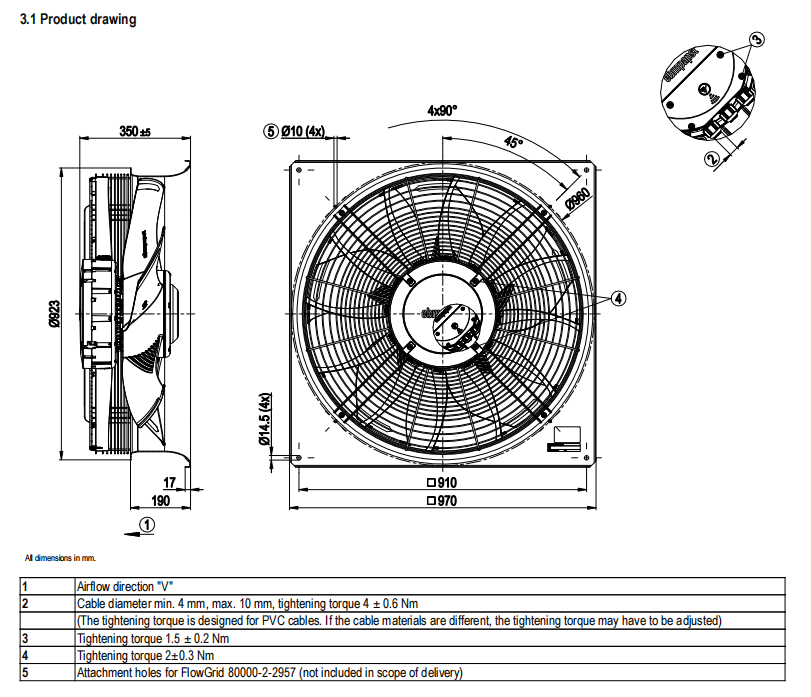
Also consider whether the replacement requires additional brackets, adapters, or modifications to the existing equipment.A fan with suitable aerodynamic performance may still be unsuitable if it cannot be installed correctly.
Key takeaway: Matching the nominal diameter is not enough. Confirm the complete mechanical interface before ordering.
3. Verify Power Supply and Electrical Characteristics
Electrical compatibility involves more than matching the rated voltage.
A replacement EC fan must operate within the equipment's available electrical supply and remain compatible with its protection devices.
Important parameters include:
- Rated voltage and frequency
- Rated current and power consumption
- Maximum current and starting characteristics
- Electrical connections and wiring
- Overcurrent and short-circuit protection requirements
Pay particular attention to the original circuit breakers, fuses, and other protective components.
Different EC fan models may have different electrical characteristics, even when their rated voltage and nominal power appear similar. For multi-fan systems, also consider the combined electrical load and simultaneous startup conditions.
Key takeaway: Verify the complete electrical characteristics and protection requirements, not just the voltage shown on the nameplate.
4. Confirm Speed Control and Communication Interfaces
This is one of the most frequently overlooked aspects of EC axial fan replacement.
EC fans may support different speed-control methods and communication interfaces. Two fans with similar aerodynamic performance may not be interchangeable if their control requirements differ.
Common interfaces include:
- 0–10V: Verify the input range, signal reference, and control logic.
- PWM: Check frequency, signal level, duty-cycle range, and input logic.
- Modbus: Confirm RTU or TCP, communication settings, and register mapping.
- Status feedback: Verify running status, fault signals, and alarm outputs.
For equipment connected to a building management system (BMS) or industrial control system, the replacement interface must be evaluated against the existing controller configuration.
Supporting Modbus does not automatically mean a fan can communicate directly with every BMS. Protocol settings, register definitions, and control logic must also be verified.
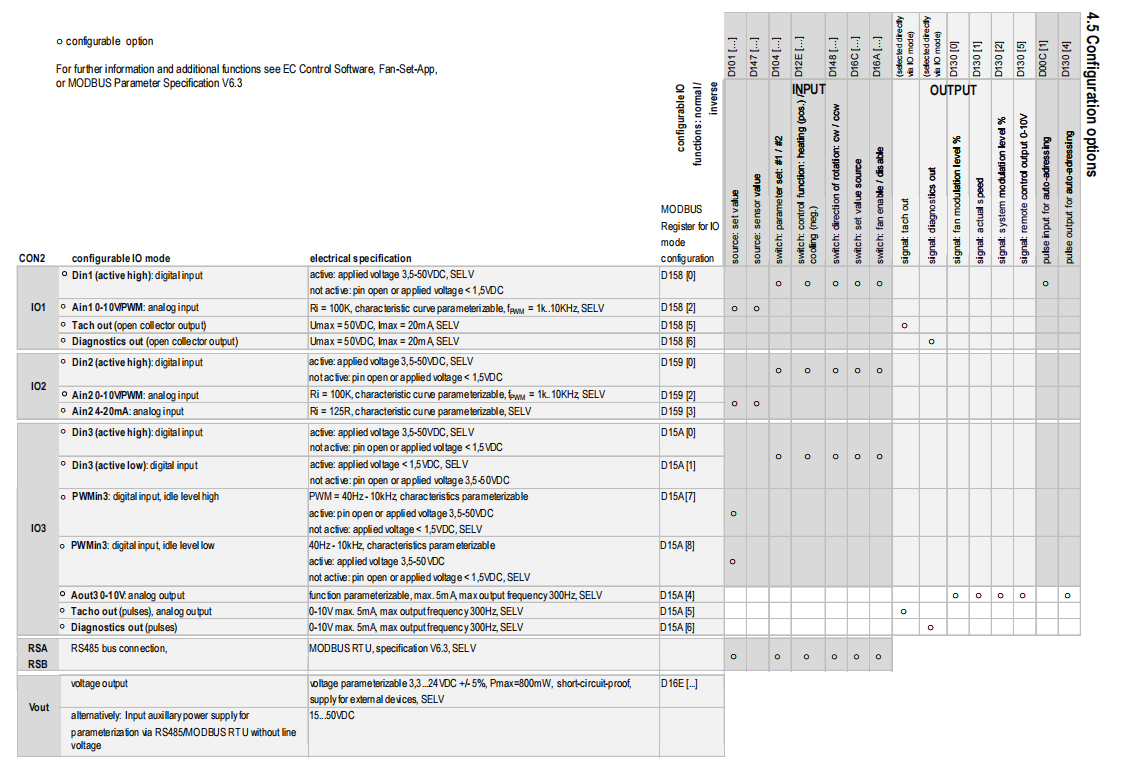
Figure3. Operating instructions in the manual
Key takeaway: Match the complete control and feedback requirements, not simply the interface name.
5. Evaluate Environmental Operating Conditions
Industrial EC axial fans often operate in demanding environments, particularly in outdoor cooling equipment and dry cooler installations.
Before selecting a replacement, check:
- Maximum and minimum ambient temperatures
- Operating altitude
- Relative humidity
- IP protection rating
- Condensation, dust, and moisture exposure
- Corrosive environments and outdoor installation requirements
Temperature deserves particular attention. A fan's maximum permissible temperature does not necessarily mean it can maintain the same output across its entire operating range. Some models have output limitations, derating requirements, or specific low-temperature startup restrictions.
At high altitudes, reduced air density can also affect aerodynamic performance and cooling conditions.
Key takeaway: Select according to actual site conditions, not just standard operating conditions listed in a general product description.
6. Compare Noise and Vibration Performance
A replacement fan that meets the airflow requirement may still introduce unwanted noise or vibration.
This is particularly important for equipment installed near occupied buildings, commercial facilities, or noise-sensitive industrial sites.
Consider:
- Sound pressure and sound power levels
- Operating speed and control range
- Fan balance and mechanical vibration
- Mounting structure stiffness
- Potential structural resonance
- Interactions between multiple fans in a fan array
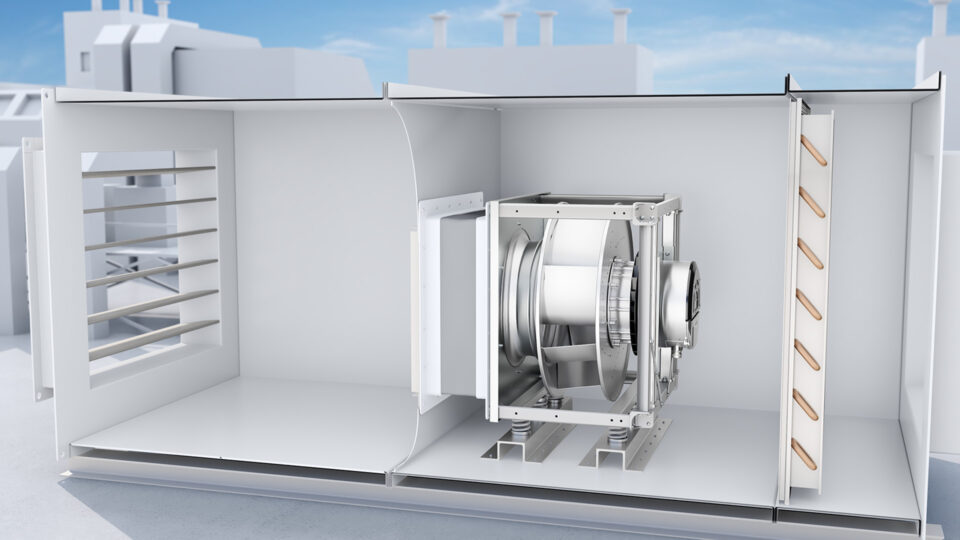
When comparing noise data, ensure the measurement conditions are comparable. Sound pressure and sound power are different quantities and should not be treated as interchangeable.
For multi-fan installations, the combined acoustic performance may also differ from that of a single fan.
Key takeaway: Evaluate noise and vibration under comparable operating conditions, rather than relying solely on catalogue values.
7. Understand Protection, Failure Modes, and Maintenance Requirements
A replacement fan should also meet the equipment's operational safety and maintenance requirements.
Review the following:
- Motor thermal protection
- Overload and locked-rotor protection
- Fault detection and alarm functions
- Restart behavior after power interruption
- Running-status feedback
- Maintenance accessibility
For systems using multiple axial fans, consider what happens if one fan stops operating.
Will the system continue running with reduced cooling capacity? Will the controller generate an alarm? Is automatic compensation through the remaining fans required?
These questions are especially relevant for dry coolers, data center cooling equipment, and other applications where continuous heat rejection is important.
Also consider the availability of compatible spare fans and the ease of future maintenance.
Key takeaway: Evaluate the replacement fan as part of the complete equipment system, including its fault response and maintenance strategy.
8. Confirm Availability, Lead Time, and Commissioning Requirements
Technical compatibility is essential, but procurement and maintenance considerations also affect the success of a replacement project.
An otherwise suitable fan may create operational problems if it is difficult to source or has an uncertain delivery schedule.
Before purchasing, confirm:
- Original model identification and availability
- Whether the original model has been discontinued
- Suitable alternative or successor models
- Product availability and delivery lead time
- Manufacturer documentation and authorization status
- Spare parts consistency for future maintenance
After installation, verify the replacement against predefined acceptance criteria, including actual airflow, operating current, fan speed, control response, noise, vibration, and alarm feedback.
Do not assume that a fan is fully compatible simply because it starts successfully.
Key takeaway: A successful replacement includes product sourcing, installation, commissioning, and performance verification.
How to Determine Whether a Replacement Fan Is Compatible
After completing the eight checks, the proposed replacement can be classified into three categories:
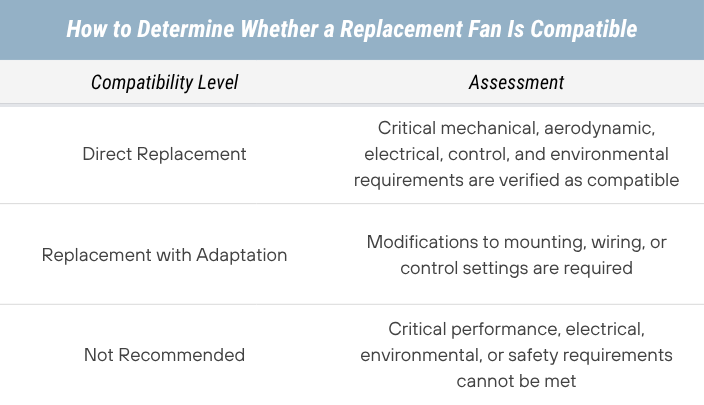
Figure5. How to Determine Whether a Replacement Fan Is Compatible
This classification is intended as an initial engineering assessment. Final approval should be based on verified technical documentation and, where necessary, on-site testing.
What Information Should You Prepare?
The more complete the original equipment information, the more accurately a replacement can be evaluated.
Before requesting a compatibility assessment, prepare:
Existing Fan Information
- Original fan model and complete nameplate photo
- Original manufacturer's datasheet and P–Q curve, if available
Mechanical Information
- Installation dimensions and mounting drawings
- Photos of the existing fan and installation position
Operating Requirements
- Required airflow and corresponding static pressure
- Operating temperature, altitude, and humidity
Electrical and Control Information
- Power supply and electrical protection details
- Control method, such as 0–10V, PWM, or Modbus
- Required status feedback and BMS communication details
If the original performance curve or system operating point is unavailable, additional equipment data or on-site measurements may be needed.
Need Help Verifying an EC Axial Fan Replacement?
Replacing an EC axial fan involves more than matching its diameter and rated voltage.
Send BeijingHengrui your existing fan model, nameplate photo, installation dimensions, required airflow and static pressure, power supply, control interface, and operating conditions.
Our engineering team can assist with a free compatibility review and fan-selection proposal based on your application requirements.
With access to multiple industrial fan brands, product sourcing resources, and application-oriented technical support, BeijingHengrui helps customers identify suitable replacement options and coordinate their procurement requirements.
Product availability, authorization status, technical documentation, and final performance data will be verified for the specific model before quotation.
The right replacement starts with the right information.
Contact BeijingHengrui to discuss your EC axial fan replacement requirements.
FAQ
Q1. Can I replace an EC axial fan with another fan of the same diameter and voltage?
Not necessarily. Diameter and rated voltage are only two compatibility parameters. You must also verify airflow, static pressure, installation dimensions, electrical characteristics, control interfaces, and environmental conditions.
Q2. Can an EC axial fan from a different brand replace the original fan?
Yes. Cross-bran

 whatsapp
- Links
- Contact Us
-
Sales Hotline:+86 10-62547612/ +86 18701526587 /+86 13102080631
-
Email:Jason@bjhengrui.cn / qin@bjhengrui.cn / sales06@bjhengrui.cn
-
Address:Central Square, Daoxianghu Road, Haidian District, Beijing
- Follow Us


