
 English
 Français
 Deutsch
 Português
 Español
 русский
 한국어
 العربية
 Italiano
 Indonesia
 Schweiz
 Polski
 Nederlands
 ישראל - עברית
 Perzisch
 ไทย
 日本語
 ኢትዮ-አማርኛ
 Việt Nam
 Kiswahili
 Srpski
 Ελληνικά
 简体中文
Discontinued or Unavailable Fan? 8 Parameters to Check Before Replacement
BeijingHengrui 3-Step Summary
01 — PROBLEM
A discontinued or unavailable fan cannot be replaced based on dimensions alone. Differences in performance, electrical specifications, and control interfaces can affect equipment compatibility.
02 — SOLUTION
Check eight critical parameters: installation dimensions, electrical specifications, airflow, static pressure, control method, protection rating, operating temperature, and certifications.
03 — KEY RULE
Verify the replacement against the original fan specifications and actual system operating conditions before ordering or installation.
When an original fan is discontinued, out of stock, or unavailable within the required delivery time, finding a suitable alternative becomes essential for equipment manufacturers, system integrators, and maintenance teams.
However, two fans with similar dimensions or appearances may perform differently once installed.
For example:
- The diameter matches, but mounting dimensions differ.
- Maximum airflow is higher, but performance at the required static pressure is insufficient.
- An EC fan uses an incompatible control signal.
- A newer model has different wiring or protection requirements.
A suitable replacement must match both the original equipment requirements and actual operating conditions.
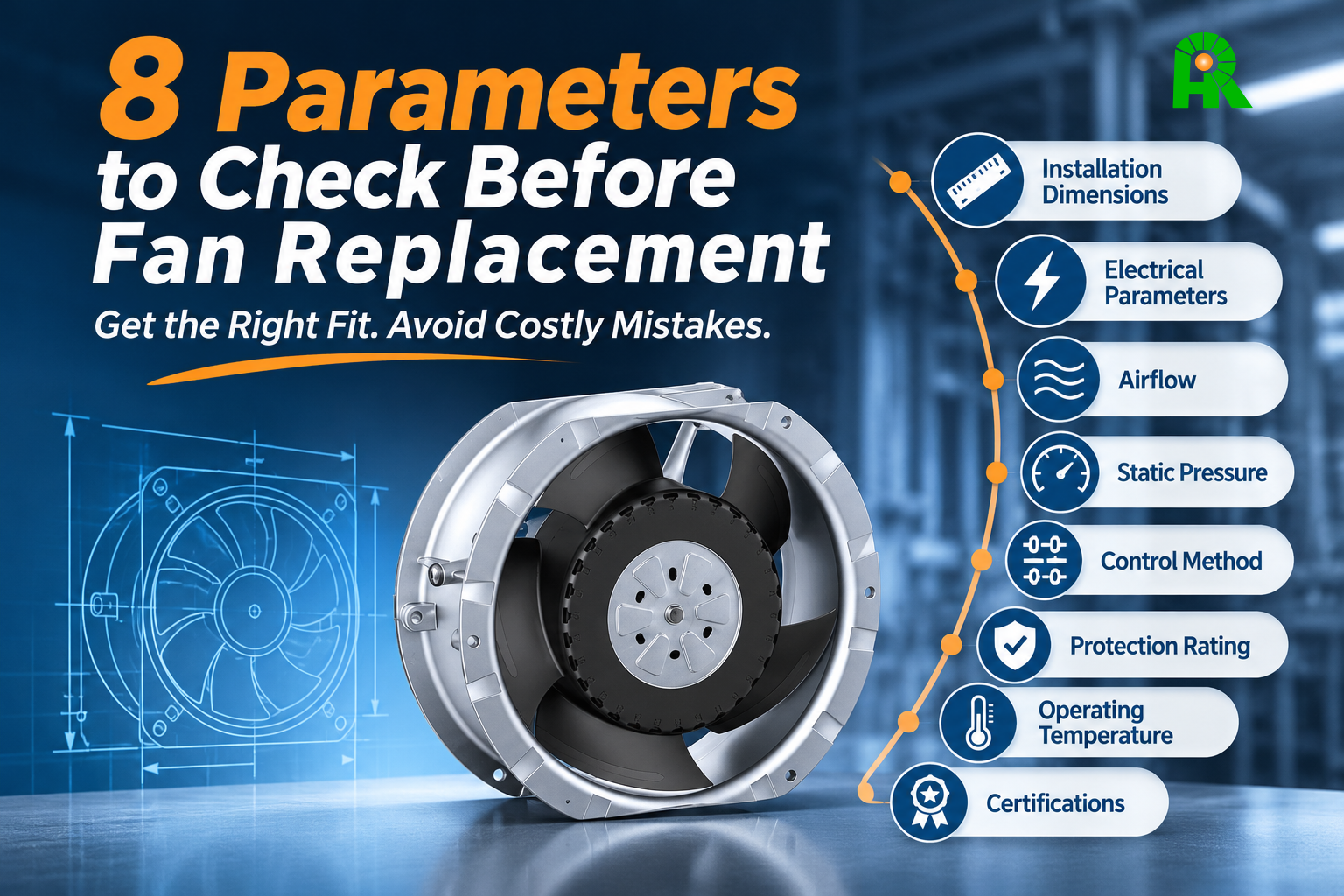
8 Parameters to Check Before Fan Replacement
1. Installation Dimensions and Mechanical Compatibility
Check:
- Fan diameter and overall dimensions
- Mounting-hole positions and spacing
- Flange and connection dimensions
- Airflow and rotation direction
- Available installation space and clearance
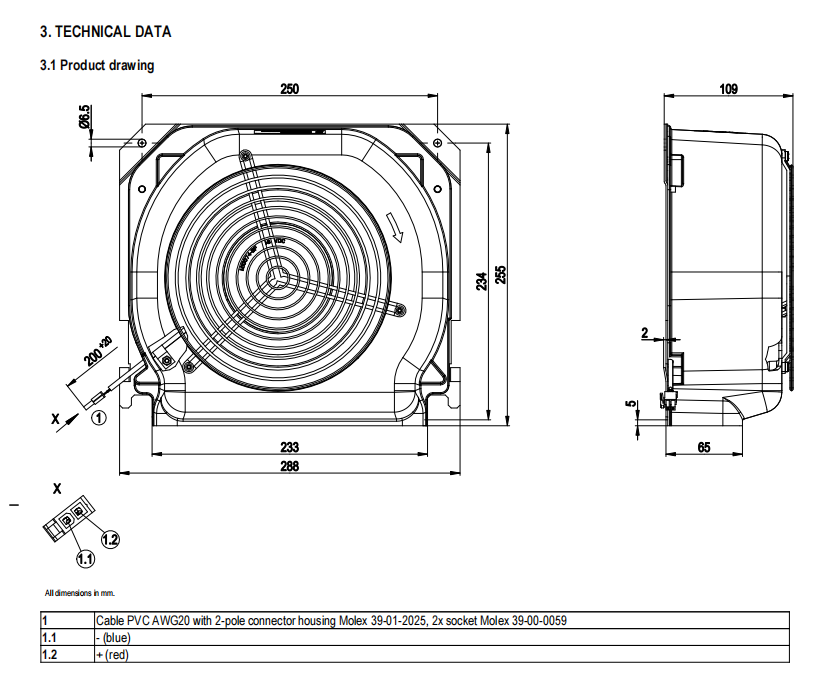
Key point: Matching the fan diameter does not guarantee mechanical compatibility. Confirm the complete mounting interface.
2. Electrical Parameters
Compare:
- Rated voltage and frequency
- Number of phases
- Rated current and power
- Wiring configuration
- Electrical connection requirements
Pay particular attention when changing between AC and EC fans, as power supply and wiring requirements may differ.
Key point: The same rated voltage does not necessarily mean electrical compatibility.
3. Required Airflow
Check the airflow required by the equipment under actual operating conditions.
Do not rely solely on catalogue maximum airflow. A fan's airflow can decrease when operating against resistance from ducts, filters, or heat exchangers.
Also consider whether the application requires fixed-speed or variable-airflow operation.
Key point: Compare airflow under equivalent operating conditions.
4. Static Pressure and Fan Performance Curve
Airflow alone cannot determine whether a replacement is suitable.
The actual operating point is determined by the intersection of the fan performance curve and the system resistance curve.
Review:
- Required airflow and static pressure
- Fan performance curve
- Expected operating point
- System resistance characteristics
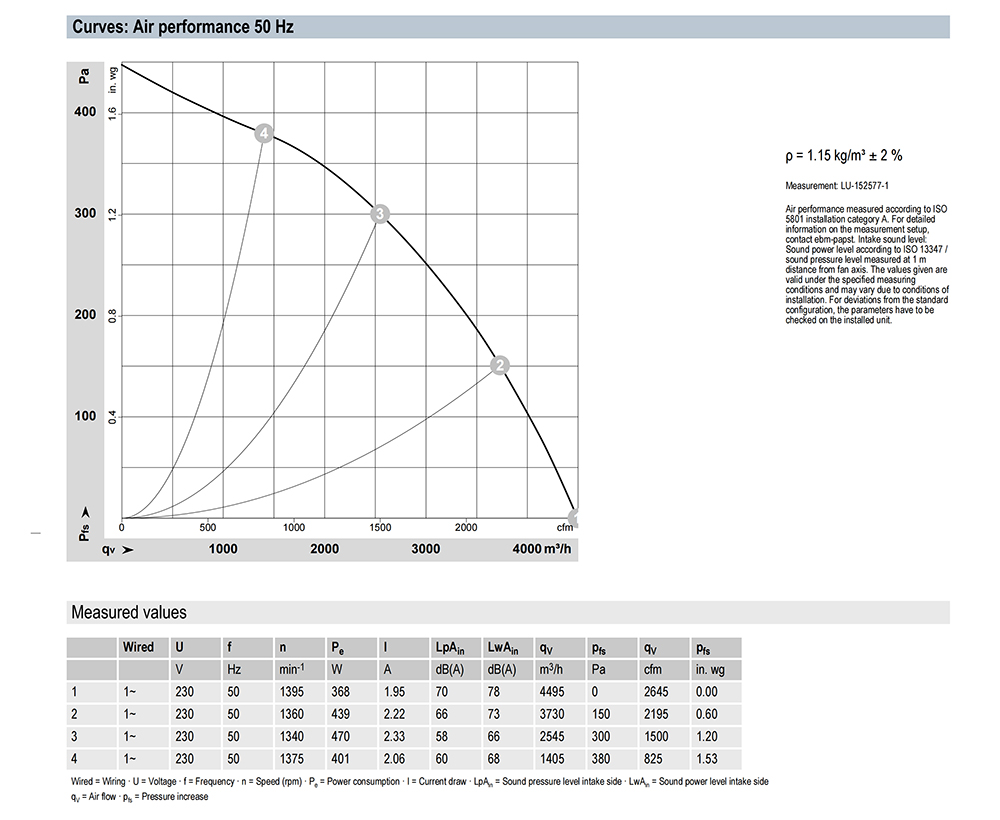
Key point: Compare the operating point, not just maximum airflow or maximum static pressure.
5. Control Method and Signal Compatibility
Check whether the original and replacement fans use:
- AC, DC, or EC motor technology
- Fixed-speed or variable-speed control
- PWM or 0–10 V signals
- Speed feedback or digital communication interfaces
Even two EC fans may have different control inputs, wiring definitions, and feedback requirements.
Key point: Verify the complete control interface before replacement.
6. Protection Rating and Insulation Requirements
Check:
- IP protection rating
- Insulation class
- Motor protection features
- Applicable electrical safety requirements
The replacement must be suitable for the dust, moisture, and other environmental conditions of the application.

Figure4. Match IP ratings with actual applications
Key point: Confirm that the replacement meets the equipment's protection and insulation requirements.
7. Operating Temperature
Identify:
- Ambient temperature
- Air or medium temperature
- Minimum and maximum operating temperatures
- Startup requirements under extreme conditions
This is particularly important for refrigeration, cold storage, data center cooling, and outdoor ventilation.
Key point: Check the manufacturer's permitted temperature range against actual operating conditions.
8. Certifications and Project Requirements
Depending on the application and destination market, verify:
- CE/UL or other applicable certifications
- Project-specific technical specifications
- Equipment manufacturer's approval requirements
Always check certification for the exact model and configuration.
Key point: A technically compatible fan may still be unsuitable if it does not meet project approval requirements.
Same-Brand vs. Cross-Brand Replacement
Once the eight parameters have been reviewed, the next step is to evaluate the replacement option.
- Same-brand replacement
Start by checking whether the original manufacturer offers an official successor model. However, verify changes in dimensions, electrical characteristics, performance, control interfaces, and certifications.
- Cross-brand replacement
When the original model is unavailable, an alternative from another manufacturer may be suitable.
Compare all eight parameters, particularly the performance curve, mounting interface, and control compatibility. Identify any required mechanical, electrical, or control modifications before implementation.
Assess Replacement Risk Before Ordering
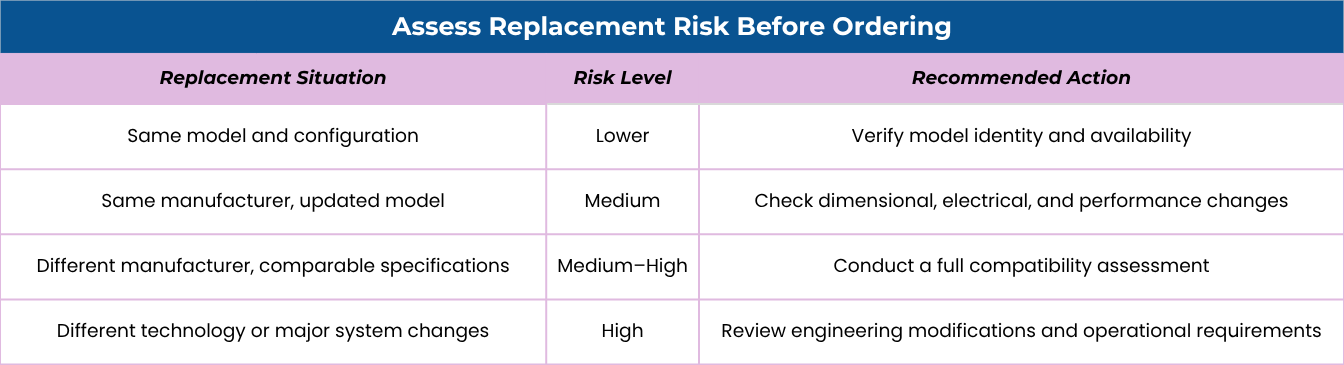
These risk levels are indicative. Even a same-brand successor model may require modifications, while a cross-brand alternative may be suitable if all critical requirements are verified.
A Practical Fan Replacement Process
Follow these five steps before ordering or deploying a replacement:
1.Identify the original fan: Collect the nameplate, complete model number, and technical datasheet.
2.Confirm operating conditions: Identify airflow, static pressure, temperature, and control requirements.
3.Compare alternatives: Review mechanical, electrical, aerodynamic, and environmental compatibility.
4.Assess modifications: Check whether mounting, wiring, power supply, or controls need adjustment.
5.Verify operation: Inspect installation and electrical connections, then verify actual performance where necessary.
For complex cross-brand replacements, additional measurements or trial operation may be required.
Frequently Asked Questions
Q1: Can I replace a discontinued fan with another model from the same manufacturer?
Yes, if the successor model meets the equipment's mechanical, electrical, performance, and control requirements. Always verify the actual specifications.
Q2: Can a fan with the same dimensions be used as a direct replacement?
Not necessarily. Airflow, static pressure, electrical characteristics, control method, and operating conditions must also match.
Q3: What information is needed to identify a replacement fan?
Start with the original fan's nameplate photo and complete model number. Dimensions, operating airflow and pressure, voltage, control requirements, and application conditions are also useful.
Q4: How do I verify a cross-brand replacement?
Compare the alternative against the original equipment requirements, including performance curves, mechanical dimensions, electrical parameters, control interfaces, protection ratings, and certifications. Additional testing may be necessary.
Need Help Finding a Replacement for a Discontinued Fan?
At BeijingHengrui, we support customers with:
- Original fan model identification
- Same-brand successor model and availability checks
- Cross-brand fan selection and technical matching
- Product sourcing and stock verification
- Technical support for replacement and retrofit projects
Whether you are an equipment manufacturer, system integrator, or maintenance contractor, the first step is to collect the right technical information.
Send us the original fan nameplate, installation dimensions, and available operating data. We can help identify the original model, compare replacement options, and assess key compatibility requirements.
The right replacement starts with the right technical comparison.
 whatsapp


