
 English
 Français
 Deutsch
 Português
 Español
 русский
  한국어
한국어 العربية
 Italiano
 Indonesia
 Schweiz
 Polski
 Nederlands
 ישראל - עברית
 Perzisch
 ไทย
ไทย 日本語
日本語 ኢትዮ-አማርኛ
 Việt Nam
 Kiswahili
 Srpski
 Ελληνικά
 简体中文
简体中文Data Center Cooling Is Hitting a New Limit: Acoustic Compliance in Dry Cooler Systems
For years, data center designers have focused on efficiency metrics such as PUE.But in North America today, another limit is quietly reshaping system design:
Acoustic compliance is no longer optional—it’s a hard constraint.
In many regions, night-time noise thresholds drop to ≤45 dB(A) at the site boundary.And here’s what many teams are starting to realize—often too late:
Cooling systems designed purely for airflow are struggling to operate within these limits—especially in dry cooler-based data center cooling systems.
The issue is not a single component—it’s aerodynamic behavior at the system level.
In data center dry cooler applications, where multiple axial fans operate in parallel across large heat exchanger surfaces, increasing airflow typically requires higher fan speeds. This intensifies turbulence, tip vortex formation, and leads to non-linear noise growth.
The effect becomes even more pronounced under partial load conditions, where airflow recirculation inside the dry cooler plenum can destabilize pressure distribution. As a result, real-world acoustic performance of dry cooler fans often deviates significantly from design expectations or lab data.
Leading operators are beginning to shift their approach—especially in dry cooler design, retrofit, and fan replacement projects—moving away from asking how much air a system can move, toward understanding:
How predictably, efficiently, and quietly a cooling system can perform under real operating constraints
In noise-sensitive data center environments, even a marginal reduction of a few decibels can determine whether a site meets municipal acoustic regulations, or faces redesign, cooling derating, or operational restrictions.
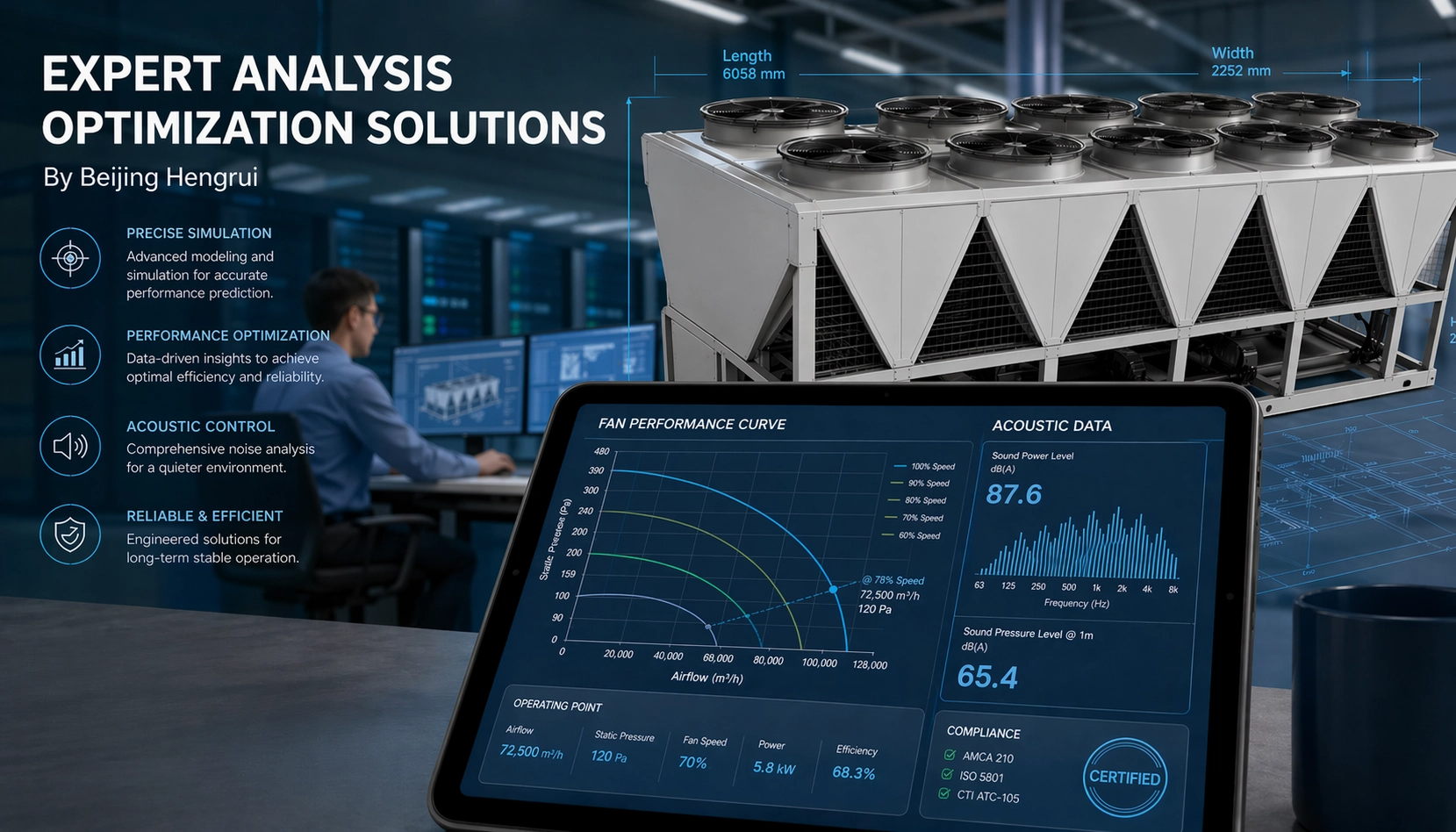 |
For engineering teams, contractors, and spare parts suppliers, this shift highlights a growing need for accurate fan performance evaluation, airflow optimization, and noise reduction strategies in dry cooler systems.In practice, achieving this level of control often depends on selecting high-efficiency EC axial fans with optimized aerodynamic design, such as those from leading manufacturers like ebm-papst, which are engineered to deliver stable airflow performance while reducing acoustic impact under real operating conditions.
At Beijing Hengrui, we support global data center clients with in-depth fan performance curve analysis, dry cooler fan optimization, and cross-model replacement solutions, helping identify opportunities to improve airflow stability, reduce energy consumption, and optimize acoustic performance under real operating conditions.
 whatsapp


