
 English
 Français
 Deutsch
 Português
 Español
 русский
  한국어
한국어 العربية
 Italiano
 Indonesia
 Schweiz
 Polski
 Nederlands
 ישראל - עברית
 Perzisch
 ไทย
ไทย 日本語
日本語 ኢትዮ-አማርኛ
 Việt Nam
 Kiswahili
 Srpski
 Ελληνικά
 简体中文
简体中文The Real Bottleneck in the $3T AI Infrastructure Boom: Solving the Power & Space Constraint
 |
|
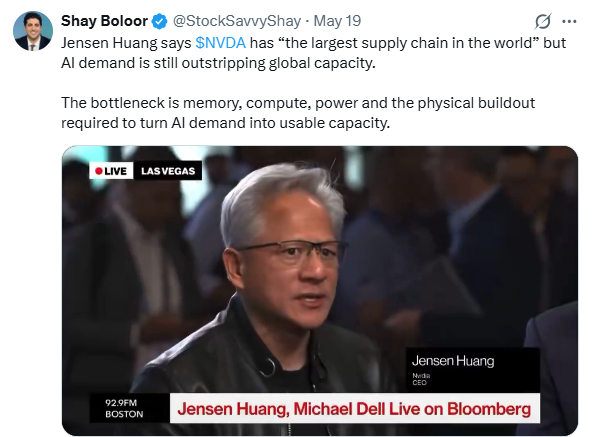
(Source:@StockSavvyShay paraphrases Jensen Huang's judgment on the bottleneck of AI production capacity) |
Jensen Huang recently dropped a powerful truth bomb about the state of AI: We are no longer just fighting a GPU shortage. We are facing a physical infrastructure crisis. With NVIDIA’s data center revenue skyrocketing, Huang noted that the bottlenecks have officially breached the digital world and entered the physical one—specifically gripping memory bandwidth, power grids, and physical data center buildouts.
There is a powerful phrase floating around infrastructure circles right now: "Choose the best under absolute constraints." As a specialized team dedicated to fan engineering and thermal management solutions at Beijing Hengrui, we find this highly relevant. In a multi-trillion-dollar AI land rush restricted by power availability and physical space, the limits of AI compute are fundamentally determined by the limits of cooling efficiency. Here is our perspective on how advanced fan technology is answering the call to "choose the best" under these rigid physical constraints.
1. Debunking the Myth: Liquid Cooling Doesn't Mean the "End of Fans"
There is a common misconception that as data centers shift from air cooling to liquid cooling (Direct-to-Chip or Immersion) to handle high-density racks , fans will become obsolete.
This is a fundamental misunderstanding of thermodynamics.
Heat cannot be destroyed; it can only be moved. Liquid cooling shifts heat away from the silicon efficiently, but that heat must still be rejected into the atmosphere. Where does it go? To outdoor Dry Coolers and Cooling Towers.
The New Battleground: Fans aren't disappearing; they are migrating. The heavy lifting has moved from small, high-RPM server fans inside the chassis to massive, highly efficient outdoor EC (Electronically Commutated) fan arrays.
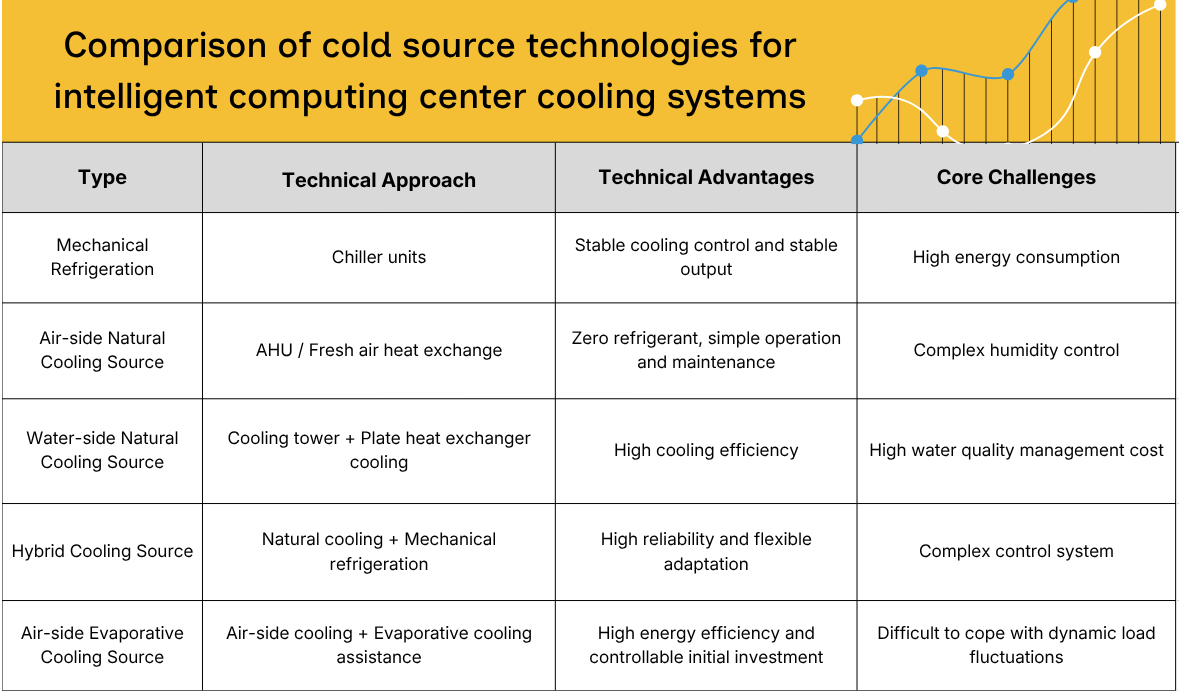
The Hybrid Reality: Even in advanced AI data centers, peripheral components like memory modules, NICs, and power supplies still rely on precision air management. The future belongs to hybrid architectures—where Fan Walls and liquid loops work in perfect harmony.The following table compares the cooling source technologies of the intelligent computing center's cooling system.
 |
|
(Source: Adapted from “Comparison of Cold Source Technologies for Intelligent Computing Center Cooling Systems”, published via CNKI.) |
2. Solving the Power Constraint: The Cubed-Law Advantage of EC Technology
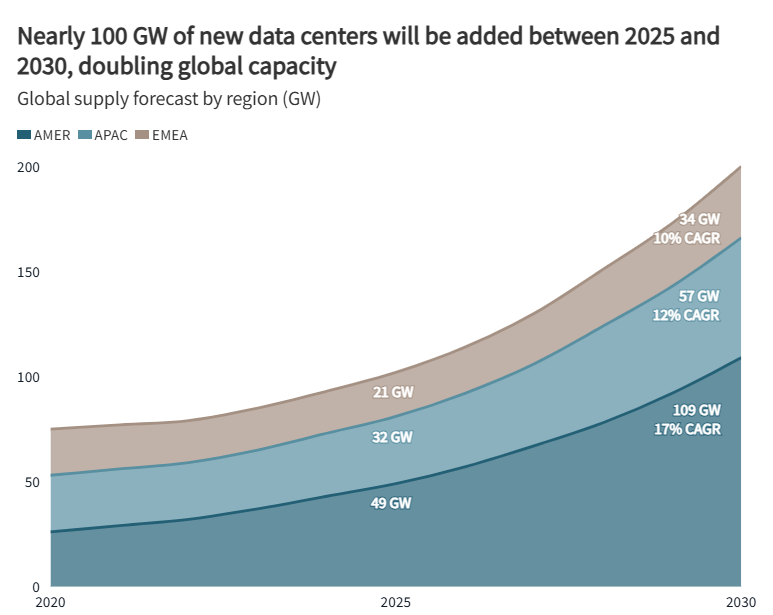
Power availability is the ultimate hard constraint of the AI era. JLL Research’s forecasts indicate the industry is looking at adding nearly 100GW of capacity globally by 2030. When power grids are maxed out, every watt saved on cooling is a watt redirected to an AI tensor core.
 |
|
(Source: JLL Research, 2025 • Supply totals include colocation, build-to-suit, hyperscale owner-occupied and on-prem) |
This is where advanced fan engineering shifts from a commodity component to a strategic asset:
Dynamic Load Matching: AI inference workloads are notoriously spiky. Traditional AC fans are too rigid to adapt efficiently. Modern EC fans offer seamless, millisecond-level speed modulation. Because fan power consumption follows the cube law, dropping fan speed by just 20% cuts power consumption by nearly 50%.
Aerodynamic Innovations: Overcoming the high back-pressure of densely packed AI architecture requires serious aerodynamics. By utilizing biomimetic blade designs (such as serrated trailing edges inspired by owl wings), our cooling solutions maximize airflow and static pressure while drastically reducing acoustic noise and turbulence-induced energy loss.
3. The Shift from "Buying Hardware" to "Buying Compute Sustainability"
In a resource-constrained world, infrastructure procurement cannot just be about capital expenditure (CAPEX). It has to be about Total Cost of Ownership (TCO) and maximum uptime.
If a cooling fan fails and a GPU cluster throttles for even a few minutes, the financial loss is staggering. That is why Beijing Hengrui focuses on integrating Predictive Health Monitoring (PHM) and hot-swappable redundancy into next-generation data center fans to ensure zero downtime.
Final Thoughts
The AI infrastructure race is no longer just about who has the smartest algorithm; it’s about who can secure the power, the space, and the cooling to let that algorithm run.
Constraints force us to innovate. For our team at Beijing Hengrui, our job is clear—deliver the most aerodynamic, power-sipping, and reliable air-moving technology possible. Because at the end of the day, a cool data center is the only way to keep the AI revolution firing on all cylinders.
To our network: As data center densities scale toward 100 kW per rack, what is the biggest bottleneck you are seeing in your thermal deployments? Is it power availability, physical footprint, or acoustic constraints? Let's discuss in the comments.
 whatsapp


