 English
 Français
 Deutsch
 Português
 Español
 русский
  한국어
한국어 العربية
 Italiano
 Indonesia
 Schweiz
 Polski
 Nederlands
 ישראל - עברית
 Perzisch
 ไทย
ไทย 日本語
日本語 ኢትዮ-አማርኛ
 Việt Nam
 Kiswahili
 Srpski
 Ελληνικά
 简体中文
简体中文ErP 2026 vs. ErP 2015: Why Europe's New Regulation Will Reshape Data Center Cooling
 |
|
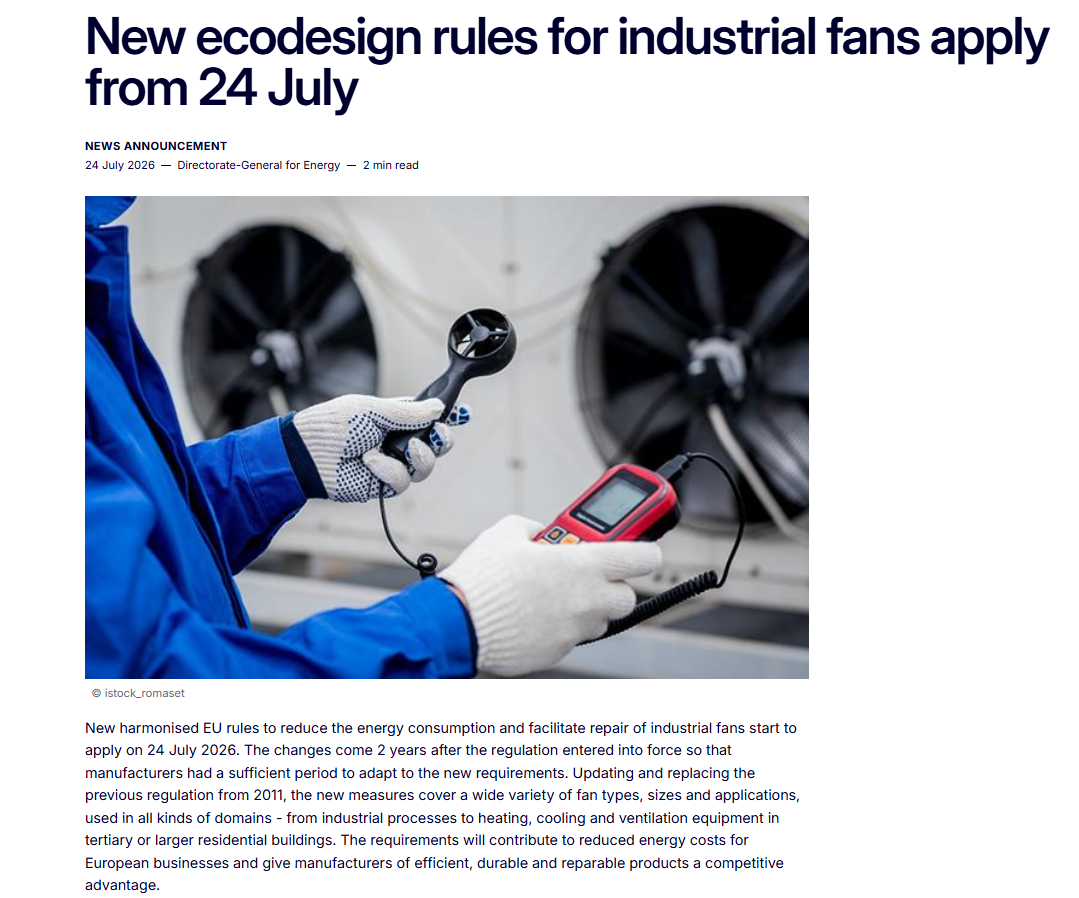
Pic.1 EU Regulation (EU) 2024/1834(Source|European Commission) |
For years, the data center cooling industry has focused on three key performance indicators:
More airflow. Higher efficiency. Lower energy consumption.
But beginning in 2026, another factor will become equally important:Compliance.
The introduction of ErP 2026 (EU 2024/1834) is more than a routine update to Europe's Ecodesign Regulation. It represents a fundamental shift in how industrial fans and cooling systems are evaluated.
For manufacturers of dry coolers, AHUs, and data center cooling equipment, this isn't simply about selecting a more efficient fan. It may influence product design, system architecture, lifecycle cost, and even long-term competitiveness in the European market.
From Fan Efficiency to System Performance
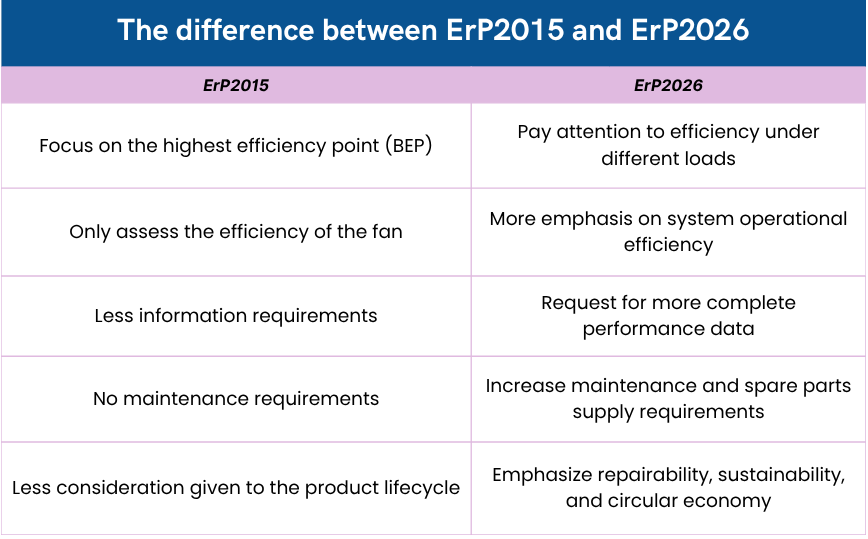
Under ErP 2015, most manufacturers focused on meeting the minimum efficiency requirement at the Best Efficiency Point (BEP).
However, modern cooling systems rarely operate under ideal conditions.
Whether supporting AI data centers, hyperscale facilities, or industrial cooling applications, fan speed continuously changes with thermal demand. Partial-load operation has become the norm rather than the exception.
ErP 2026 reflects this reality.
Instead of focusing only on peak efficiency, the new regulation places greater emphasis on real operating performance, product transparency, repairability, and lifecycle sustainability.
The question is no longer:
"How efficient is the fan?"
It is becoming:
"How efficiently can the entire cooling system perform throughout its service life?"
 |
|
Pic.2 The difference between ErP2015 and ErP2026 |
 |
|
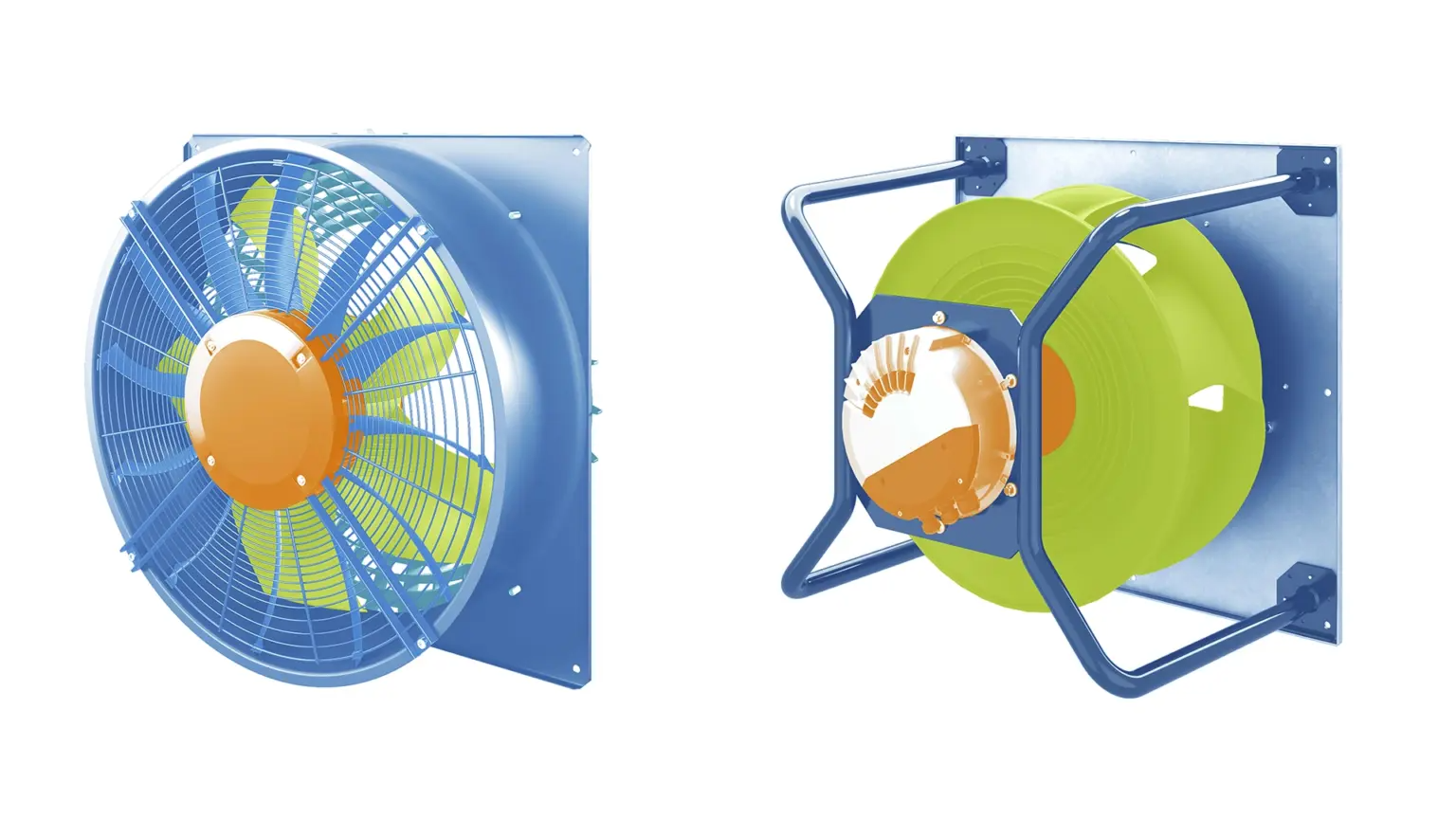
Pic.3 The central functional areas of axial (left) and centrifugal fans (right): the impeller as the aerodynamic centerpiece (green), the motor with integrated electronics as the drive unit (orange), and the stator, i.e., the air-conducting and supporting structures (blue). (Source| ebm-papst) |
Looking Beyond Compliance
At Beijing Hengrui, we've seen more OEMs and cooling system manufacturers begin evaluating projects from a life-cycle perspective rather than focusing solely on initial purchase cost.
Whether it's a data center dry cooler, an AHU retrofit, or a new thermal management platform, selecting the right fan today is increasingly about balancing efficiency, reliability, serviceability, and future compliance.
Because ErP 2026 isn't simply introducing a new regulation.It's redefining what the next generation of cooling systems should look like.
How is your team preparing for ErP 2026?
Will the biggest challenge be fan selection, system redesign, energy efficiency, or long-term compliance?We'd love to hear your perspective.
Q1: What is the biggest difference between ErP 2026 and ErP 2015?
A: ErP 2026 expands the focus beyond peak fan efficiency to include real operating performance, repairability, product transparency, and lifecycle sustainability. It encourages manufacturers to evaluate the performance of the entire cooling system rather than the fan alone.
Q2: How will ErP 2026 affect data center cooling systems?
A: ErP 2026 encourages data center cooling systems to deliver high efficiency under variable operating conditions while improving reliability, serviceability, and lifecycle performance. This is especially important for AI data centers and other high-density cooling applications.
Q3: Why are EC fans becoming more important under ErP 2026?
A: EC fans support variable-speed operation, intelligent motor control, and high efficiency across different load conditions. These characteristics help manufacturers design cooling systems that better align with the performance and lifecycle objectives emphasized by ErP 2026.
 whatsapp


