
 English
 Français
 Deutsch
 Português
 Español
 русский
  한국어
한국어 العربية
 Italiano
 Indonesia
 Schweiz
 Polski
 Nederlands
 ישראל - עברית
 Perzisch
 ไทย
ไทย 日本語
日本語 ኢትዮ-አማርኛ
 Việt Nam
 Kiswahili
 Srpski
 Ελληνικά
 简体中文
简体中文Your EC Fan May Be Energy-Efficient — But Is It Power-Grid Friendly?
When engineers evaluate an EC fan, they usually focus on airflow, static pressure, power consumption and efficiency.
But for large-scale applications such as data centers, BESS, AHUs and industrial HVAC, another question deserves attention:How does the fan affect power quality?
As more electronically controlled fans operate in parallel, current harmonics and power factor can become important considerations for the overall electrical system.
This is where Active PFC — Active Power Factor Correction — becomes important.
What Is Active PFC?
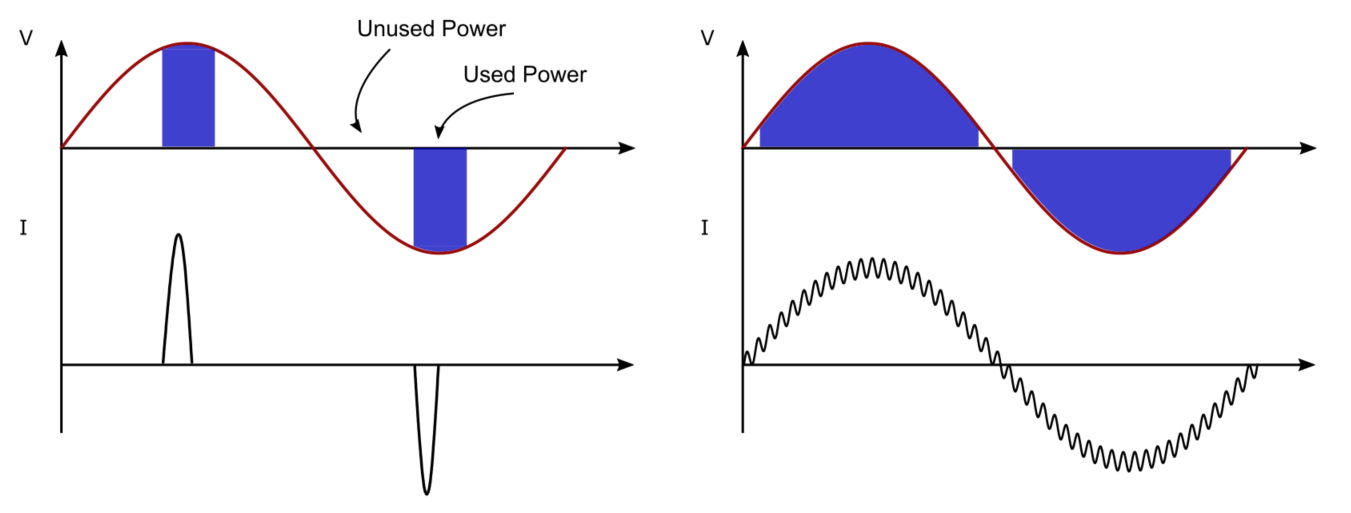
Modern EC fans use electronic motor control, which can result in a distorted input current waveform.
This distortion is measured as THD(I) — Total Harmonic Distortion of Current.
Active PFC addresses this issue at the fan itself by actively shaping the input current to be closer to a sinusoidal waveform and better aligned with the supply voltage.
In simple terms:
Instead of dealing with harmonics after they occur, Active PFC helps prevent excessive current harmonics at the source.
This source-level approach is particularly valuable when many EC fans operate in parallel.
 |
|
Pic.1: Low PF Power Transmission with No PFC (Left) and Power Transmission with Corrected Power Factor and PFC (Right) |
Passive PFC vs. Active PFC: What's the Difference?
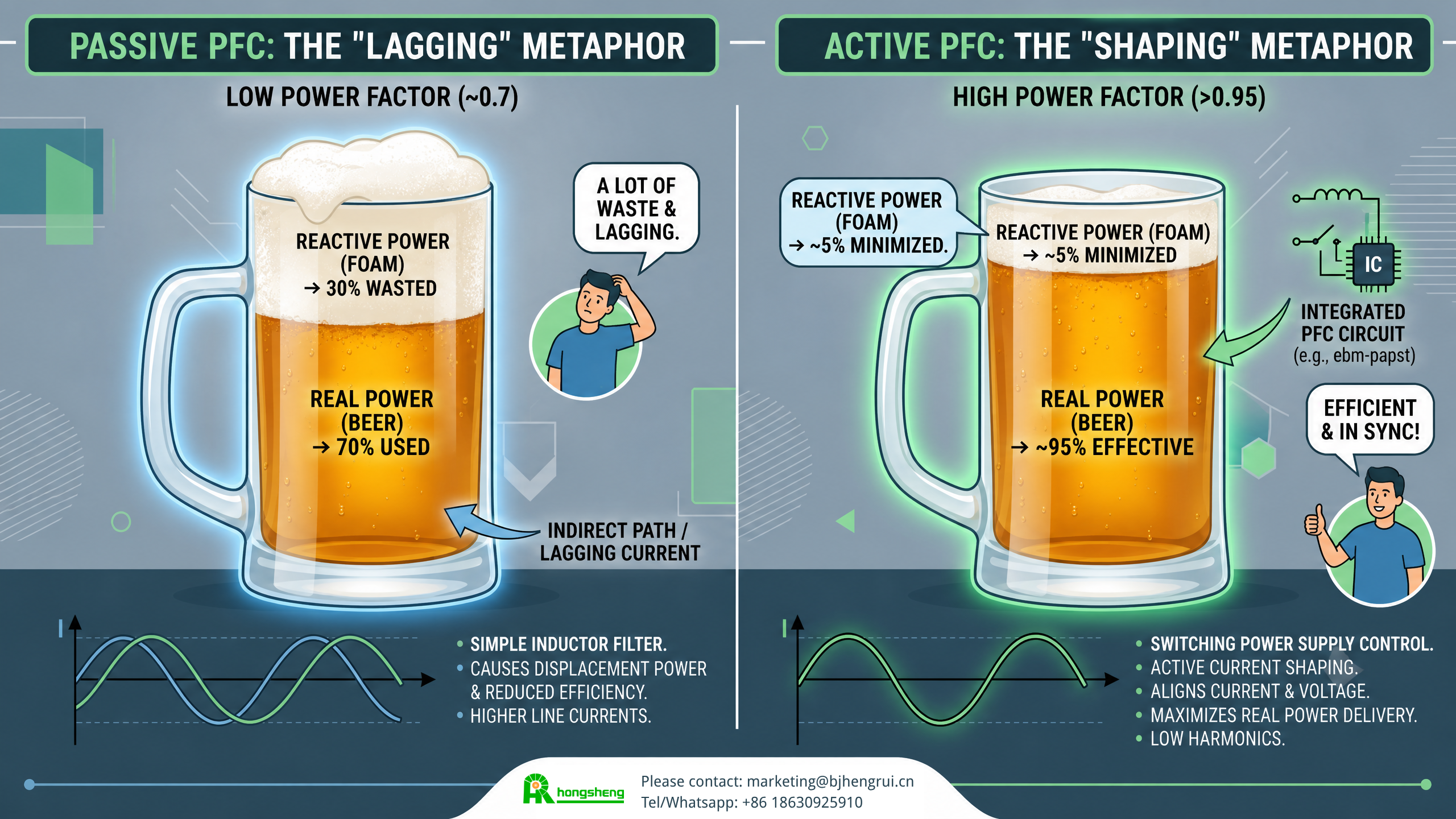
Passive PFC uses components such as inductors or chokes to improve input current characteristics, while Active PFC uses electronic control to actively shape the current waveform, providing more precise control across a broader operating range.
According to ebm-papst test data, its three-phase Active PFC can achieve PF up to 0.998 and THD(I) ≤ 5% over a broad power range.
The key difference is how and where power-quality issues are addressed—an increasingly important consideration when multiple fans operate in parallel.
The illustration below provides a clear visual comparison of how Passive PFC and Active PFC work differently.
 |
|
Pic.2 Difference between passive PFC and active PFC |
What Does Active PFC Bring to EC Fans?
ebm-papst's three-phase Active PFC technology offers several system-level advantages.
A power factor close to 1 means the relationship between useful power and apparent power is close to ideal.
Low current harmonic distortion helps reduce electrical stress and supports more predictable power-system design. ebm-papst states that THD(I) can remain below 5% across a broad operating range, with approximately 2% at rated output in the referenced material.
Multiple fans can operate together without requiring each fan to be individually connected to additional external filtering equipment.
Because the Active PFC technology is integrated into the fan electronics, additional wiring and component matching can be reduced.
 |
|
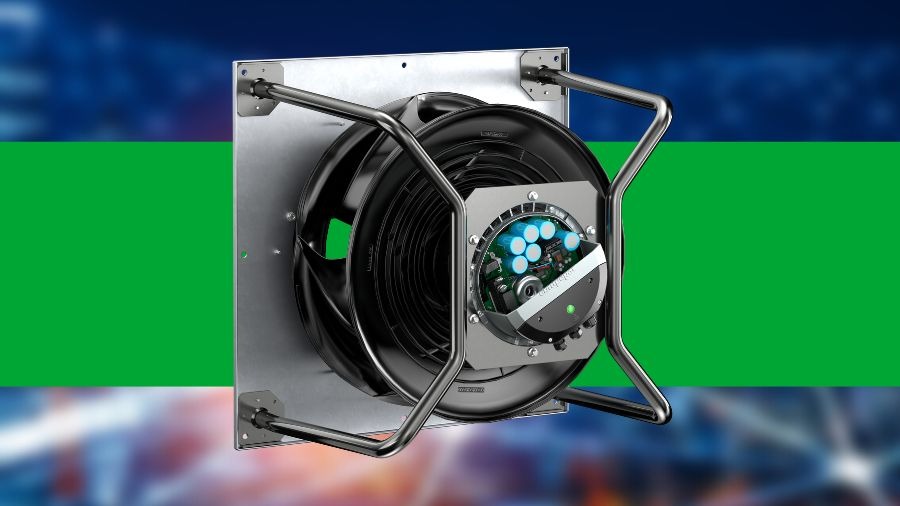
Pic.3 ebm-papst’s Green Intelligence EC fan |
Why Does Active PFC Matter for High-Density Cooling Applications?
Consider a data center cooling system with dozens or even hundreds of fans.
One fan may have a relatively small electrical impact. But when many electronically controlled fans operate simultaneously, their combined electrical characteristics become much more important.
Current harmonics can place additional demands on electrical infrastructure and, in critical applications, may contribute to issues such as transformer loading, nuisance tripping, and interference.
This is why Active PFC can be particularly valuable in FanGrid and other high-density cooling applications.
By addressing harmonics directly at the fan, system designers may be able to avoid unnecessary oversizing of components such as:
The actual sizing still depends on the complete electrical design and applicable requirements.
And the principle is not limited to data centers.
BESS (Battery Energy Storage Systems) also relies heavily on power electronics and sophisticated thermal management. The cooling system therefore needs to be considered not only from a thermal perspective, but also from an electrical one. Reducing current distortion at the fan level can become part of a broader power-quality strategy.
The same consideration applies to large AHUs and industrial HVAC systems, where multiple EC plug fans increasingly operate in parallel.
Instead of evaluating each fan only by its airflow and efficiency, engineers can also consider:Power Factor + THD(I) + Parallel Operation + Electrical Infrastructure
This provides a more complete view of how fan selection can influence the electrical performance, scalability, and lifecycle requirements of high-density cooling systems.
How Can Beijing HENGRUI Help?
As an authorized Tier-1 distributor of ebm-papst, Beijing HENGRUI supports customers beyond product supply.
For Data Centers, BESS, AHUs and industrial HVAC projects, we can assist with:
✔ EC fan selection
The right fan is not necessarily the one with the highest efficiency on the datasheet.
It is the one that delivers the right combination of air performance, energy efficiency, power quality and life cycle value for the complete system.
Designing a high-density cooling system or evaluating EC fans for your next project?
Let's discuss whether Active PFC should be part of your fan specification.
 whatsapp


