
 English
 Français
 Deutsch
 Português
 Español
 русский
  한국어
한국어 العربية
 Italiano
 Indonesia
 Schweiz
 Polski
 Nederlands
 ישראל - עברית
 Perzisch
 ไทย
ไทย 日本語
日本語 ኢትዮ-አማርኛ
 Việt Nam
 Kiswahili
 Srpski
 Ελληνικά
 简体中文
简体中文How a Singapore Semiconductor Fab Cut AHU Energy Consumption by Up to 40% with EC Fans
For semiconductor fabs and electronics manufacturing facilities, energy efficiency is not simply a sustainability target.
It is an operating cost issue.
These facilities often operate 24/7, with air handling systems running continuously to maintain the environmental conditions required for production. In cleanrooms and wafer fabs, ventilation cannot simply be reduced whenever production demand changes. Airflow, temperature, humidity, and cleanliness must remain tightly controlled.
This creates a difficult challenge:
How can a semiconductor facility reduce HVAC energy consumption without compromising ventilation performance or operational reliability?
A retrofit project at a Singapore wafer fab facility provides a practical answer.
The Challenge: 24/7 AHU Operation Comes at a Cost
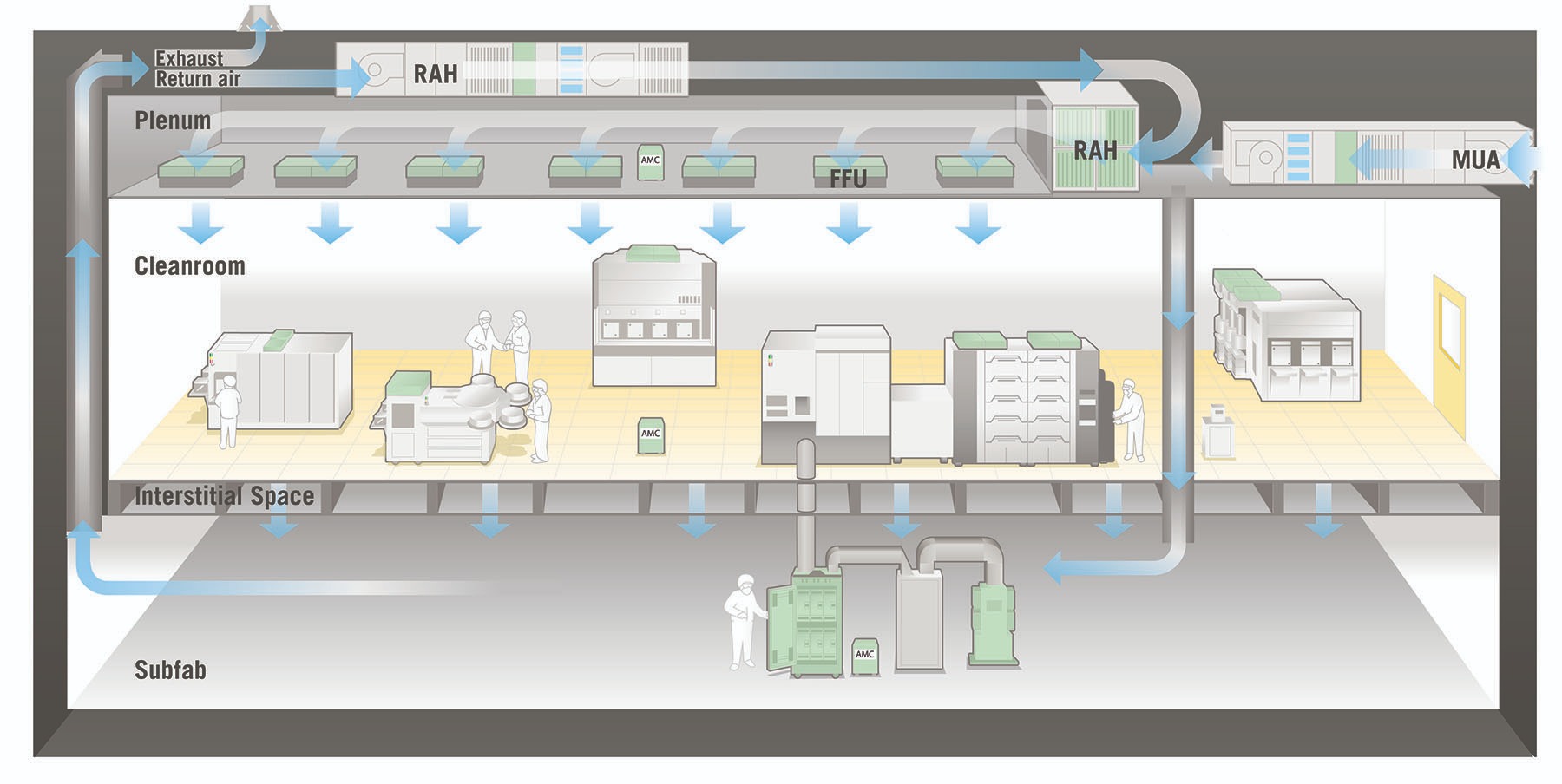 |
Pic.1 Semiconductor processing ventilation solution |
With ambitious sustainability targets—including a goal of achieving net-zero emissions by 2050—reducing electricity consumption became an important part of its long-term strategy.
For a semiconductor facility, however, simply reducing fan speed or operating hours is not always an option.
The ventilation system must continue supporting the production environment.This makes the AHU fan system an important opportunity for efficiency improvements.
The Problem with Conventional AC Belt-Driven Fans
Before the retrofit, old AHUs used conventional AC belt-driven fans with VSDs.This type of system can provide variable-speed operation, but it also introduces several challenges for modern clean room and semiconductor facilities:
Energy losses:
Limited low-speed efficiency:
Maintenance requirements:
No built-in operational redundancy:
For a facility that operates continuously, these issues can translate into higher lifecycle costs and greater maintenance pressure.
The Solution: Retrofit the AHU with EC Centrifugal Fans
After evaluating more efficient ventilation technologies, they selected ebm-papst EC centrifugal fans for the AHU retrofit.
The key difference is that the EC fan integrates the motor, electronics, and impeller into a compact, optimized unit.
This eliminates many of the mechanical transmission losses associated with traditional belt-driven systems while enabling much more flexible speed control.
The EC fans can provide 100% variable-speed control through analog or serial interfaces, allowing the ventilation system to deliver only the airflow required by the operating conditions.
For a semiconductor facility running continuously, this is particularly important.
Even a relatively small improvement in fan efficiency can accumulate into significant annual energy savings when thousands of operating hours are involved.
The Result: Up to 40% Energy Savings
After retrofitting the AHU ventilation system with ebm-papst EC centrifugal fans, it achieved up to 40% energy savings.
 |
|
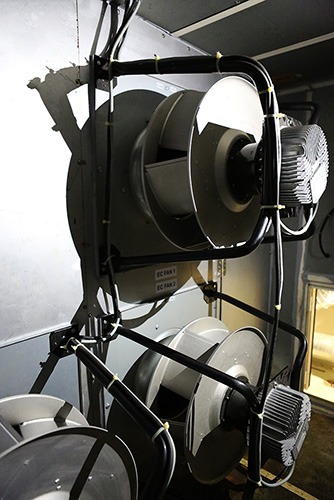
Pic.2 RadiPac EC centrifugal fans in AHU |
But energy savings were not the only benefit.
The retrofit also addressed several operational challenges:
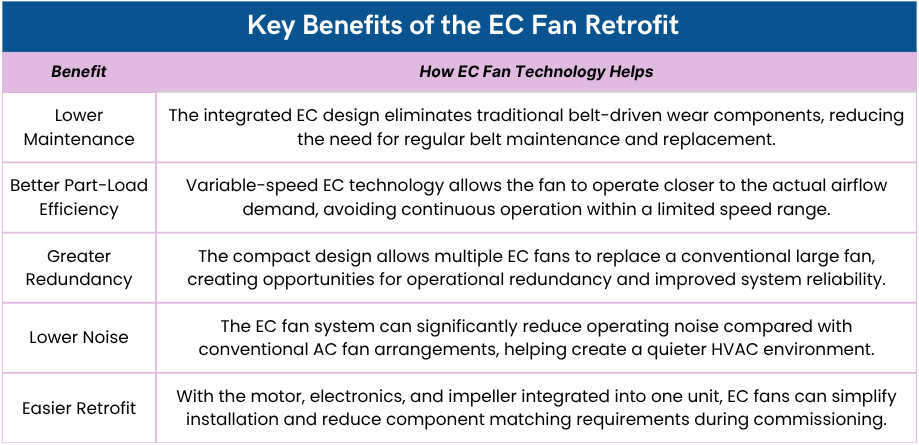 |
Pic.3 Key Benefits of the EC Fan Retrofit |
Why This Matters for Semiconductor & Cleanroom Facilities
The case highlights an important point for semiconductor fabs, electronics factories, and cleanroom operators:
HVAC efficiency cannot be separated from production reliability.
A fan retrofit should not be evaluated only by its initial purchase price.
The more important questions are:
For facilities operating continuously, these factors can have a much greater impact on total cost of ownership than the initial equipment cost.
From Energy Saving to Long-Term Facility Strategy
For semiconductor fabs, electronics plants, and cleanrooms, the key is not simply choosing a more efficient fan, but matching the solution to the airflow, static pressure, operating hours, and load profile of the existing system.
Considering an AHU retrofit? Beijing HENGRUI can support you from fan selection and system evaluation to EC fan supply and technical consultation.
Let’s explore where EC technology can create the greatest energy and lifecycle benefits for your HVAC system.
 whatsapp


