
 English
 Français
 Deutsch
 Português
 Español
 русский
  한국어
한국어 العربية
 Italiano
 Indonesia
 Schweiz
 Polski
 Nederlands
 ישראל - עברית
 Perzisch
 ไทย
ไทย 日本語
日本語 ኢትዮ-አማርኛ
 Việt Nam
 Kiswahili
 Srpski
 Ελληνικά
 简体中文
简体中文Case Study: Designing the Cooling Strategy for High-Power EV Charging Systems
As EV charging technology moves toward higher power density, faster charging, and more compact system architectures, thermal management is becoming a design challenge that cannot be solved simply by adding more airflow.
For high-power DC charging systems, heat can be generated simultaneously by power electronics, electrical modules, charging cables, and dispensing equipment.
The challenge is therefore not just:“How much air do we need?”
It is:“Where does the heat come from, where does it need to go, and how should airflow be distributed throughout the system?”
A recent EV charging project we supported provides a good example.
The Challenge: Multiple Heat Sources in a Compact Architecture
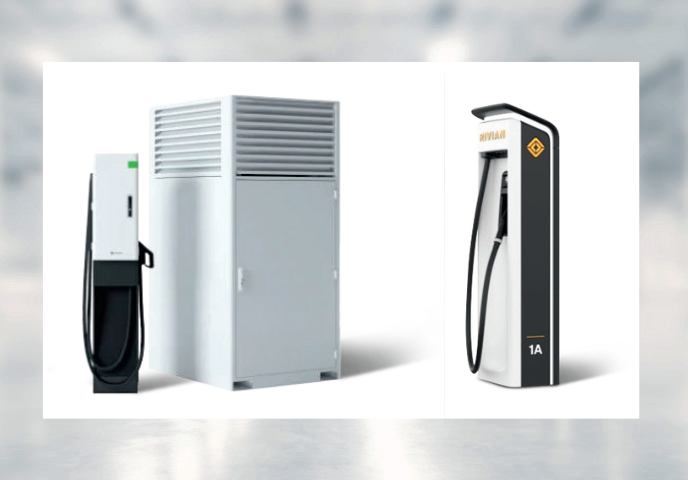
The charging system consisted of a central power cabinet and multiple downstream charging dispensers.
 |
|
Pic.1 power cabinet and multiple downstream charging dispensers |
Inside the system, different components generated heat under different operating conditions. At the same time, the available installation space was limited, making it impractical to rely on a single centralized airflow path.
This created several engineering requirements:
► Targeted cooling for high-heat electronic components
► Effective air circulation inside enclosed cabinet
► Cooling for charging cable areas
► Adequate airflow within charging dispensers
► Compact installation dimensions
► Reliable operation during continuous high-power charging
A single fan configuration could not efficiently address all of these requirements.The cooling architecture therefore needed to be designed around the actual heat sources and airflow paths.
The Solution: Distributed Cooling Instead of One Large Airflow Path
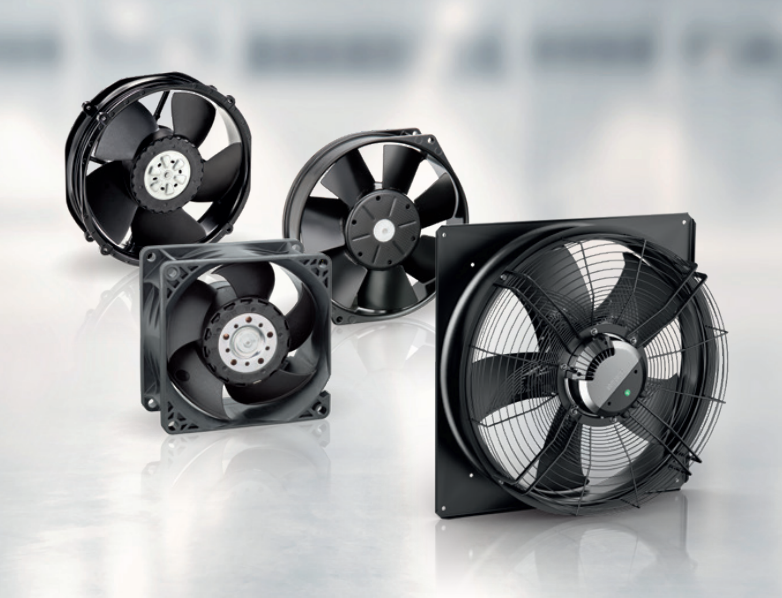
The project adopted a distributed fan cooling strategy, combining compact fans with AxiBlade axial fans for different sections of the charging system.
Rather than using one large fan to move air through the entire system, the cooling capacity was distributed according to the thermal requirements of individual zones.
 |
|
Pic.2 ebm-papst products(7114NH/2214F/2TDHHO/, 8214JN/W3G630-NR63-05) |
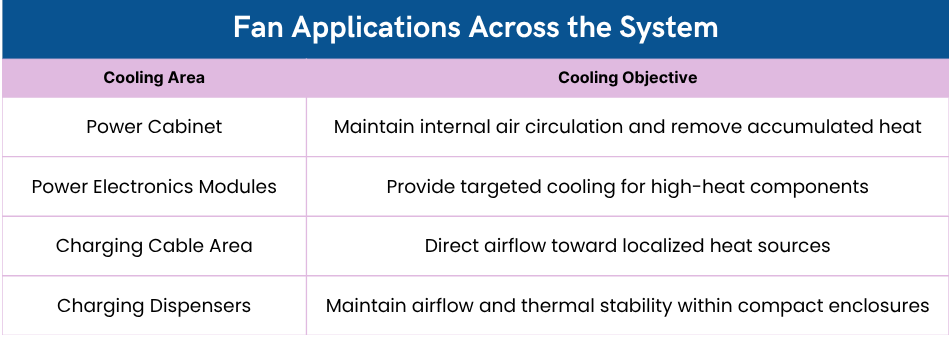
Pic.3 Fan Applications Across the System
This approach allows each cooling point to be matched more closely to its actual thermal load and spatial constraints.
7 Fan Variants. 23 Fans. One Integrated Cooling Strategy.
The project ultimately required 7 different fan variants and 23 fans per system.
This is an important detail.
It demonstrates that thermal management for high-power charging equipment is rarely a simple matter of selecting one fan model and applying it everywhere.
Different locations may require different combinations of:
Airflow + static pressure + size + control + installation configuration.
The fan selection therefore needs to be considered together with the architecture of the entire charging system.
Why Fan Selection Matters
For compact power-electronics equipment, a fan can be technically capable of delivering the required airflow and still be unsuitable for the application.
Engineers need to consider:
Heat load — How much heat needs to be removed?
Airflow path — Where does the cooling air enter and exit?
Static pressure — How restrictive are the internal components and airflow channels?
Installation space — Can the fan fit without compromising the electrical architecture?
Operating conditions — How continuously will the equipment operate?
Control requirements — Does airflow need to change with charging load?
Reliability — Can the cooling system maintain performance throughout the equipment lifecycle?
This is why fan selection should be treated as part of the thermal design, rather than simply a component purchasing decision.
The Engineering Takeaway
As EV charging systems become more powerful and compact, thermal management is becoming increasingly interconnected with electrical and mechanical design.
The objective is no longer simply to move more air.
It is to deliver the right airflow to the right location at the right operating condition.
At Beijing Hengrui, we support EV charger manufacturers, power electronics companies, energy storage system integrators, and thermal management engineers with fan selection, airflow analysis, and customized cooling solutions.
If you are developing a high-power charging system or evaluating a cooling upgrade, share your airflow and pressure requirements with us—we can help assess the appropriate fan configuration for your application.
As power density increases, cooling performance should be engineered—not simply added.
 whatsapp


