
 English
 Français
 Deutsch
 Português
 Español
 русский
 한국어
 العربية
 Italiano
 Indonesia
 Schweiz
 Polski
 Nederlands
 ישראל - עברית
 Perzisch
 ไทย
 日本語
 ኢትዮ-አማርኛ
 Việt Nam
 Kiswahili
 Srpski
 Ελληνικά
 简体中文
OCP Global Summit 2026: 3 Challenges Shaping AI Data Center Infrastructure
Beijinghengrui 3-Step Approach
01 — PROBLEM
AI infrastructure is scaling faster than traditional data center designs were built to accommodate. Higher rack power density, rising cooling demands, and more complex system integration are changing how data centers must be engineered.
02 — SOLUTION
OCP Global Summit 2026 highlighted three connected priorities: high-density power delivery, scalable liquid cooling, and system-level validation. Together, they point toward a more integrated approach to AI infrastructure design.
03 — KEY RULE
Cooling performance cannot be evaluated in isolation. Reliable AI infrastructure depends on matching power, thermal management, equipment selection, and system validation to actual operating requirements.
AI Infrastructure Is Becoming a System-Level Engineering Challenge
Held in San Jose from October 12–15, OCP Global Summit 2026 brought together roughly 15,000 attendees — with tickets sold out and a waitlist of 3,000 — under the theme Scaling Innovation for the AI Era.
The technical program covered 22 tracks spanning AI computing, power distribution, cooling, networking, sustainability, and test and validation. This breadth reflects an important shift: scaling AI is no longer a matter of adding computing capacity. It requires coordinated progress across the entire infrastructure stack.
Three developments are particularly relevant to data center cooling.
Challenge One: Higher Power Density Is Reshaping Power Delivery
Power was the summit's headline theme. Discussions and contributions centered on 800 VDC architectures, rack-level power designs, and rack targets above 1 MW.
Three announcements illustrate the scale of the shift:
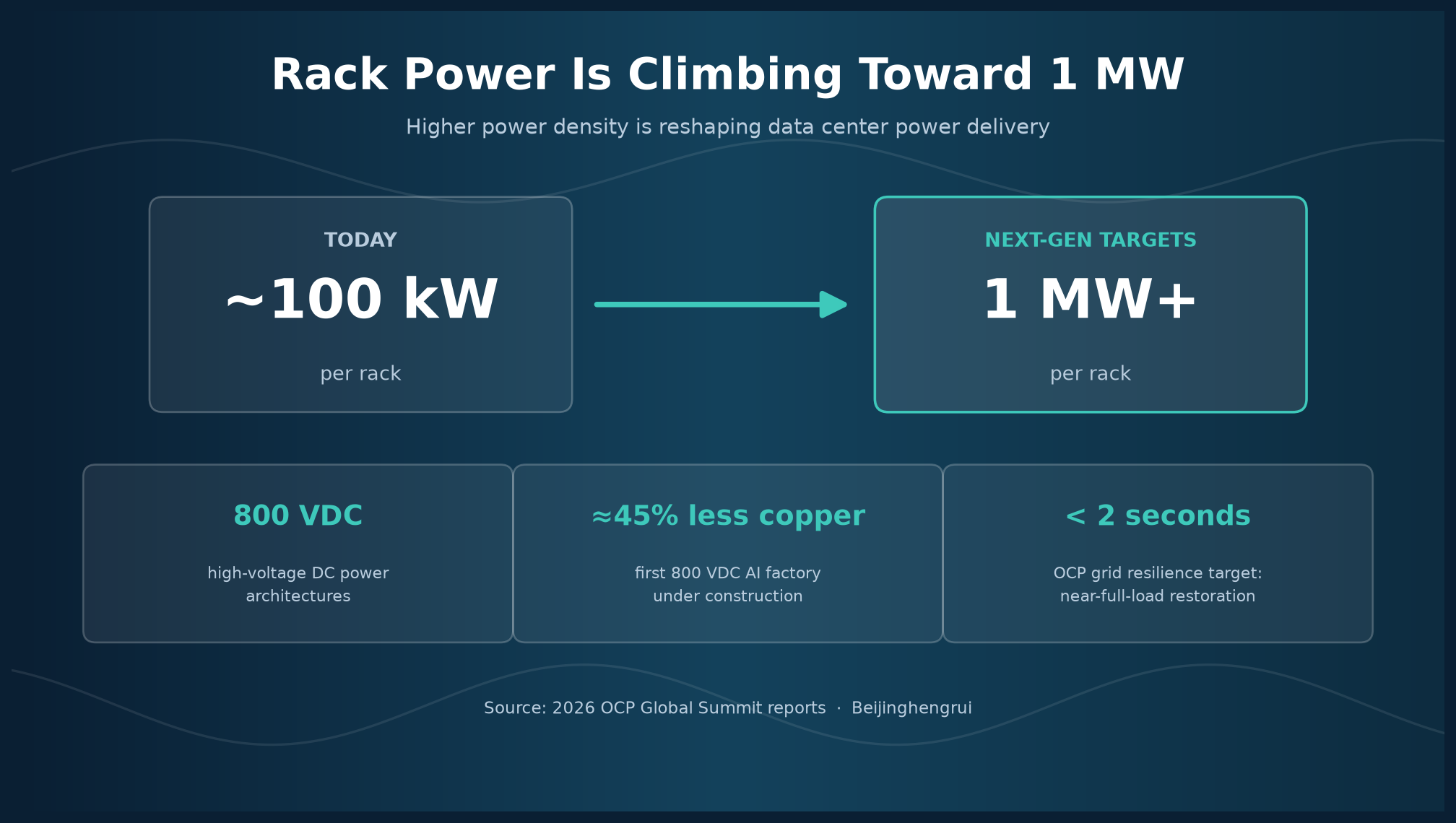
Higher power density creates equally demanding thermal requirements. Cooling systems must account for heat loads, equipment limits, airflow or coolant distribution, redundancy, and serviceability. A solution that performs at one operating condition may not deliver the same results under a different load or ambient temperature.
Thermal performance must be evaluated against the requirements of the complete system, not a single component specification.
Challenge Two: Liquid Cooling and the Cost of Late Preparation
Liquid cooling was the summit's second major focus. The program covered cold plates, immersion, coolant distribution units (CDUs), door heat exchangers, coolant management, and heat reuse, while the Innovation Village demonstrations included a 1 MW heat exchanger, direct-to-chip two-phase cooling, and thermal designs for liquid-cooled server adapters.
The most cited contribution of the week, however, was a document. On October 12, OCP published Thermal Boundaries in AI Infrastructure, a 104-page paper whose authors come from Promersion, Oracle, Meta, and Avayla. It names two dynamics worth every infrastructure planner's attention:
The paper projects single-phase cold plate's own limit near 4,000 W for a reticle-class die, while frontier package power doubles roughly every two years. Its conclusion is not “liquid replaces air,” but a toolbox: air, cold plate, immersion, two-phase, and microfluidics kept ready, interoperable, and matched to the heat, the site, and the moment.
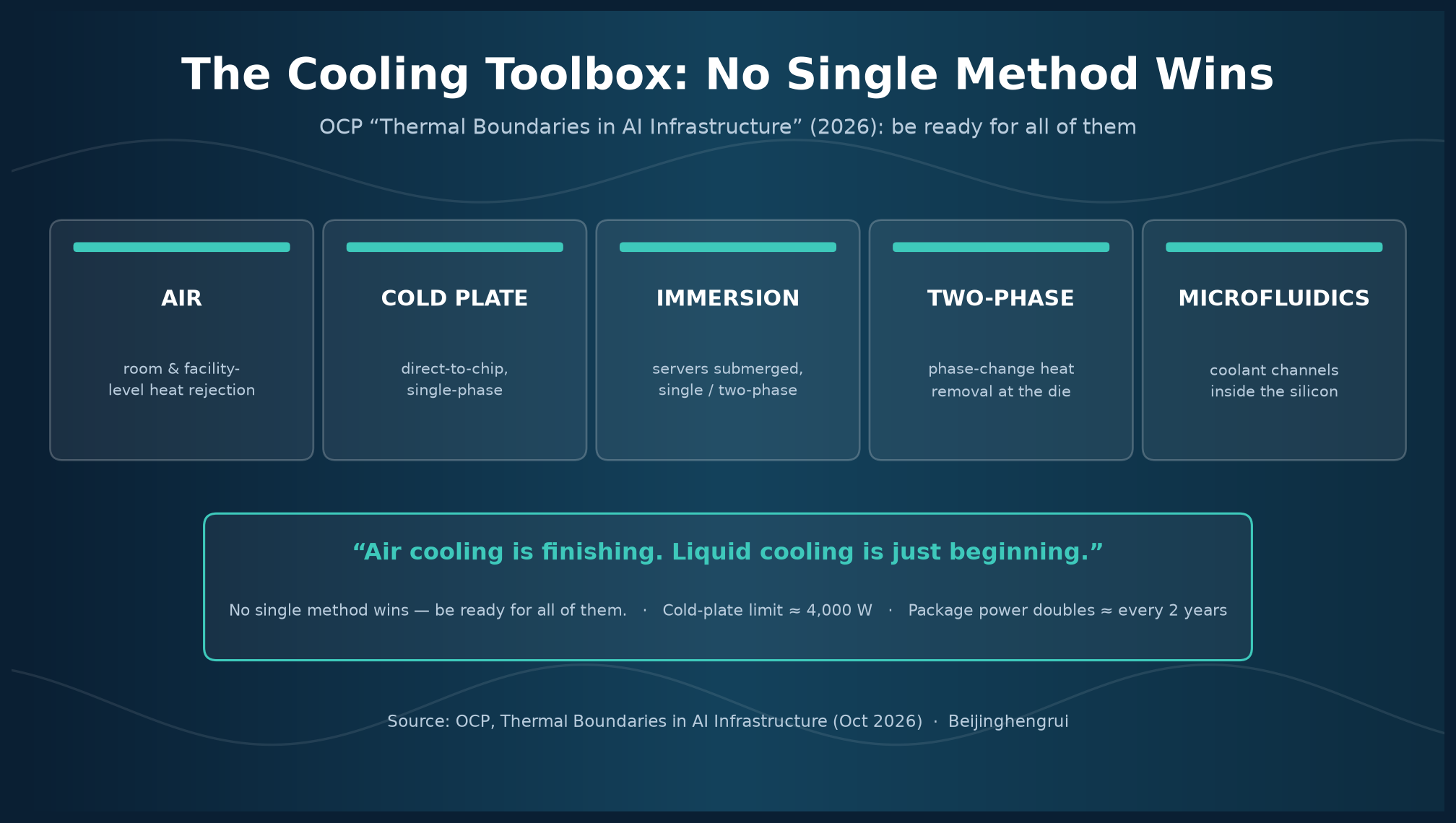
Pic.2 The five cooling methods OCP's 2026 thermal paper says the industry must keep ready — no single method wins.
For cooling equipment buyers, the message is practical: liquid cooling is a system architecture — spanning heat-transfer components, coolant flow, pumps, heat exchangers, controls, and facility-level heat rejection — not an isolated equipment upgrade.
Challenge Three: Validation, Open Standards, and the Commissioning Gap
As AI infrastructure becomes more integrated, proving that components work together matters as much as the components themselves.
OCP's program included dedicated work on test and validation, infrastructure management, and interoperability, and open hardware contributions made the trend concrete — NVIDIA, for example, contributed its MGX 1.2 rack architecture to OCP, including blind-mate liquid cooling and designs supporting up to 250 kW per rack.
The thermal paper adds a sharper point: it identifies commissioning — the step between building a multi-technology thermal system and trusting it with production load — as a gap that “no single vendor owns,” sitting at the seam between the server and the building.
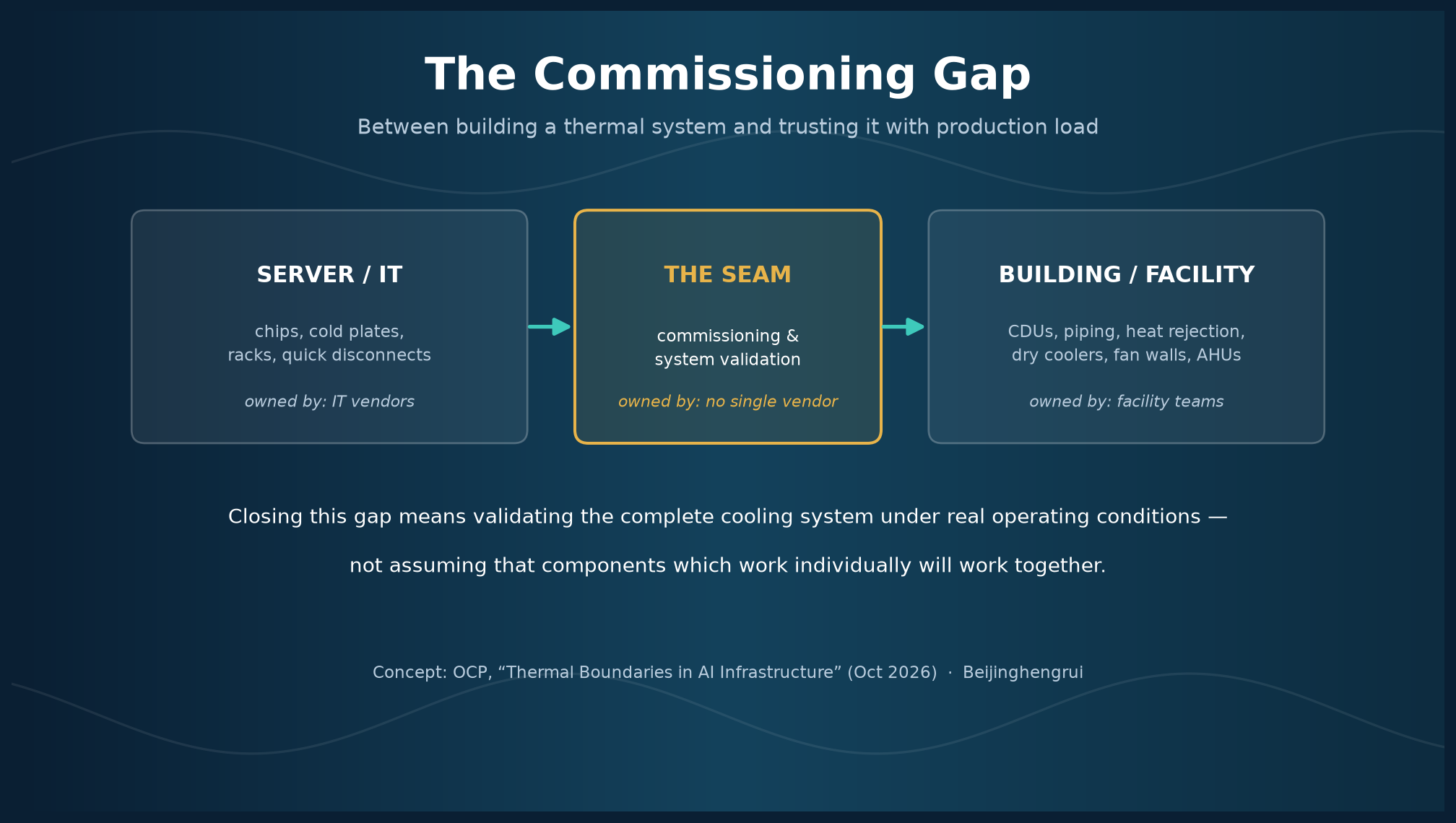
Pic.3 The commissioning gap: no single vendor owns the seam between the server and the building.
For cooling equipment, meaningful validation starts with actual application requirements:
For air-cooled equipment, fan selection must account for system resistance and the required operating point — not simply the fan's maximum airflow rating. For liquid-cooled systems, validation must also cover coolant-side performance, control strategies, heat rejection, and component interfaces.
The engineering principle is the same: measure, analyze, select, and verify under relevant operating conditions.
What Does This Mean for Air Cooling?
The growth of liquid cooling does not mean every cooling requirement in an AI data center will become liquid-based. Even the thermal paper's blunt summary — air cooling is finishing, liquid cooling is just beginning — ends with a qualifier: no single method wins; the only real choice is to be ready for all of them.
The summit showed what that mixed future looks like in practice. Microsoft, for instance, described running multiple independent water loops at different temperatures to serve a mixed fleet of liquid-cooled and air-cooled racks.
Air cooling remains relevant in selected servers, power and auxiliary equipment, air-handling systems, and facility-level heat rejection. Dry coolers and similar equipment must be evaluated against required thermal duty, ambient conditions, system resistance, and energy targets — and where fans are used, performance must match the actual operating point.
The question is not whether liquid or air cooling is better. It is which method is appropriate for each part of the system — and how its performance can be verified.
Beijinghengrui's Perspective: Selection Must Follow the Application
For Beijinghengrui, the developments at OCP Global Summit 2026 reinforce the importance of application-based equipment selection.
In industrial cooling and air-side heat rejection, selecting a fan involves more than matching dimensions or nominal airflow. Operating conditions, system resistance, energy consumption, installation constraints, and reliability requirements all need consideration. Our work in industrial fan sourcing, selection support, and technical assistance follows a practical approach:Measure → Analyze → Select → Verify
As AI infrastructure evolves, this discipline remains relevant across cooling architectures. Technologies change; equipment still has to perform reliably under real operating conditions — and the commissioning gap the industry is now discussing is exactly where verification creates value.
Reliable cooling starts with the right selection. For air-side equipment such as dry coolers, fan walls, and AHUs, selection starts from the actual duty point — Beijinghengrui supports this evaluation with selection review and technical documentation.
 whatsapp


