
 English
 Français
 Deutsch
 Português
 Español
 русский
  한국어
한국어 العربية
 Italiano
 Indonesia
 Schweiz
 Polski
 Nederlands
 ישראל - עברית
 Perzisch
 ไทย
ไทย 日本語
日本語 ኢትዮ-አማርኛ
 Việt Nam
 Kiswahili
 Srpski
 Ελληνικά
 简体中文
简体中文How to Select EC Fans for Industrial AHU Energy Upgrades
Beijinghengrui 3-Step Approach
01 — PROBLEM
Replacing belt-driven fans in industrial AHUs requires more than matching the original airflow. Pressure, power, installation conditions, and control compatibility matter equally.
02 — SOLUTION
Evaluate EC fan performance, electrical requirements, and control interfaces against the actual operating point before confirming the replacement.
03 — KEY RULE
Select for the required operating point — not the rated airflow or motor power. Verify performance before evaluating energy savings.

Project Background
Replacing belt-driven fans with EC fans eliminates belt losses, reduces maintenance, and adds integrated speed control. But a successful upgrade depends on more than the technology: the replacement must deliver the required airflow against actual system resistance, within the specified power limit, and with compatible electrical and control interfaces.
These considerations shaped the EC fan procurement specification for an energy-efficiency project at a semiconductor manufacturing facility, covering twelve AHUs. Beijinghengrui supported the fan selection. Instead of matching the original fan's nominal rating, the specification defined explicit performance and control requirements.
Define the Operating Point First
The specification established the following requirements per fan. Each AHU uses four EC plug fans in a fan-wall arrangement:
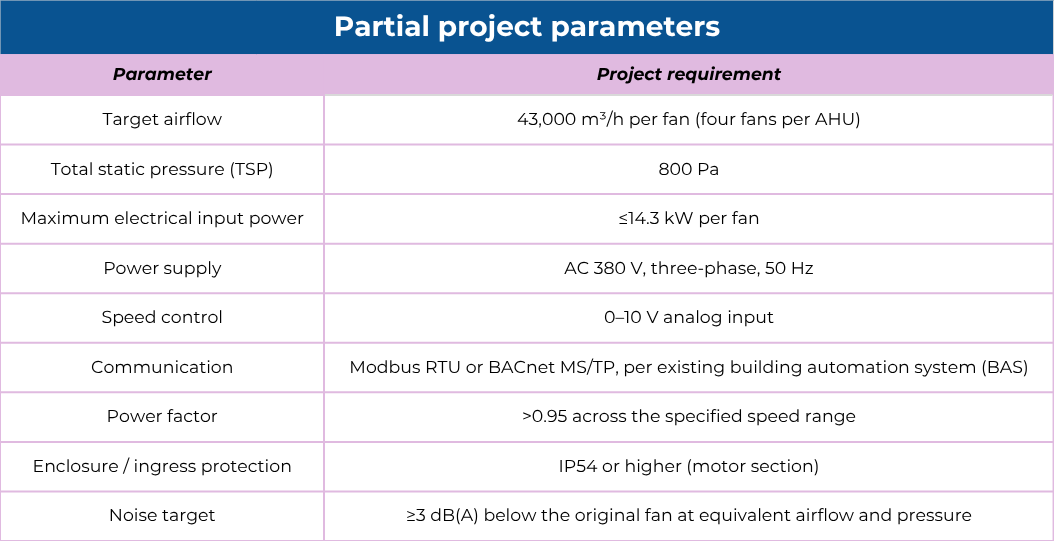
Pic.1 Partial project parameters
These values are selection requirements, not post-installation results.
A fan's rated airflow alone says nothing about whether it can perform in an existing AHU — the fan must overcome the resistance of ductwork, filters, and coils. Airflow and pressure must therefore be evaluated as one operating point, checked against the fan curve: the operating point should sit within the fan's efficient region, not just on the curve.
A quick plausibility check: at 43,000 m³/h and 800 Pa, air power is about 9.6 kW, so the 14.3 kW input limit implies a minimum wire-to-air efficiency of roughly 67% for the complete assembly.
In a fan wall, the same logic applies at two levels: each fan runs at one quarter of the AHU's total airflow against the same system pressure, and both per-fan and whole-AHU power must stay within limits. Only after duty point and power are verified does energy-saving evaluation have a sound basis.
Electrical and Control Compatibility
A fan can meet its aerodynamic requirements and still fail in an existing AHU if electrical or control interfaces are incompatible. The specification addressed three areas:
Integrated EC drive. External-rotor brushless permanent-magnet motors with integrated controllers; high-efficiency backward-curved centrifugal or mixed-flow impellers, dynamically balanced. The complete assembly — fan, motor, and controller — must meet the applicable Grade 1 efficiency requirements under GB 19761. A motor certificate alone does not demonstrate assembly efficiency.
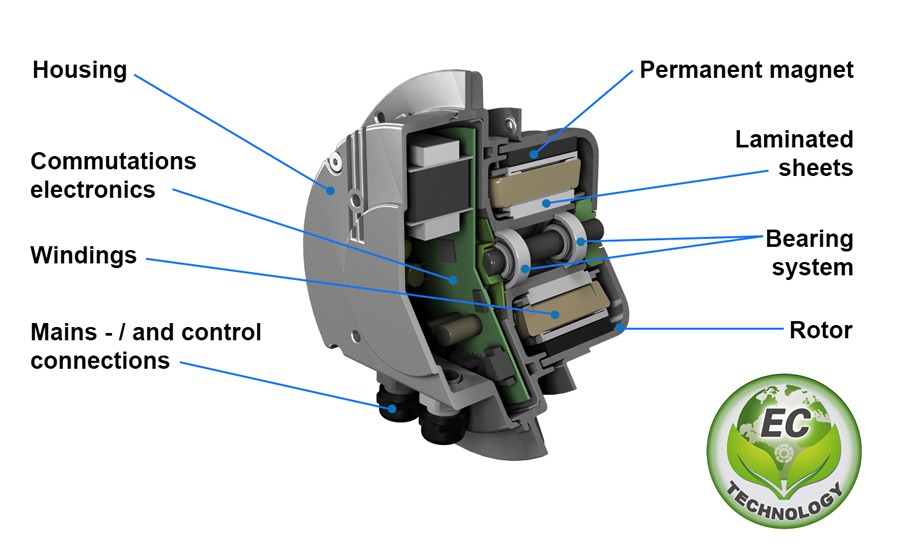
Pic.2 Schematic diagram of EC fan structure
BAS integration. 0–10 V stepless control plus Modbus RTU or BACnet MS/TP, with a complete point list and manual/automatic switchover. Protocol support on paper does not guarantee compatibility with the installed BAS — confirm the interface, protocol details, and point list before finalizing.
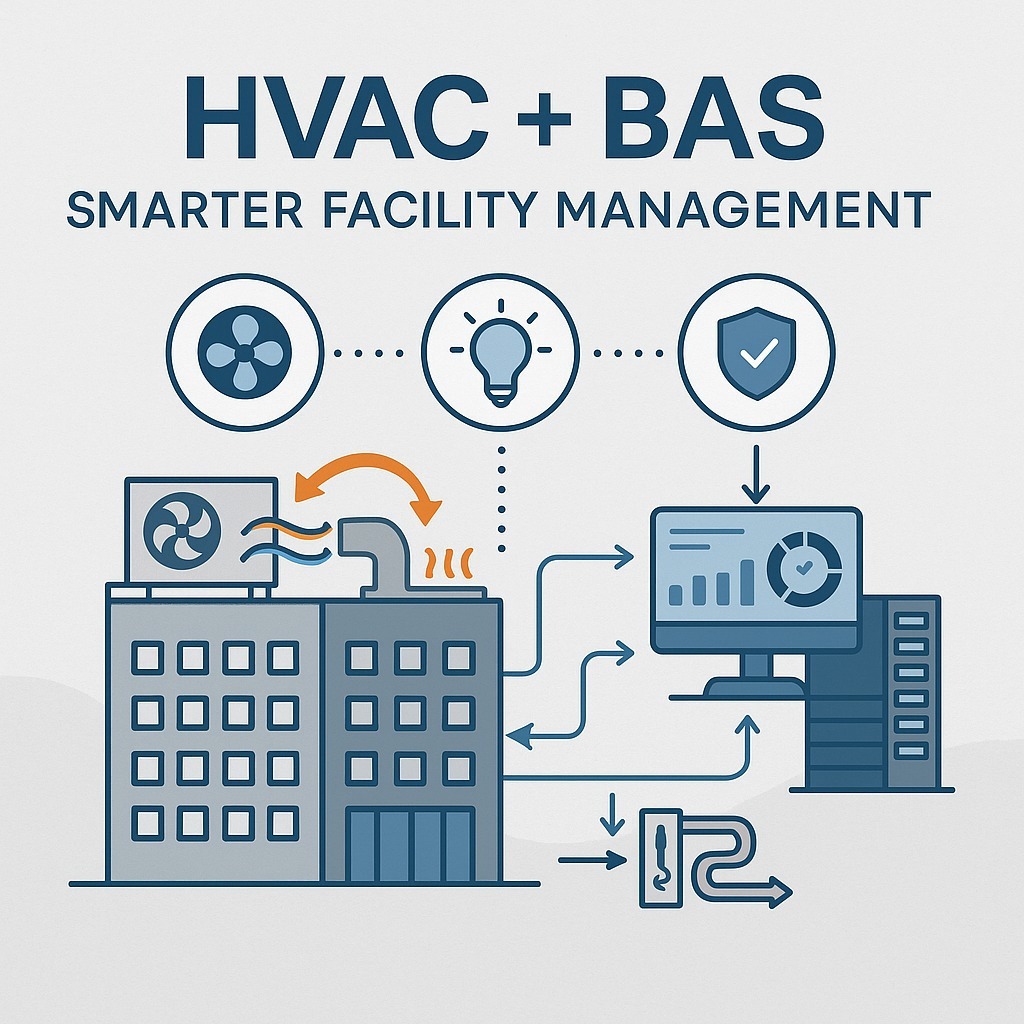
Pic.3 BAS integration is an important part of systems
Protection and reliability. Built-in electronic protection against overcurrent, overheating, rotor blockage, undervoltage, and phase loss; power factor above 0.95 across the speed range; balanced external-rotor bearings that eliminate regreasing; L10 bearing life above 40,000 hours; corrosion-protected steel housing. These establish the conditions for reliable operation — actual service life still depends on the real operating environment.
Pic.4 Actual service life depends on the real operating environment
Verify Before and After Installation
Selection is only the first step. Verification covers four areas:
The specification defines the requirements — commissioning data determines whether they were achieved.
FAQ
Q1: Can an EC fan directly replace a belt-driven fan in an existing AHU?
No. The replacement must match the actual duty point, electrical supply, control interfaces, and installation space. For large AHUs, a fan wall of several EC plug fans is a common retrofit approach.
Q2: What if we have no baseline airflow and pressure data?
Start from the AHU design documents and the original fan nameplate; if unavailable or unreliable, establish the operating point by on-site measurement. Beijinghengrui can support the measurement and selection.
Q3: When is a fan wall preferable to a single large fan?
When installation space is limited, redundancy matters, part-load operation is frequent, or a single large fan is impractical to transport, install, or maintain.
Q4: How are energy savings measured after the retrofit?
Compare input power at the same duty point against a documented baseline, under comparable conditions and actual operating hours.
Q5: What information is needed for a replacement selection?
Existing fan model and nameplate photo, required airflow and pressure, power supply, control and communication requirements, installation dimensions, and operating environment.
The Engineering Takeaway
Replacing a belt-driven fan with EC fans is an engineering selection task — aerodynamic performance, power limits, electrical integration, control compatibility, and verification — not a component substitution. Define these factors before the replacement is finalized.
Need support with an industrial AHU fan upgrade?
Beijinghengrui can assist with fan selection, operating-point verification, fan-wall configuration, model identification, and replacement matching. Share the existing fan model, nameplate photo, required airflow and pressure, and available electrical or control information — we will establish the right starting point for your project.
 whatsapp


