
 English
 Français
 Deutsch
 Português
 Español
 русский
 한국어
 العربية
 Italiano
 Indonesia
 Schweiz
 Polski
 Nederlands
 ישראל - עברית
 Perzisch
 ไทย
 日本語
 ኢትዮ-አማርኛ
 Việt Nam
 Kiswahili
 Srpski
 Ελληνικά
 简体中文
AI Factories Are Going Liquid-Cooled. Why Do They Still Need Large Axial Fans?
Beijinghengrui 3-Step Approach
01 — PROBLEM: Liquid cooling reduces the need for airflow inside servers, but it does not eliminate the heat that must be rejected.
02 — SOLUTION: Large EC axial fans support air-side heat rejection in dry coolers and other facility cooling equipment.
03 — KEY RULE: Select fans according to the actual system operating point—not nominal airflow or impeller diameter alone.
Take a look at NVIDIA DSX POD, the modular AI factory solution unveiled at GTC Berlin 2026.As AI factories move toward liquid cooling, do large cooling fans still matter? The answer lies in where the heat goes next.
Liquid Cooling Changes Where Fans Are Needed
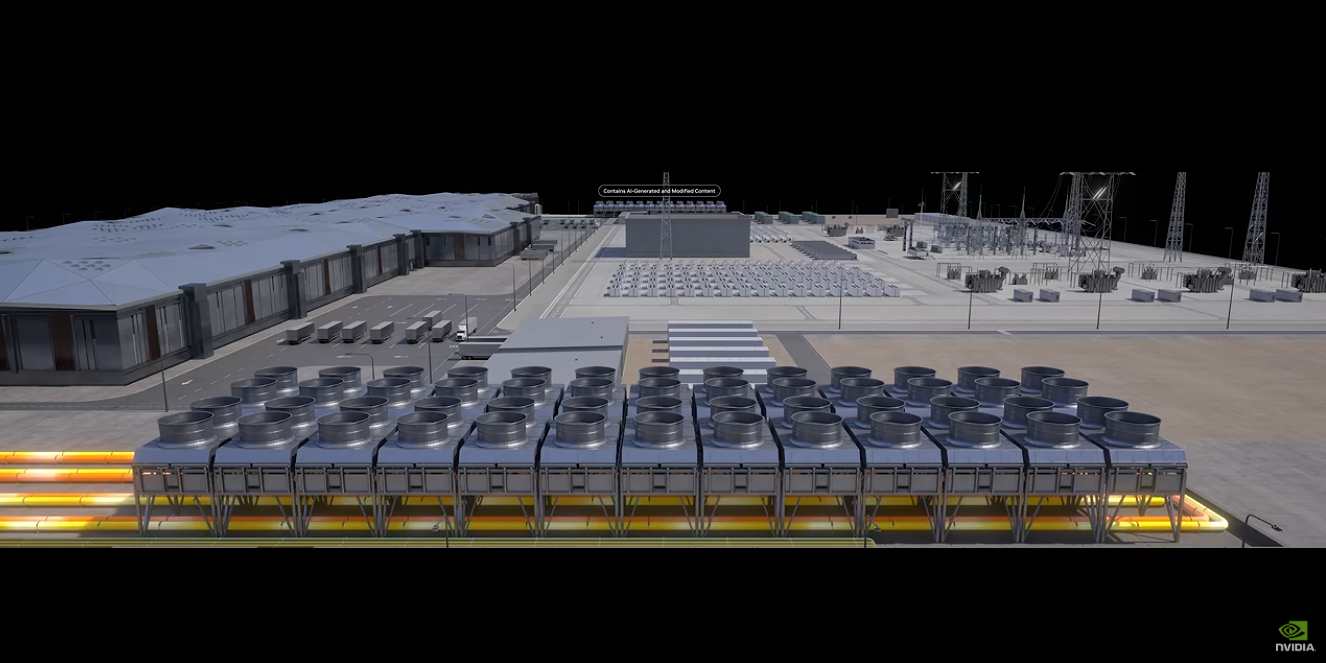
Pic.1 The dry cooler queue shown in the video
Traditional air-cooled servers use fans to remove heat from processors. As rack power density increases, managing airflow and pressure drop becomes more challenging.
Liquid cooling addresses this by using cold plates to transfer heat directly from chips into circulating coolant. In some configurations, server-tray fans can be significantly reduced or even eliminated.
NVIDIA's Vera Rubin infrastructure, for example, is designed for 100% liquid cooling, with coolant inlet temperatures of up to approximately 45°C.
However, liquid cooling does not eliminate heat—it changes how heat is transferred. Under suitable conditions, facility-side dry coolers can use ambient air to reject this heat, although mechanical cooling may still be needed during periods of high outdoor temperatures.
Liquid cooling moves heat. It does not make heat disappear. The heat still needs to leave the facility.
The heat-rejection process follows a clear path:
Chip → Cold Plate → Rack Coolant Loop → CDU / Heat Exchanger → Facility Cooling Loop → Dry Cooler Coil → Ambient Air
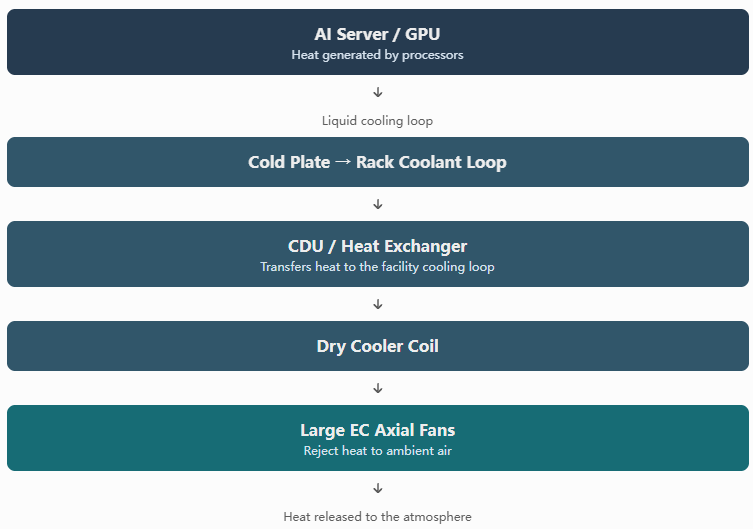
Pic.2 Simplified heat transfer path diagram
Cold plates transfer heat from chips into circulating coolant. A CDU or heat exchanger transfers that heat to the facility-side cooling loop, which carries it to outdoor equipment such as a dry cooler.
Inside the dry cooler, coolant flows through coils while axial fans move ambient air across the coil surface, transferring heat from the liquid to the surrounding air.
This is where the ebm-papst AxiBlade 800mm and 910mm EC axial fan series come into play. They are designed for air-side heat rejection in applications such as dry coolers, condensers, evaporators, and air-cooled chillers—not for installation inside servers or necessarily within CDUs.
Their role is further downstream: moving air across heat exchangers to help transfer facility heat to the environment.
The key engineering challenge is selecting a fan that can deliver the required airflow against the actual resistance of the complete equipment.
What Does Rejecting 1 MW of Heat Mean for Airflow?
Consider a simplified example.
A dry cooler needs to reject 1 MW of heat to ambient air. Assume the air temperature rises by 10 K as it passes through the equipment.
Using:
- Heat rejection: 1,000 kW
- Air specific heat capacity: 1.005 kJ/(kg·K)
- Air density: 1.2 kg/m³
- Air temperature rise: 10 K
The required airflow can be estimated using the sensible heat equation:The resulting airflow is approximately:82.9 m³/s, or 298,000 m³/h.
This illustrates the scale of airflow that may be required for a 1 MW heat-rejection duty.
However, this is an order-of-magnitude heat-balance estimate—not a final fan selection.
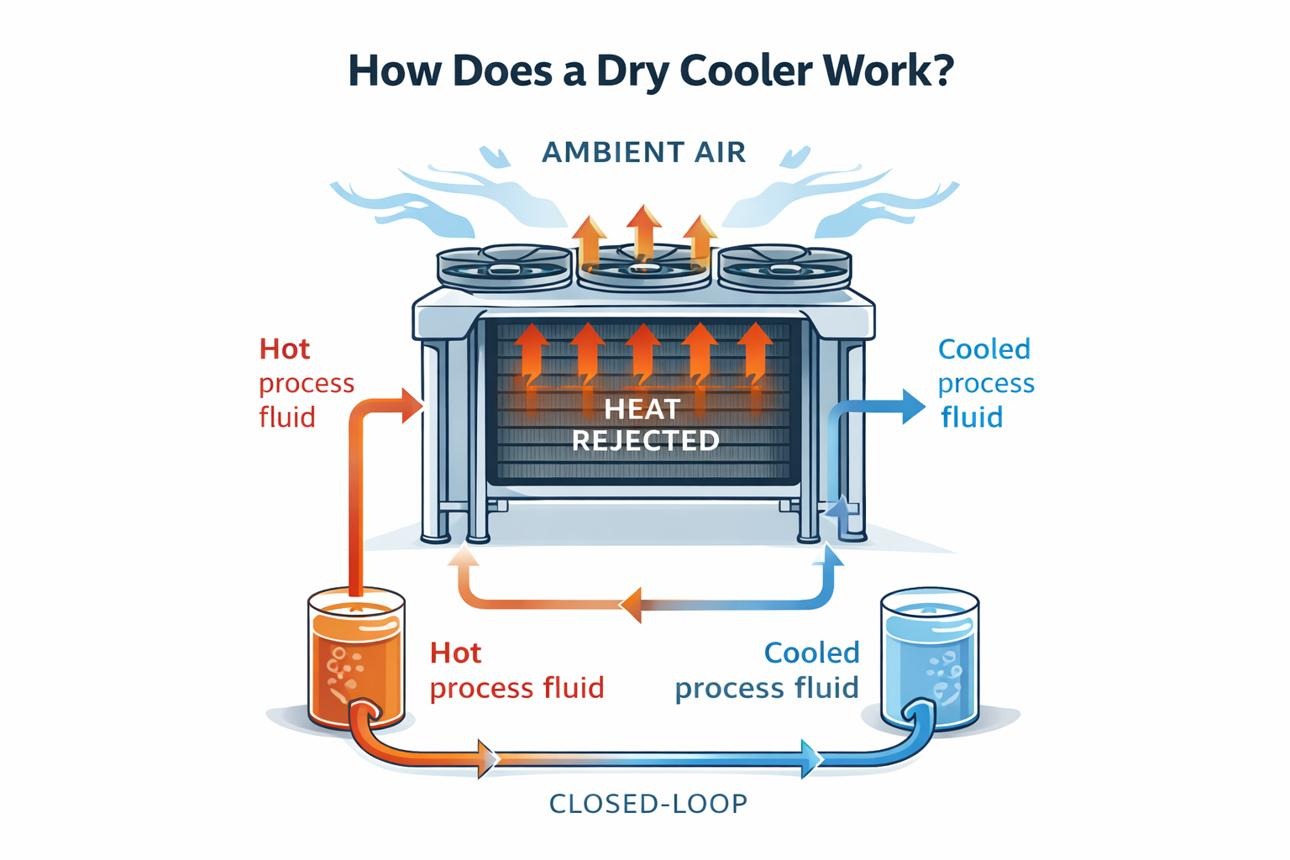
Pic.3 How Does a Dry Cooler Work?
A real project must also account for coil pressure drop, ambient dry-bulb temperature, site altitude, coil fouling, hot-air recirculation, approach temperature, acoustic limits, and the required margin for single-fan failure.
Most importantly, the total airflow requirement cannot simply be divided by a fan's nominal free-air volume to determine the number of fans.
The actual operating point depends on the intersection of the fan performance curve and the system resistance curve.
AxiBlade 800mm vs. 910mm: Aerodynamic Design and Selection Considerations
Large axial fan performance depends on more than impeller diameter. The AxiBlade system combines an aerodynamically optimized impeller, EC external-rotor motor, fan ring, and optional guide vanes and FlowGrid to improve airflow performance and acoustic behavior.
Airfoil blades and winglets help reduce tip vortices and turbulence losses, while the optimized inlet ring guides air smoothly into the impeller. Optional guide vanes help manage outlet airflow under higher back-pressure conditions. FlowGrid can improve inlet airflow uniformity and reduce certain noise components caused by non-uniform airflow.
For engineers evaluating the 800mm and 910mm models, their key specifications highlight different operating characteristics:
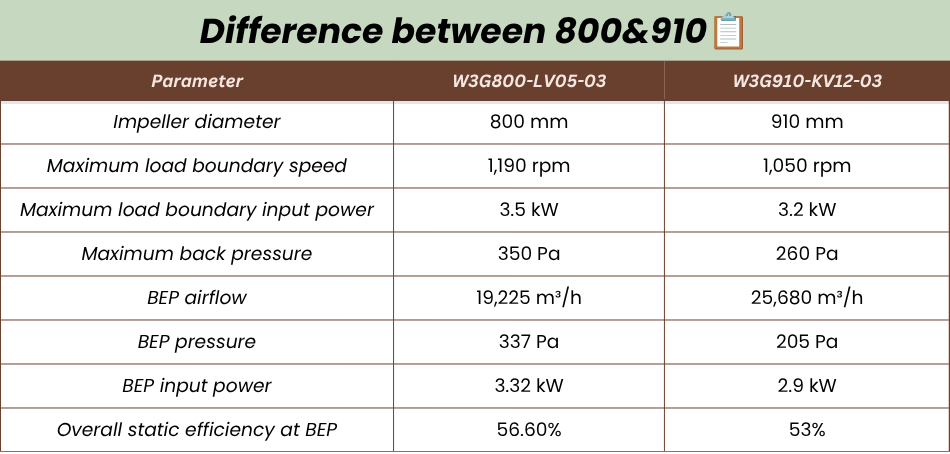
Pic.4 Key specifications highlight of W3G800/910
The 910mm impeller has approximately 29% more disk area than the 800mm version. However, this does not translate directly into 29% more airflow. Actual performance depends on blade geometry, rotational speed, hub ratio, and system resistance.
EC Speed Control and Digital Communication
AI workloads and outdoor temperatures fluctuate, so dry cooler fans do not always need to operate at full speed. EC technology enables variable-speed control, allowing airflow to respond to changing cooling demand.
Depending on the model configuration, control options include 0–10 V, PWM, and RS-485 Modbus RTU. The referenced AxiBlade models also support integrated control and protection functions, enabling operating status and fault information to be incorporated into facility monitoring systems.
Under similar operating conditions, fan affinity laws show that airflow is approximately proportional to speed, while air power varies roughly with the cube of speed. This makes low-load speed control an important consideration in overall cooling energy management.
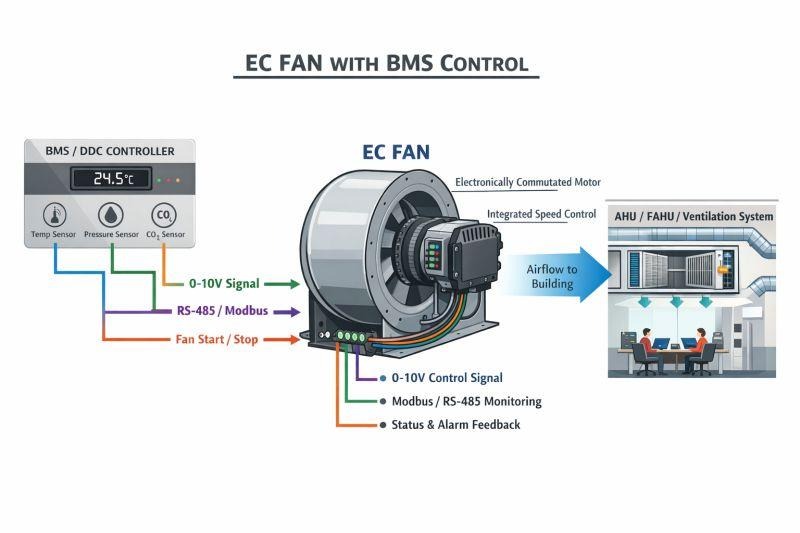
Pic.5 EC fan with BMS control
One More Engineering Detail: The Electrical Interface
A detail that can easily be overlooked is the difference between the power architecture of an AI factory and the electrical input requirements of its cooling equipment.
NVIDIA DSX POD's 800 VDC reference relates to the power architecture described in the OCP LVDC solid-state transformer specification context.
The two AxiBlade models discussed here have a rated input of three-phase 380–480 VAC. They are not designed to connect directly to an 800 VDC bus.
A project therefore needs an appropriate auxiliary power distribution or conversion arrangement to provide the correct voltage, protection, isolation, and grounding for fans, pumps, and control equipment.
Understanding this electrical boundary is just as important as matching airflow and pressure.
Final Thoughts: Liquid Cooling Still Needs Heat Rejection
Liquid cooling is changing the architecture of AI factory cooling. It can reduce the need for server-side airflow, but when the facility ultimately rejects heat to ambient air, large axial fans remain an important part of the heat-rejection chain.
The role of the fan is shifting—from local server cooling to facility-level heat rejection, where it directly affects cooling capacity, auxiliary energy consumption, acoustic performance, and system redundancy.
The AxiBlade 800mm and 910mm series combine large-diameter axial fan design, EC speed control, and digital communication for demanding air-side cooling applications.
For engineers, the selection process should follow a clear sequence:
- Define the thermal load and design temperatures.
- Establish the coil and system resistance curve.
- Identify the required fan operating point.
- Verify efficiency, noise, redundancy, electrical compatibility, and control strategy.
At BeijingHengrui, we support dry cooler fan replacement, EC fan retrofit projects, cross-model selection analysis, and application-oriented technical matching.
Because the key question is not simply whether an AI factory uses liquid cooling.
It is where the heat goes after the liquid has collected it. If that heat still needs to be rejected to ambient air, large axial fans still have a job to do.
 whatsapp


