
 English
 Français
 Deutsch
 Português
 Español
 русский
 한국어
 العربية
 Italiano
 Indonesia
 Schweiz
 Polski
 Nederlands
 ישראל - עברית
 Perzisch
 ไทย
 日本語
 ኢትዮ-አማርኛ
 Việt Nam
 Kiswahili
 Srpski
 Ελληνικά
 简体中文
How to Balance EC Fan Selection, Cost, and Delivery in Data Center Projects?
Beijinghengrui 3-Step Approach
01 — PROBLEM
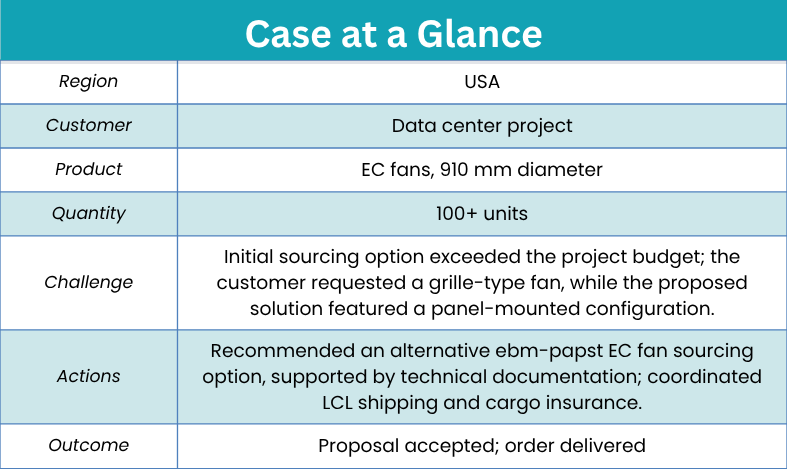
A data center project in the USA required a specific EC fan configuration. The challenge was to identify a suitable sourcing solution that could meet the project's requirements while keeping the overall procurement cost under control, especially for an order of more than 100 units.
02 — SOLUTION
BeijingHengrui reviewed the project's airflow and static pressure requirements, verified the proposed model against the application needs, and recommended an alternative ebm-papst EC fan solution supported by relevant technical documentation.
03 — KEY RULE
The requested model is a starting point, not a verified selection. Size, configuration, origin, and delivery should all be confirmed against the project's actual requirements.
The Challenge: Balancing Project Requirements and Procurement Budget
For data center projects, selecting a fan is rarely just a matter of choosing a familiar brand. Project teams must consider airflow performance, product configuration, procurement costs, and delivery arrangements — all while ensuring the proposed solution meets the project's actual requirements.
In this case, a data center project in the USA was evaluating EC fan options from established European brands, including Ziehl-Abegg and ebm-papst. The initial requirement was for a 800 mm EC fan with a protective grille. The project team provided airflow and static pressure requirements, along with product specification documents, to support the selection process.
However, the initial sourcing option came with a significantly higher quotation. For an order of more than 100 fans, international freight added another cost consideration, making the overall procurement budget an important factor in the decision.
This led to a broader purchasing question: Could an alternative sourcing solution meet the project's technical and application requirements while offering a more practical balance between product cost and delivery?
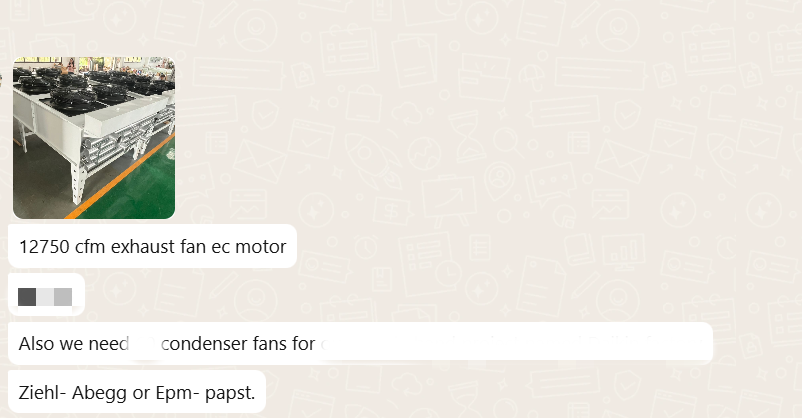
Pic.1 Initial selection request
From 800 mm to 910 mm: Verifying the Selection First
BeijingHengrui did not simply quote the requested model. The selection was reviewed against the project's actual airflow and static pressure requirements.
The verification produced a different answer from the original inquiry: selection calculations indicated that a 910 mm diameter model was the appropriate match for the required duty point — not the 800 mm size initially requested.
This is a common situation in industrial fan procurement. The size in an inquiry reflects the buyer's initial plan, but it has not necessarily been verified against the system's actual requirements. Treating the requested model as the final answer can mean ordering a fan that is not the best fit for the application.
The customer reviewed the calculation basis and accepted the 910 mm selection.
The requested model is a starting point, not a verified selection. The required size should be confirmed against the actual airflow and static pressure requirements before an order is placed.

Pic.2 Redacted selection for 910 mm recommendation.
Configuration: Protective Grille vs Panel-Mounted
A second difference concerned the product configuration.
The initial request was an EC fan with a protective grille. BeijingHengrui's proposed solution featured a panel-mounted configuration.
These are different configurations, and they should not be described as identical or automatically interchangeable. The relevant question was whether the proposed configuration could satisfy the requirements of the project.
Following the evaluation, the customer accepted that the panel-mounted EC fan could meet those requirements.
This highlights an important principle: a different product configuration may be acceptable when it meets the actual project requirements — but that suitability must be evaluated rather than assumed.
For data center operators and their design teams, this means distinguishing between requirements that are essential to system operation and preferences that may allow alternatives. The assessment should be based on the project's specifications and constraints, not solely on visual similarity, brand recognition, or price.

Pic.3 Different product configuration may be acceptable when it meets the actual project requirements
Supporting the Evaluation with Technical Documentation
A competitive quotation is only one part of an industrial fan proposal. The customer also needed technical information to assess whether the product was suitable.
BeijingHengrui supplied supporting materials, including parameter comparisons, product certificates, and product catalogue or datasheet information. These documents supported the customer's review of the proposed 910 mm panel-mounted solution.
For EC fan selection, airflow and static pressure requirements are important starting points — but not necessarily every condition that must be checked. Depending on the application, the evaluation may also cover dimensions, electrical parameters, installation constraints, control requirements, and operating conditions.
A parameter comparison can help organize that assessment. However, its presence alone does not establish that two different sizes or configurations are technically equivalent in every respect. The appropriate criteria depend on the specific project.
In this case, the customer accepted the proposed solution as suitable.
Shipping 100+ Fans: Choosing a Practical Arrangement
Once the customer accepted the proposed solution, the next question was transportation. The order involved more than 100 fans, each with a diameter of 910 mm. A full-container shipment was not economical for this order, so BeijingHengrui coordinated less-than-container-load (LCL) shipping — the cargo shares container space with shipments from other parties instead of requiring a dedicated container.
Whether LCL is suitable depends on cargo volume, dimensions, handling requirements, route, and freight costs. For this order, it was the selected arrangement.
This stage illustrates why industrial fan procurement is a process rather than a single purchasing decision. After the product is selected, the order still needs a workable transportation plan — and for a 100+ unit order, freight arrangements can influence the overall cost as much as the product price.
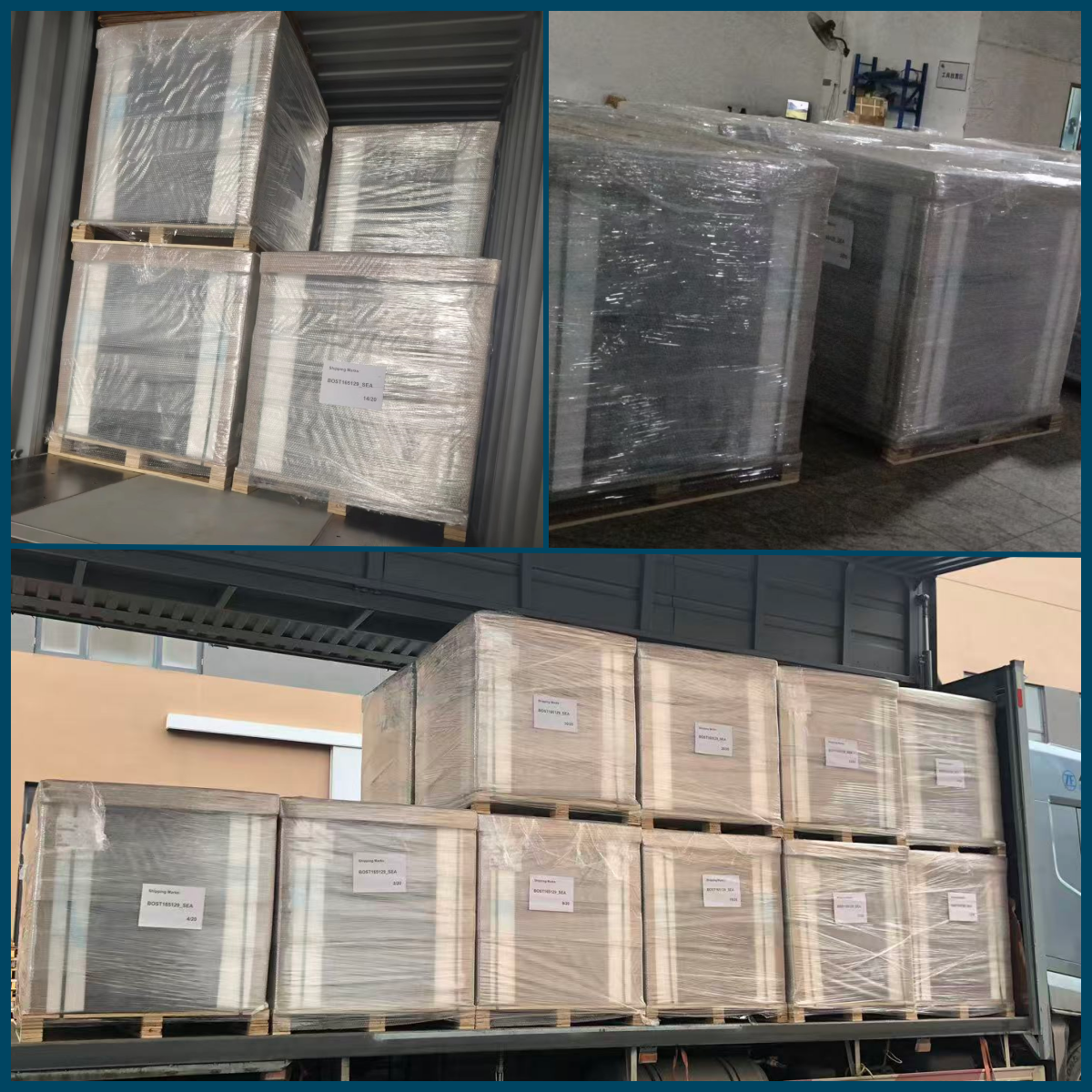
Pic.4 Packing & shipment photos
Considering Transportation Risk
International shipping involves risks that need attention separately from product selection and freight arrangements.
For this order, BeijingHengrui arranged cargo insurance.
The details of any cargo insurance depend on the applicable policy — its coverage, exclusions, insured value, and claim conditions. These should be verified before making any specific statement about the protection provided.
Including insurance in the order reflects a practical aspect of procurement coordination: arranging transportation means considering both how the goods will move and what risk-management measures are appropriate for the shipment.
What This Case Reveals About Industrial Fan Procurement
This case highlights four important considerations for data center operators and industrial buyers evaluating EC fan solutions.
First, the requested model is a starting point, not a verified selection.
In this case, the evaluation resulted in a change from an 800 mm to a 910 mm fan. Fan size should be assessed against the actual airflow and static pressure requirements rather than determined by the initial model specification alone.
Second, product configuration matters as much as the product itself.
A grille-type EC fan and a panel-mounted EC fan are different configurations. They should not be treated as interchangeable by default. The key is to verify whether the proposed configuration meets the project's application requirements and receives the customer's acceptance.
Third, procurement decisions should consider more than the initial product quotation.
For projects involving large quantities and international shipping, buyers need to evaluate the overall procurement cost, including product pricing, transportation, and related logistics arrangements. An alternative sourcing solution may offer a more practical balance between project requirements and budget.
Fourth, delivery planning is part of the procurement solution.
Product selection is only one stage of the process. Shipping arrangements, cargo insurance, and transportation coordination also need to be considered to support a smoother international delivery process.
At Beijinghengrui, our approach to industrial fan sourcing goes beyond product availability. We focus on verifying application requirements, evaluating suitable product options, providing technical documentation, and coordinating procurement and delivery arrangements to support informed purchasing decisions.
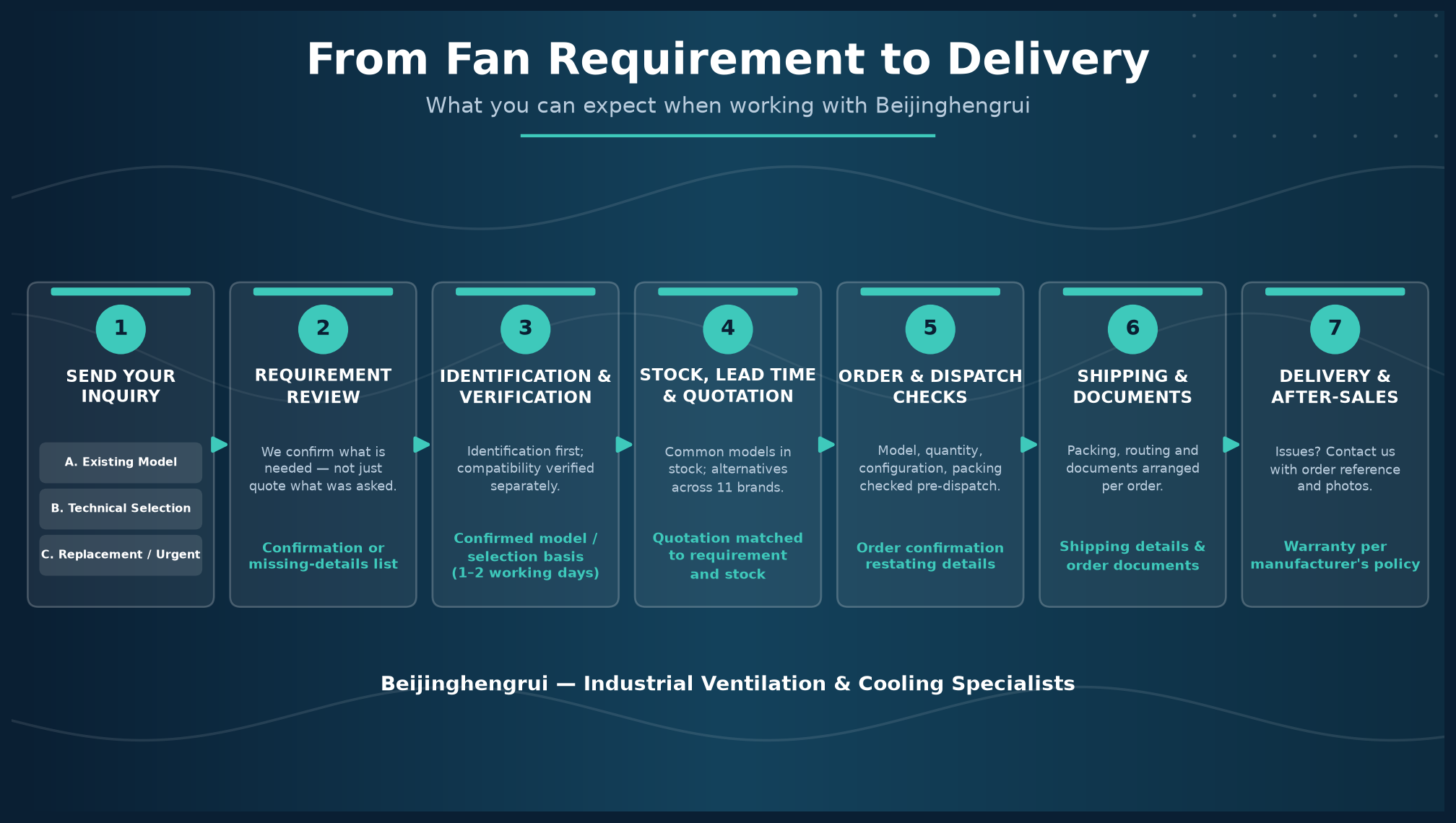
Pic.5 From fan requirement to delivery,what will BeijingHengrui do?
FAQ
Q1: Should I order exactly the fan size stated in my original plan?
Not necessarily. The required size should be verified against airflow and static pressure requirements. In this case, selection verification moved the order from an 800 mm inquiry to a 910 mm selection.
Q2: Can a panel-mounted EC fan replace a grille-type configuration?
They are different configurations and not automatically interchangeable. Suitability must be evaluated against the project's installation and operating requirements.
Q3:What information should I provide for an EC fan selection review?
Airflow and static pressure requirements, preferred configuration, electrical supply, target quantity, destination, and any project specification documents available.
Need support with EC fan selection or an international fan order?
Send BeijingHengrui your airflow and static pressure requirements, target quantity, and destination. Our team typically provides initial feedback within 1–2 working days.
 whatsapp


