
 English
 Français
 Deutsch
 Português
 Español
 русский
 한국어
 العربية
 Italiano
 Indonesia
 Schweiz
 Polski
 Nederlands
 ישראל - עברית
 Perzisch
 ไทย
 日本語
 ኢትዮ-አማርኛ
 Việt Nam
 Kiswahili
 Srpski
 Ελληνικά
 简体中文
Owl-Inspired Fan Blades: Why Serrations Alone Don't Guarantee Lower Noise
Beijinghengrui 3-Step Approach
01 — PROBLEM
Reducing fan noise without compromising airflow, pressure, or energy efficiency remains a challenge in cooling and ventilation applications.
02 — SOLUTION
Owl-inspired blade geometry offers a potential passive noise-control approach. Its effectiveness depends on how the blade interacts with the airflow.
03 — KEY RULE
A quieter blade is only a successful engineering solution if it also meets the application's aerodynamic and operating requirements.
Owls fly remarkably quietly. Could their feather structures inspire quieter fan blades?
Researchers have explored owl-inspired serrations to reduce aerodynamic noise—but the results depend on blade geometry and operating conditions.
The challenge is not just reducing noise. It’s doing so without compromising airflow, pressure, or efficiency.
What Makes an Owl's Wings So Interesting to Engineers?
An owl's wing has several distinctive features that have attracted attention in aeroacoustic research:
- Leading-edge serrations: Comb-like structures along the front edge of the wing.
- Trailing-edge fringes: Fine structures along the rear edge of the feathers.
- Velvety surface texture: A soft, fine surface structure on the feathers.
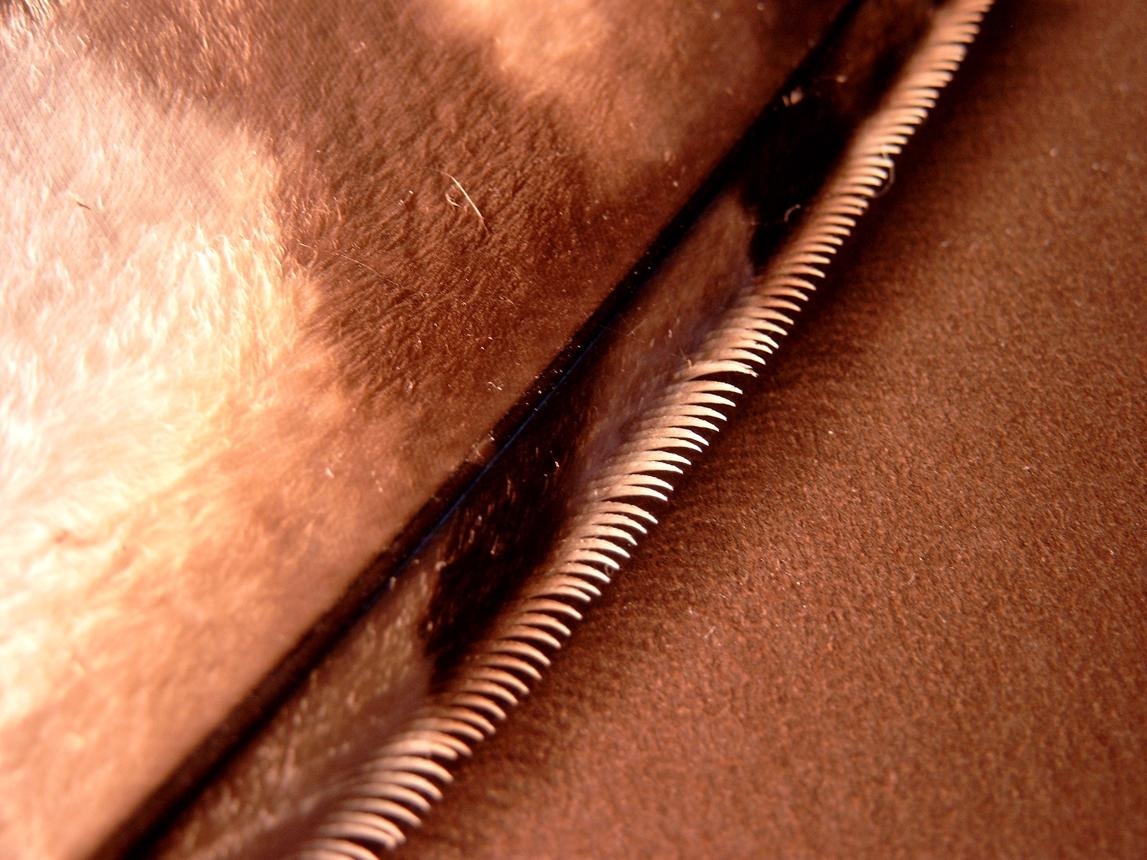
Pic.1 Detail image of owl wings
These features are not identical, and they should not be treated as one universal noise-reduction mechanism. Researchers have investigated their individual and combined effects on airflow, aerodynamic forces, and sound generation.
The engineering inspiration is straightforward: instead of treating noise only after it has been generated, could the geometry of a blade be designed to influence the flow structures that generate it?
This is the principle behind biomimetic aeroacoustic design.
However, a bird's wing and a rotating fan blade operate under different conditions. A successful design for one application cannot automatically be transferred to another.
How Can Serrated Edges Influence Fan Noise?
Fan noise has multiple sources. Depending on the fan and operating condition, these can include aerodynamic broadband noise, blade-passing tones, motor-related noise, and interactions between the fan and surrounding structures.
Serrated blade edges primarily attract attention as a way to influence aerodynamic noise.
A straight trailing edge interacts with turbulent airflow near the blade surface. The resulting pressure fluctuations can contribute to sound radiation.
A serrated trailing edge changes the geometry of this interaction. Depending on the serration shape, spacing, depth, and local flow conditions, it can modify turbulent structures and redistribute pressure fluctuations along the edge.
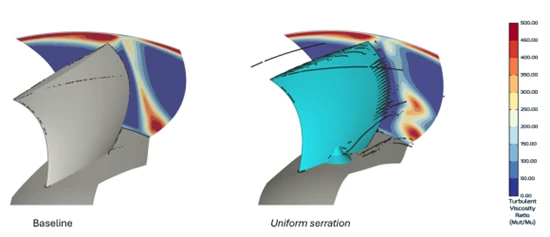
Pic.2 Turbulent viscosity ratio distribution downstream of the blade for the baseline and uniform serration design
This may reduce noise over certain frequency ranges.
But there is an important distinction: serrations do not simply cancel sound waves in every application. Their effects depend on the flow field and the acoustic characteristics of the blade. Some designs can also generate additional noise at other frequencies.
The goal is therefore not to add as many serrations as possible. It is to determine whether a particular geometry improves the overall aeroacoustic performance of the fan.
What Does the Research Actually Show?
Published studies illustrate why the details of the design matter.
Finding 1: Leading-edge and trailing-edge serrations can behave differently
A 2021 study published in Bioinspiration & Biomimetics investigated owl-inspired blade designs in a mixed-flow fan.
The researchers found that certain leading-edge serrations reduced noise while maintaining aerodynamic performance in their experimental configuration. By contrast, the trailing-edge serrations tested in that study did not achieve the expected result.
The study also reported improvements from changing the inclination angle of the leading-edge serrations, including a reduction of approximately 1.4 dB in specific noise level.
This is an important lesson: the location and geometry of a serration can matter as much as the biomimetic concept itself.
Finding 2: Optimized trailing-edge serrations can also reduce noise
A separate study published in Applied Acoustics in 2024 investigated owl-inspired propellers with different serrated trailing-edge configurations.
The researchers reported a maximum noise reduction of approximately 4.4 dBA for one particular configuration.
That result came from a specific propeller design and experimental setup. The study also examined aerodynamic performance and power consumption, highlighting the need to balance noise reduction against other performance requirements.
It would be incorrect to interpret this result as a guaranteed 4.4 dBA reduction for industrial fans, server fans, or every propeller design.
Finding 3: Biomimetic blade design is already used in commercial fans
Biomimetic blade geometry is not limited to academic research.
For example, a certain brand axial fan range uses a blade design inspired by owl wings. Its product literature describes the design as a means of achieving favorable airflow performance and reduced noise.
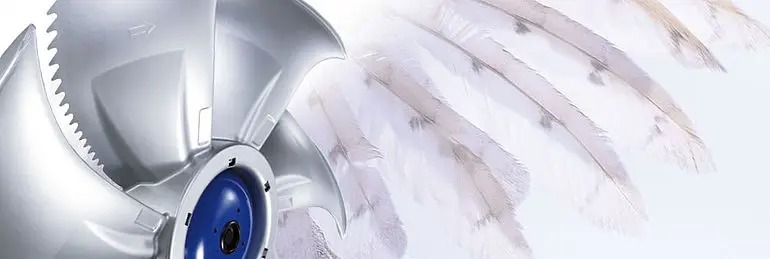
Pic.3 Fan blade design inspired by owl wings
This demonstrates that owl-inspired principles have found practical applications in commercial fan engineering. It does not mean that every fan using serrations will achieve the same results.
Taken together, these findings suggest that biomimetic blade design is a useful area of engineering research—but its effectiveness must be assessed for each design and application.
The Engineering Trade-Off: Noise, Airflow, Pressure, and Power
For fan manufacturers and equipment designers, reducing noise is only one part of the problem.
A fan must still deliver the required airflow and pressure under the intended operating conditions.
A blade modification may change the flow field, aerodynamic loading, and losses. Depending on the design, it may improve noise performance with little aerodynamic penalty, or it may reduce airflow, alter pressure capability, or increase power consumption.
This is why a lower noise reading alone does not establish that a fan is better.
When evaluating a new blade design, engineers should consider four key questions:
1. Does the fan deliver the required airflow and pressure?
Compare performance at the intended operating point, not just at free-air conditions.
2. Where does the noise reduction occur?
Review the frequency spectrum as well as the overall noise metric. A reduction in one frequency band may not translate into an equivalent reduction in overall noise.
3. What happens to power consumption?
Evaluate the fan's electrical input under comparable operating conditions. Noise improvements should be assessed alongside energy performance.
4. Does the improvement hold in the actual equipment?
The inlet, outlet, heat exchanger, grille, enclosure, and neighboring fans can all influence the installed system's aerodynamic and acoustic behavior.
The final design should be evaluated under representative operating conditions, not judged by blade appearance alone.
What Should Buyers and Equipment Manufacturers Take Away?
For manufacturers of cooling equipment, server systems, industrial cabinets, and ventilation products, owl-inspired blade design is worth understanding—but it should not be treated as a shortcut to quieter products.
If noise is a key requirement, the most useful approach is to evaluate the complete fan solution.
Start with the required airflow and pressure. Establish the acceptable noise level and the conditions under which it must be achieved. Then compare candidate fans using performance data obtained under comparable conditions.
If a particular blade design claims a noise advantage, ask for supporting test data and check whether the comparison was made at the same airflow, pressure, and operating point.
For replacement applications, the same principle applies. A fan that appears quieter under one test condition may not provide the required cooling performance in the installed equipment.
The objective is not simply to select a quieter fan. It is to select a fan that meets the required aerodynamic, acoustic, and operational requirements together.
Final Thoughts
The owl offers engineers a valuable source of inspiration, but biomimetic design is not a substitute for engineering validation.
Research on serrated blade geometries shows that noise reduction is possible, while also demonstrating that results depend on the geometry, the fan or rotor type, and the operating conditions.
For fan manufacturers and equipment designers, the practical lesson is clear:
Measure the noise. Verify the airflow and pressure. Evaluate the power consumption. Then validate the complete solution under real operating conditions.
At BeijingHengrui, we support industrial fan sourcing and application-oriented selection by helping customers review product information and technical requirements. When evaluating a fan for a specific application, understanding the required operating point is an essential starting point.
 whatsapp


