
 English
 Français
 Deutsch
 Português
 Español
 русский
 한국어
 العربية
 Italiano
 Indonesia
 Schweiz
 Polski
 Nederlands
 ישראל - עברית
 Perzisch
 ไทย
 日本語
 ኢትዮ-አማርኛ
 Việt Nam
 Kiswahili
 Srpski
 Ελληνικά
 简体中文
AC vs. DC vs. EC Fans: Key Differences in Power Supply, Efficiency, Control, and Applications
BeijingHengrui 3-Step Overview
01 — PROBLEM: Understand the differences in power supply, motor construction, and speed control.
02 — SOLUTION: Match the fan technology to the equipment's operating conditions and control requirements.
03 — KEY RULE: Select based on actual airflow, static pressure, power consumption, and operating conditions—not just the AC, DC, or EC label.
AC, DC, and EC fans are widely used in HVAC systems, industrial refrigeration, data centers, and industrial ventilation. Although they may look similar, they differ significantly in motor technology, power supply, speed control, and energy efficiency.
So, what is the difference between AC, DC, and EC fans? Which type is more energy-efficient, and how do you choose the right one?
In simple terms, AC fans use alternating-current motors, DC fans operate with direct-current power, and EC fans use electronically commutated motor technology, typically combining permanent-magnet motors with integrated electronic controls.
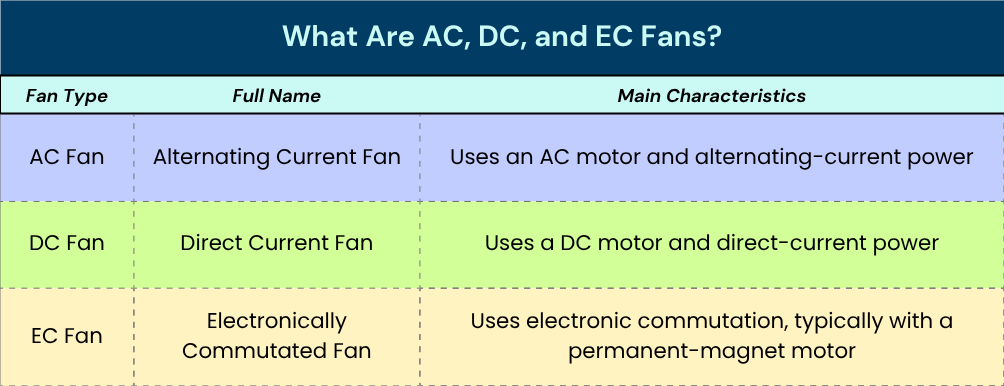
Figure1. What Are AC, DC, and EC Fans?
AC Fans typically use induction motors, such as shaded-pole or permanent split capacitor (PSC) motors. They operate directly from an AC power supply and are widely used in traditional ventilation and refrigeration equipment.
DC Fans use direct-current power and may feature brushed or brushless DC motors (BLDC). Brushless designs use electronic circuits instead of mechanical brushes for commutation. They are common in servers, communication equipment, and control cabinets.
EC Fans typically combine permanent-magnet brushless motors with integrated electronic drive circuits. Many AC-input EC fans internally rectify AC power into DC before electronically controlling the motor. This design enables efficient operation and flexible speed control.
An important distinction: DC describes the power supply, while EC describes the motor's electronic commutation technology. EC motors are closely related to brushless DC motor technology, but EC fans are not simply ordinary DC fans.
AC vs. DC vs. EC Fans: Key Differences
The following table summarizes their main technical differences.
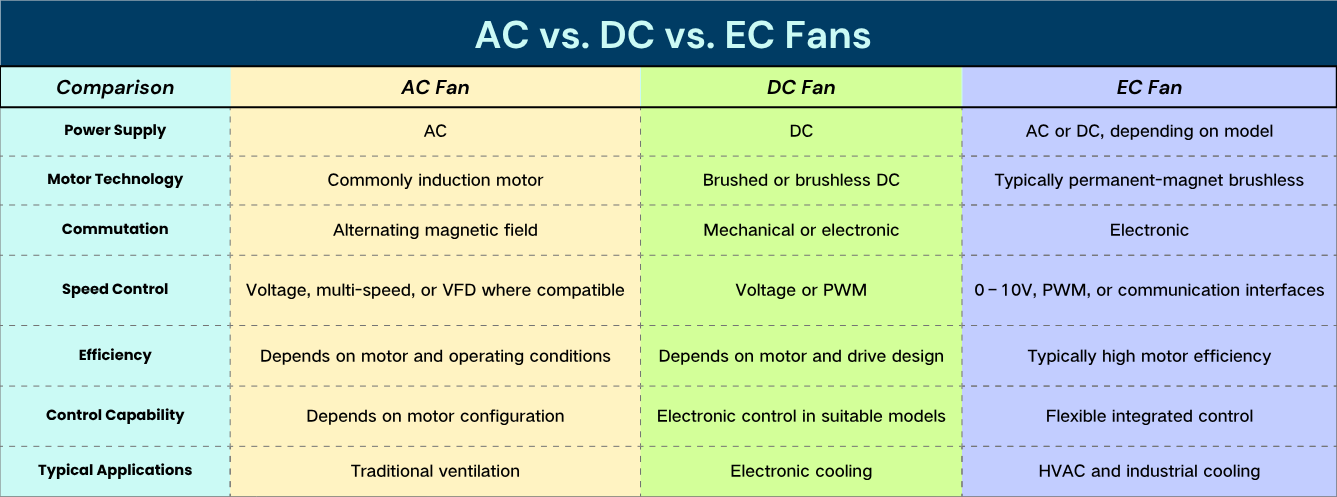
Figure2. Main technical differences between AC, DC, and EC
Actual specifications vary by manufacturer and model. Not every DC fan supports PWM control, and not every EC fan includes communication interfaces such as Modbus.
How Do AC, DC, and EC Fans Control Speed?
Speed control directly affects airflow, system performance, and energy consumption.
- AC Fans: Speed may be controlled through multiple winding configurations, voltage regulation, or variable frequency drives (VFDs), depending on motor compatibility.
- DC Fans: Speed can be adjusted through supply voltage or PWM control, depending on the internal drive design.
- EC Fans: Integrated electronics enable speed adjustment through interfaces such as 0–10V, PWM, or communication protocols, depending on the model.
For example, in an Air Handling Unit (AHU), an EC fan can adjust its speed according to duct pressure or airflow demand instead of continuously operating at maximum speed.
This flexibility makes EC fans particularly suitable for systems with changing cooling or ventilation loads.
Which Fan Is More Energy-Efficient?
EC fans generally offer high motor efficiency and advantages in variable-speed applications. However, it is not accurate to claim that every EC fan is more efficient than every AC or DC fan.
Actual energy consumption depends on:
- Motor and fan efficiency.
- Required airflow and static pressure.
- Operating speed and system resistance.
- Control strategy and operating hours.
Consider a simple example:
A fan with an input power of 1.5 kW operates 16 hours per day for 300 days annually.
Annual energy consumption:1.5 × 16 × 300 = 7,200 kWh
If a replacement fan meets the same system requirements at an actual input power of 1.0 kW:1.0 × 16 × 300 = 4,800 kWh
The difference is 2,400 kWh per year.
This is an illustrative calculation, not a guaranteed EC fan energy-saving rate. A meaningful comparison requires equivalent airflow, static pressure, and operating conditions.
Key Rule: Compare actual electrical input power while delivering the required system performance.
Typical Applications of AC, DC, and EC Fans
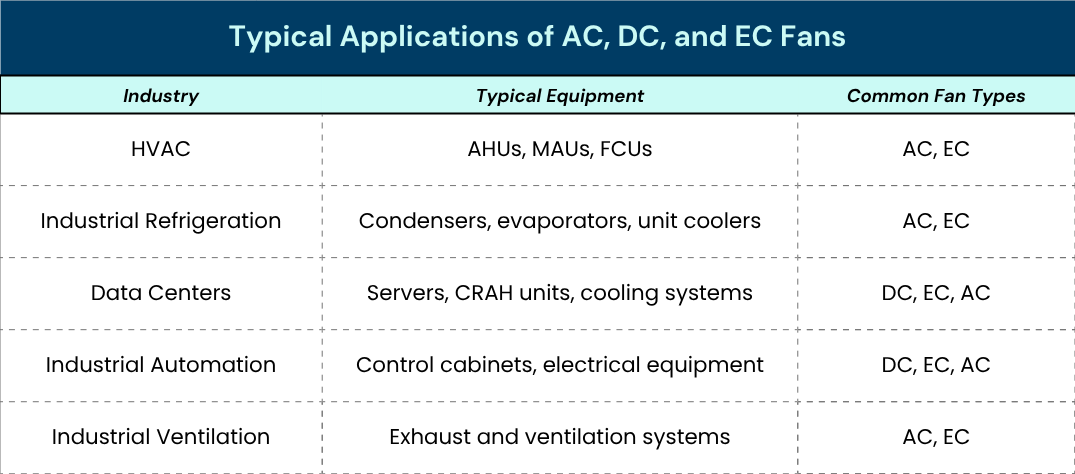
Figure3. Different application scenarios of AC, DC, and EC fans
AC fans remain practical for traditional ventilation and applications with relatively stable operating requirements.
DC fans are widely used in compact electronic cooling applications where low-voltage DC power is available.
EC fans are particularly suitable for AHUs, dry coolers, cooling towers, and data center cooling systems where variable-speed operation and energy efficiency are important.
How to Choose the Right Fan?
Before selecting or replacing a fan, evaluate these five factors:
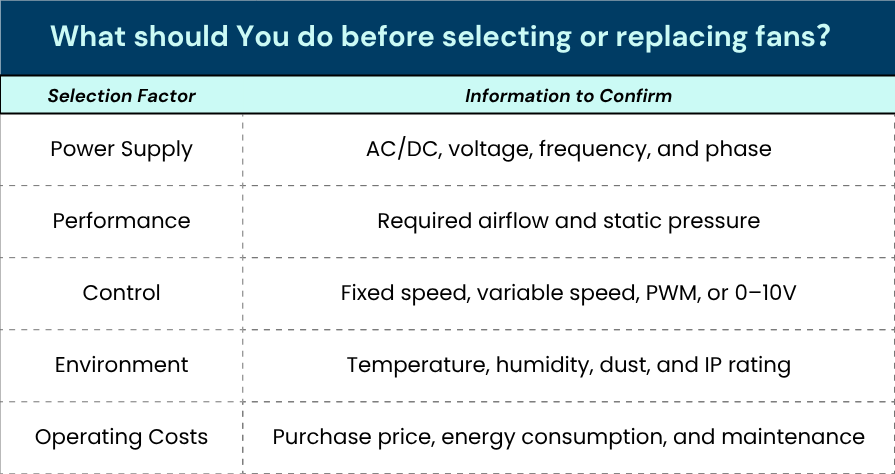
Figure4. What should You do before selecting or replacing fans?
For replacement projects, do not rely on physical dimensions or rated power alone. Check the original fan model, nameplate, operating point, wiring, and control compatibility.
A reliable fan replacement process should follow:
Measure → Analyze → Select → Verify
This helps reduce compatibility risks and ensures that the selected fan meets the actual equipment requirements.
Frequently Asked Questions
Q1: Can EC fans connect directly to AC power?
Many AC-input EC fans can connect directly to their specified AC supply because they include internal rectification and drive electronics. Always check the rated input specifications.
Q2: Are EC fans always more energy-efficient than AC fans?
Not necessarily. Actual efficiency depends on motor design, fan performance, operating conditions, and control strategy.
Q3: Can an AC fan be replaced directly with an EC fan?
Not without compatibility checks. Voltage, wiring, control signals, installation dimensions, airflow, and static pressure must all be evaluated.
Conclusion: Select the Right Fan for Your Application
AC, DC, and EC fans each have their own advantages:
AC: Mature technology for traditional ventilation and fixed-duty applications.
DC: Suitable for low-voltage and compact electronic cooling.
EC: High-efficiency motor technology with flexible speed control for HVAC and industrial cooling.
The best solution is not necessarily the most advanced technology. It is the fan that meets your actual operating requirements while delivering reliable performance and reasonable long-term costs.
Better Fan Selection Starts with Better Technical Matching.
Looking for AC, DC, or EC fans for HVAC, industrial refrigeration, data center cooling, or industrial ventilation?
BeijingHengrui can assist with fan model matching, free selection support, technical consultation, and replacement solution evaluation.
Share your equipment model, fan nameplate, power supply, required airflow, and static pressure to help us evaluate a suitable solution.
 whatsapp


