
 English
 Français
 Deutsch
 Português
 Español
 русский
  한국어
한국어 العربية
 Italiano
 Indonesia
 Schweiz
 Polski
 Nederlands
 ישראל - עברית
 Perzisch
 ไทย
ไทย 日本語
日本語 ኢትዮ-አማርኛ
 Việt Nam
 Kiswahili
 Srpski
 Ελληνικά
 简体中文
简体中文Beyond PUE: AI Is Reshaping Data Center Cooling—And Every Component in the Thermal Chain
For years, Power Usage Effectiveness (PUE) has been the industry's benchmark for measuring data center energy efficiency. Lower PUE has driven innovations in cooling technologies, airflow management, and infrastructure design.
But as AI workloads continue to push rack densities from 20–30 kW toward 100 kW and beyond, the conversation is rapidly evolving.
Today, the question is no longer simply "How do we lower PUE?"
It's becoming:
"How do we build cooling systems that remain efficient, scalable, and adaptable as computing power continues to grow?"
In other words, the future of data center cooling is no longer about choosing between air cooling and liquid cooling. It's about designing a smarter thermal management architecture.
Traditional enterprise data centers were designed around relatively stable heat loads.AI infrastructure is fundamentally different.
GPU clusters generate highly concentrated heat, rack densities continue to increase, and cooling systems must respond to rapidly changing workloads. As a result, thermal management has become a critical factor affecting not only operational efficiency but also computing performance and long-term scalability.
This is why leading operators are increasingly evaluating cooling solutions based on multiple factors—not just PUE, but also scalability, reliability, water usage, operational flexibility, and total cost of ownership.
There is a common misconception that liquid cooling will replace air cooling entirely.In reality, that's not what is happening.
Across North America, Europe, the Middle East, and Southeast Asia, the market is moving toward hybrid cooling architectures, where each technology is applied where it delivers the greatest value.
 |
|
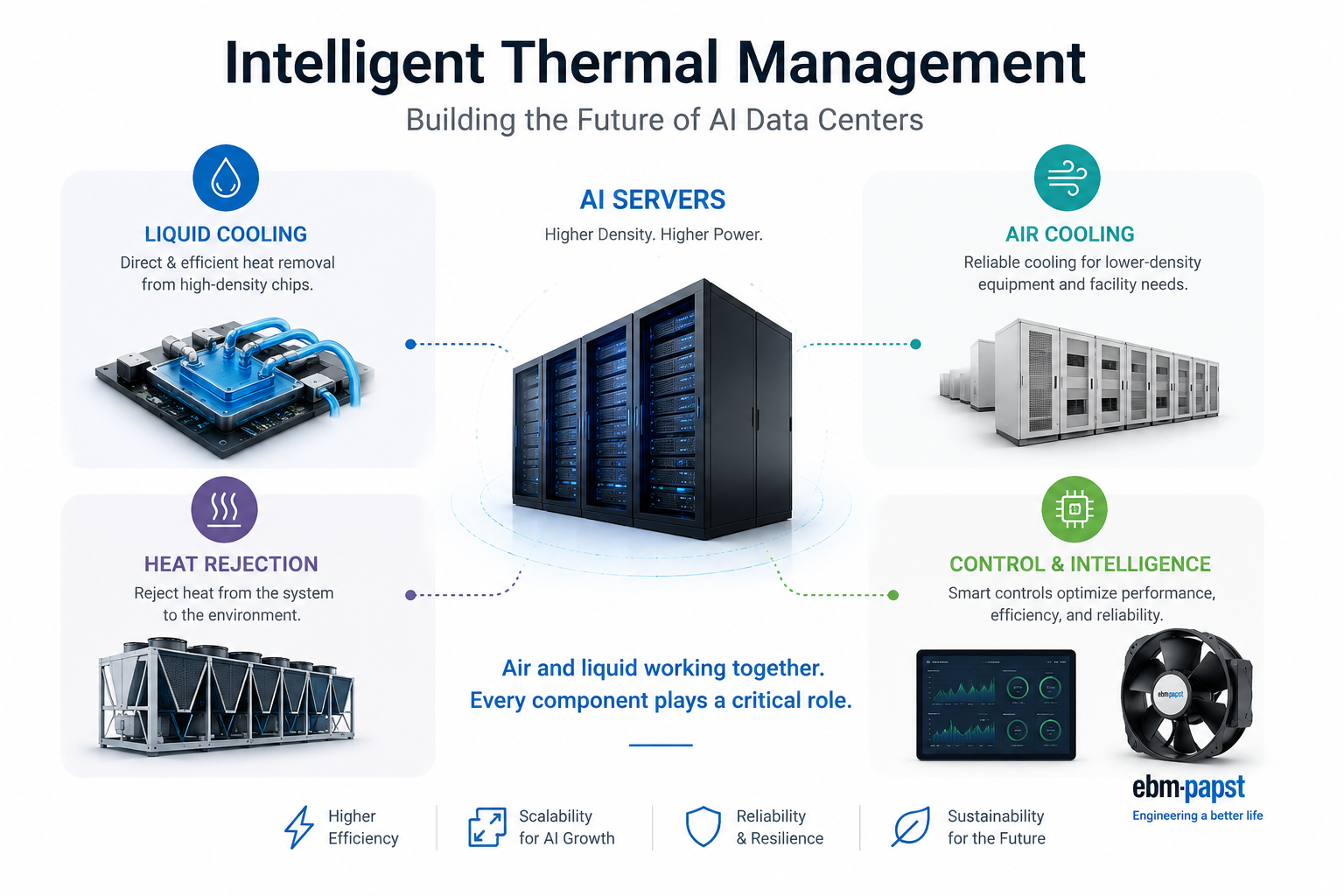
Pic.1 AI Data Center Thermal Management Ecosystem |
Direct-to-chip liquid cooling efficiently removes heat from high-density CPUs and GPUs, while air-based systems continue to cool lower-density equipment, power distribution rooms, electrical infrastructure, and many facility-level applications.
Rather than replacing one another, air and liquid cooling are becoming complementary technologies within the same thermal ecosystem.
Liquid cooling removes heat from the processors.But that heat still has to leave the building.This is where the broader thermal management system becomes increasingly important.
Dry coolers, cooling towers, air-cooled chillers, hybrid heat rejection systems, air handling units, and ventilation equipment all play essential roles in transferring heat to the ambient environment.
As AI clusters continue to expand, these systems are handling greater thermal loads than ever before—making overall system efficiency just as important as chip-level cooling efficiency.
This shift isn't making EC fans less important.
It's changing what engineers expect them to do.
In the past, fan selection focused primarily on airflow, static pressure, and peak efficiency.
Today, AI-ready cooling systems require much more:
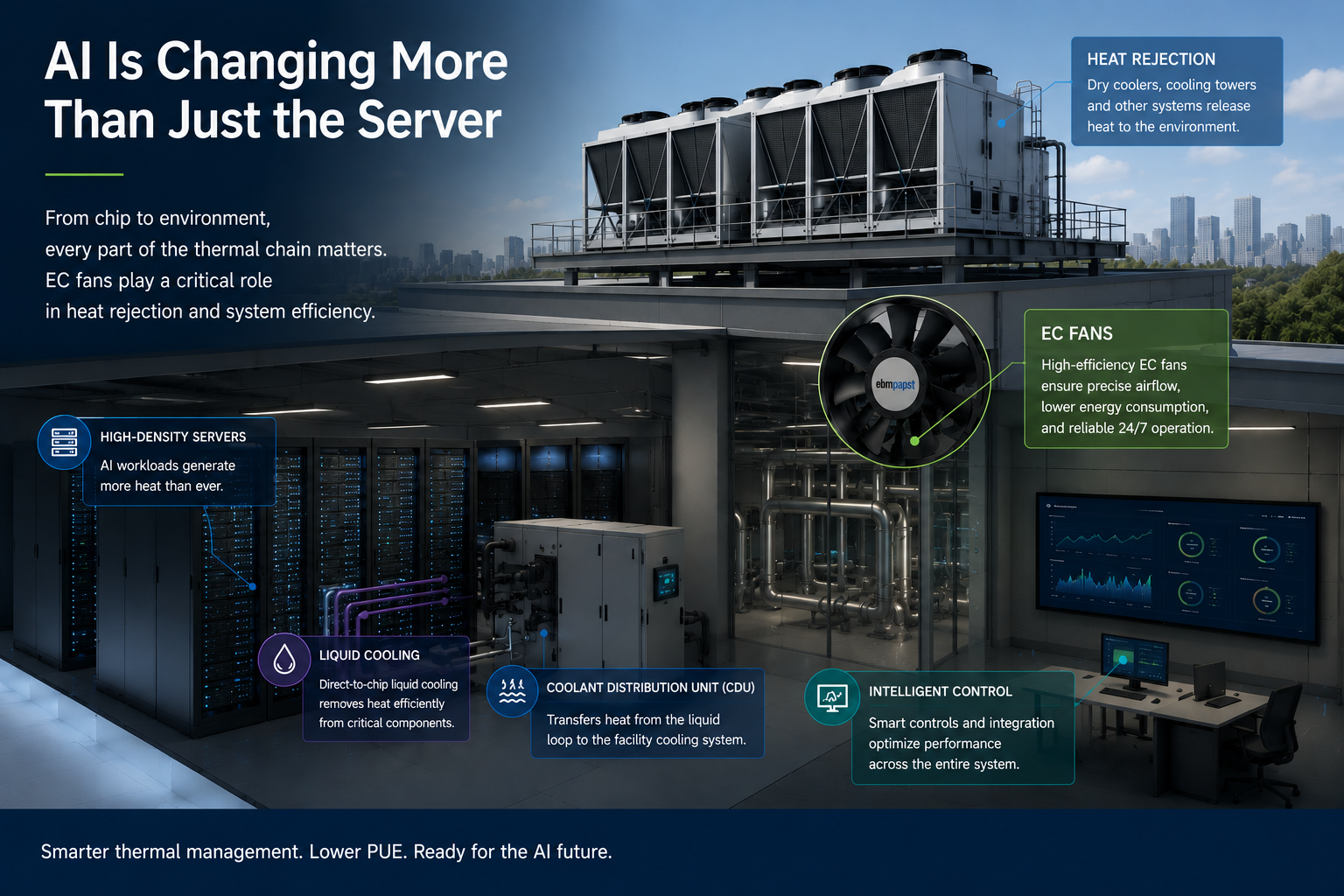
In other words, fans are no longer simply moving air—they have become intelligent components within an integrated thermal management system.
 |
|
Pic.2 Intelligent Airflow for AI Data Centers |
This evolution is one reason why advanced EC fan technologies continue to gain adoption across data center cooling applications, from dry coolers and air handling units to cooling towers and hybrid cooling systems. Manufacturers such as ebm-papst have played a significant role in driving this transition by combining high-efficiency motor technology with intelligent speed control and system integration capabilities.
PUE remains an important indicator of efficiency.But in the AI era, it is no longer the whole story.As AI infrastructure continues to evolve, selecting the right cooling architecture is only part of the equation. Choosing the right components is equally important.
At Beijing Hengrui, we work closely with OEMs, system integrators, and data center solution providers to deliver EC fan solutions for applications including dry coolers, air handling units, cooling towers, and hybrid cooling systems—helping customers improve efficiency, reliability, and long-term system performance.
If you're exploring next-generation cooling solutions, we'd be happy to exchange ideas.
 whatsapp


