
 English
 Français
 Deutsch
 Português
 Español
 русский
  한국어
한국어 العربية
 Italiano
 Indonesia
 Schweiz
 Polski
 Nederlands
 ישראל - עברית
 Perzisch
 ไทย
ไทย 日本語
日本語 ኢትዮ-አማርኛ
 Việt Nam
 Kiswahili
 Srpski
 Ελληνικά
 简体中文
简体中文Commercial HVAC Retrofit: Start with the Component That Runs All Day
When commercial buildings plan an HVAC retrofit, the discussion usually starts with the biggest equipment.
Should we upgrade the chiller?
Should we optimize the cooling tower?
Should we replace the pumps?
These systems certainly matter.
But one component is often overlooked—despite running almost every hour of every day. The fan system.
Whether it's an AHU or a Make-Up Air Unit (MAU), fans operate continuously to deliver conditioned air throughout the building. Over years of operation, even small efficiency improvements can translate into significant energy savings and lower maintenance costs.
That's why more building owners are beginning their retrofit strategy from the air side—not just the water side.
Why Fans Deserve More Attention
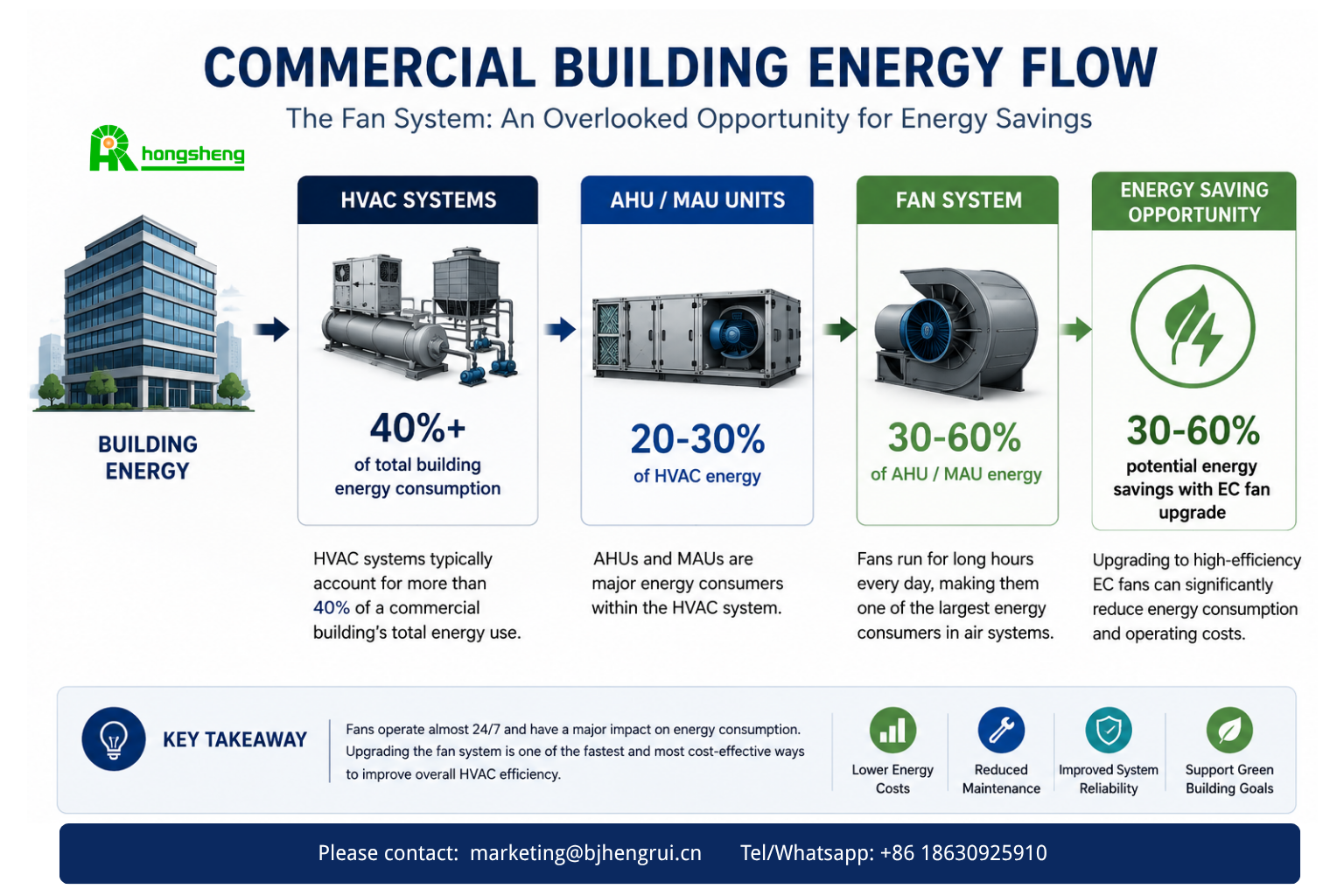
A typical commercial building spends over 40% of its total energy consumption on HVAC systems.
Within those systems, fans are among the few components that:
Because they run continuously, even small efficiency gains can have a meaningful impact on operating costs over the equipment's lifetime.
 |
|
Pic.1 Commercial building energy flow |
The Challenge with Traditional Fan Systems
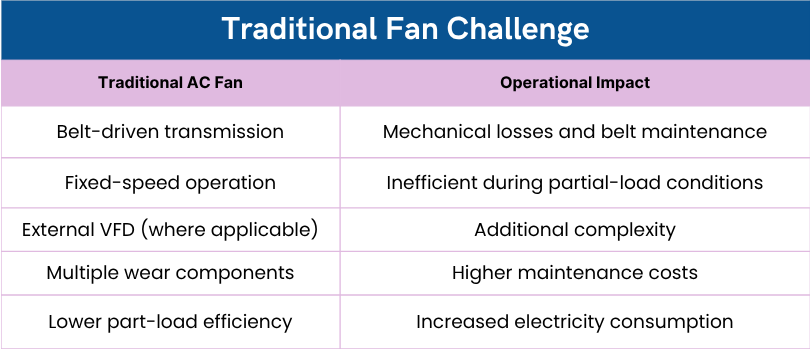
Many existing AHUs still use belt-driven AC centrifugal fans.
While reliable for years, they also introduce several challenges as buildings age.
 |
|
Pic.2 Traditional fan systems challenge |
For buildings operating 12–24 hours a day, these inefficiencies accumulate over thousands of operating hours every year.
Why More Buildings Are Switching to EC Fans
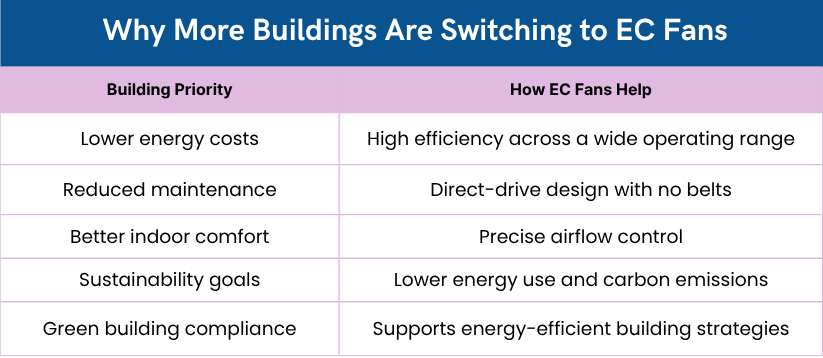
Modern EC fans address many of these limitations through an integrated motor and intelligent speed control.
Instead of focusing only on maximum efficiency, they help buildings improve overall operational performance.
 |
|
Pic.3 Why choose EC fans |
For many retrofit projects, the fan upgrade becomes one of the most practical ways to improve HVAC performance without replacing the entire system.
It's Not Just About Energy Savings
The value of a fan retrofit isn't measured only in kilowatt-hours.
It also means:
In other words, upgrading the fan system improves not only efficiency—but the overall quality of HVAC operation.
Final Thoughts
When planning a commercial HVAC retrofit, it's natural to focus on the largest pieces of equipment.
But sometimes, the greatest opportunity lies in the component that runs the longest.
The fan system may not be the biggest investment in an AHU, but it can be one of the smartest places to begin improving long-term building performance.
Discussion
When evaluating a commercial HVAC retrofit, which component do you prioritize first?
Have fan upgrades become part of your energy-efficiency strategy?
At Beijing Hengrui, we work with building owners, facility managers, HVAC contractors, AHU manufacturers, and MEP consultants to evaluate fan retrofit opportunities, optimize airflow performance, and improve long-term HVAC efficiency. If you're planning a commercial retrofit project, we'd be happy to exchange practical engineering insights.
 whatsapp


