
 English
 Français
 Deutsch
 Português
 Español
 русский
  한국어
한국어 العربية
 Italiano
 Indonesia
 Schweiz
 Polski
 Nederlands
 ישראל - עברית
 Perzisch
 ไทย
ไทย 日本語
日本語 ኢትዮ-አማርኛ
 Việt Nam
 Kiswahili
 Srpski
 Ελληνικά
 简体中文
简体中文Case Study: Cutting AHU Fan Energy Consumption by Up to 39% in a Battery Materials Facility
For manufacturers of battery materials, HVAC is not simply a building service.
In a continuous-production environment, stable airflow, reliable air handling, and controlled operating conditions are closely connected to production continuity. At the same time, MAU and AHU systems can operate for thousands of hours each year, making fan energy consumption a significant part of long-term operating costs.
This creates a difficult balance:
How can an energy-intensive production facility reduce HVAC operating costs without compromising airflow performance or introducing unnecessary downtime?
That was the challenge behind a recent AHU fan retrofit project for a new-energy materials manufacturer in China.
The Challenge: Reliable Airflow at High Operating Hours
The facility's existing AHU cabinets were equipped with conventional belt-driven fans and three-phase induction motors.
The systems were still delivering the required airflow, but the configuration had several long-term disadvantages:
For a production facility operating for extended periods, these inefficiencies can accumulate into substantial annual OPEX.
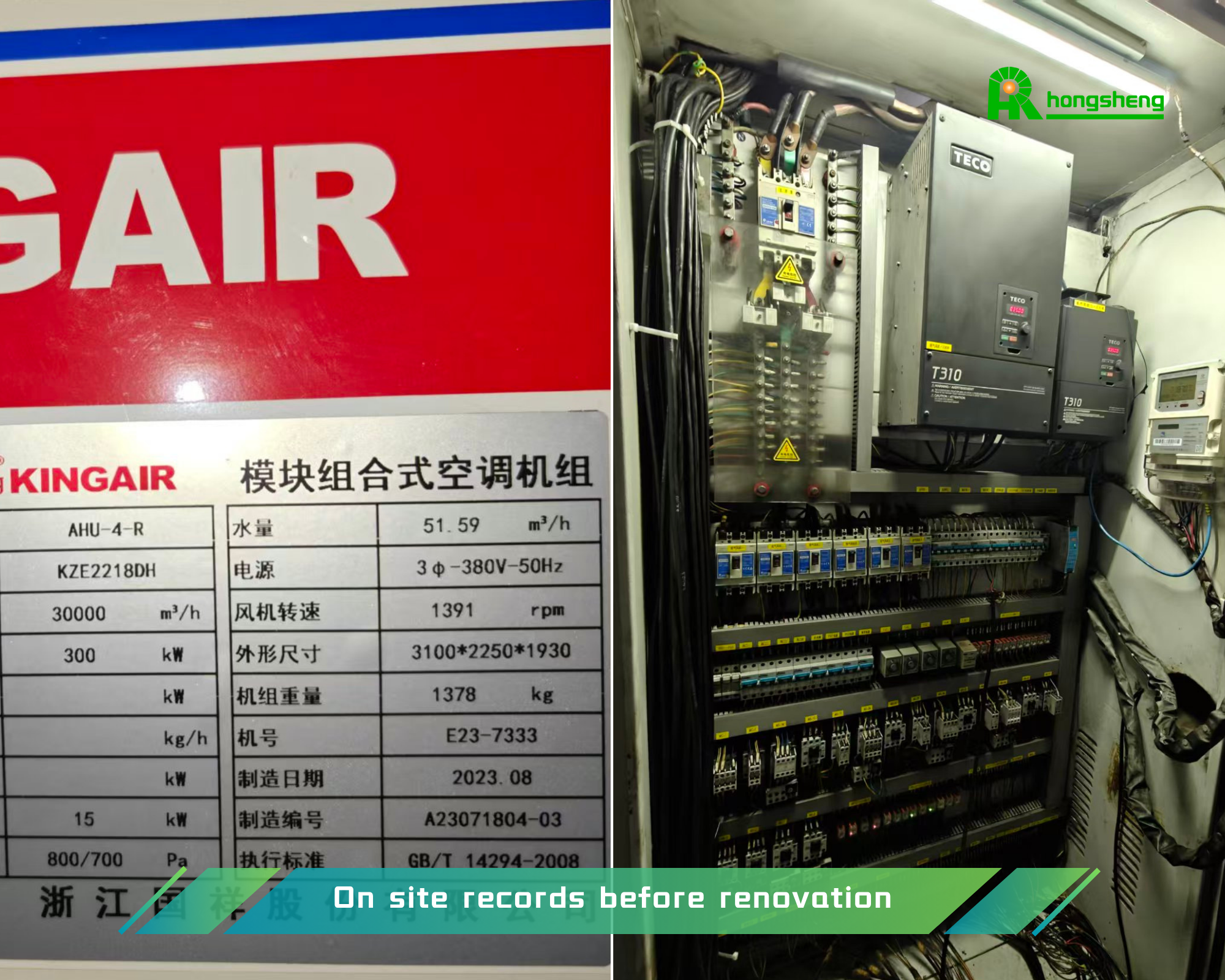
Pic.1 On site records before renovation
The Retrofit: From Belt-Driven Fans to EC Fan Walls
Instead of replacing the entire AHU cabinet, the engineering approach focused on upgrading the fan system itself.
The proposed solution replaced the conventional belt-driven arrangement with modular EC fan walls, while maintaining the required airflow and pressure operating points.Three representative operating conditions were evaluated:
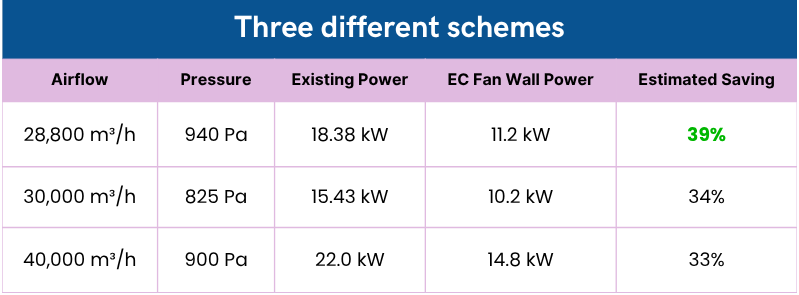
Pic.2 Three representative operating conditions
The first configuration alone showed a potential reduction of 7.18 kW in fan power, equivalent to approximately 39% energy savings at the evaluated operating point.
Based on the project's estimated electricity rate and 8,400 annual operating hours, the 11-unit configuration was projected to save approximately RMB 497,000 in annual electricity costs.
More Than an Energy-Saving Upgrade
For a continuously operating manufacturing facility, the value of the retrofit extends beyond electricity consumption.
Removing belt transmission eliminates belt wear and associated maintenance. The modular EC fan wall also allows individual fan modules to be serviced independently, reducing the need for a complete system shutdown when a single fan requires attention.
This can improve maintainability, operational flexibility, and long-term system reliability.
Engineering Lesson
For energy-intensive manufacturing facilities, AHU modernization is not simply about replacing an aging fan. The real opportunity is to match the fan system to the actual airflow, static pressure, operating hours, space constraints, and maintenance requirements of the facility.
At Beijing Hengrui, we help industrial customers evaluate EC fan selection, AHU/MAU retrofits, operating points, and Fan Wall solutions to improve energy efficiency and long-term reliability.
Planning an AHU retrofit or looking to reduce HVAC energy consumption? Let’s compare the numbers and explore what your existing system could achieve.
The best retrofit isn't the one that changes the most equipment—it’s the one that delivers the greatest reduction in energy, maintenance, and operational risk.
 whatsapp


