
 English
 Français
 Deutsch
 Português
 Español
 русский
  한국어
한국어 العربية
 Italiano
 Indonesia
 Schweiz
 Polski
 Nederlands
 ישראל - עברית
 Perzisch
 ไทย
ไทย 日本語
日本語 ኢትዮ-አማርኛ
 Việt Nam
 Kiswahili
 Srpski
 Ελληνικά
 简体中文
简体中文Beyond Water Anxiety: Why the Success of Waterless Cooling Comes Down to Your Fan Selection
As global data centers race toward higher densities and immense computing power, "waterless cooling" has become the core strategy for operators striving to eliminate water consumption and achieve true sustainability. However, a common blind spot persists in planning dry-cooling systems: assuming that once evaporative water use is eliminated, the cooling challenge is magically solved.
The reality is that heat does not simply disappear. When direct-to-chip liquid cooling extracts massive thermal loads from servers, those loads must ultimately be rejected into the atmosphere via outdoor dry coolers or air-cooled condensers. In this "waterless" final mile, the fan emerges as the critical hero that dictates the success or failure of the entire cooling system.
Why Waterless Cooling Shifts the Burden to the Air Side
Driven by tightening water regulations and strict PUE targets, dry coolers and closed-loop systems are surging in popularity. Yet physical laws remain unyielding: without the latent heat of vaporization, the system must rely entirely on sensible heat transfer using ambient air.
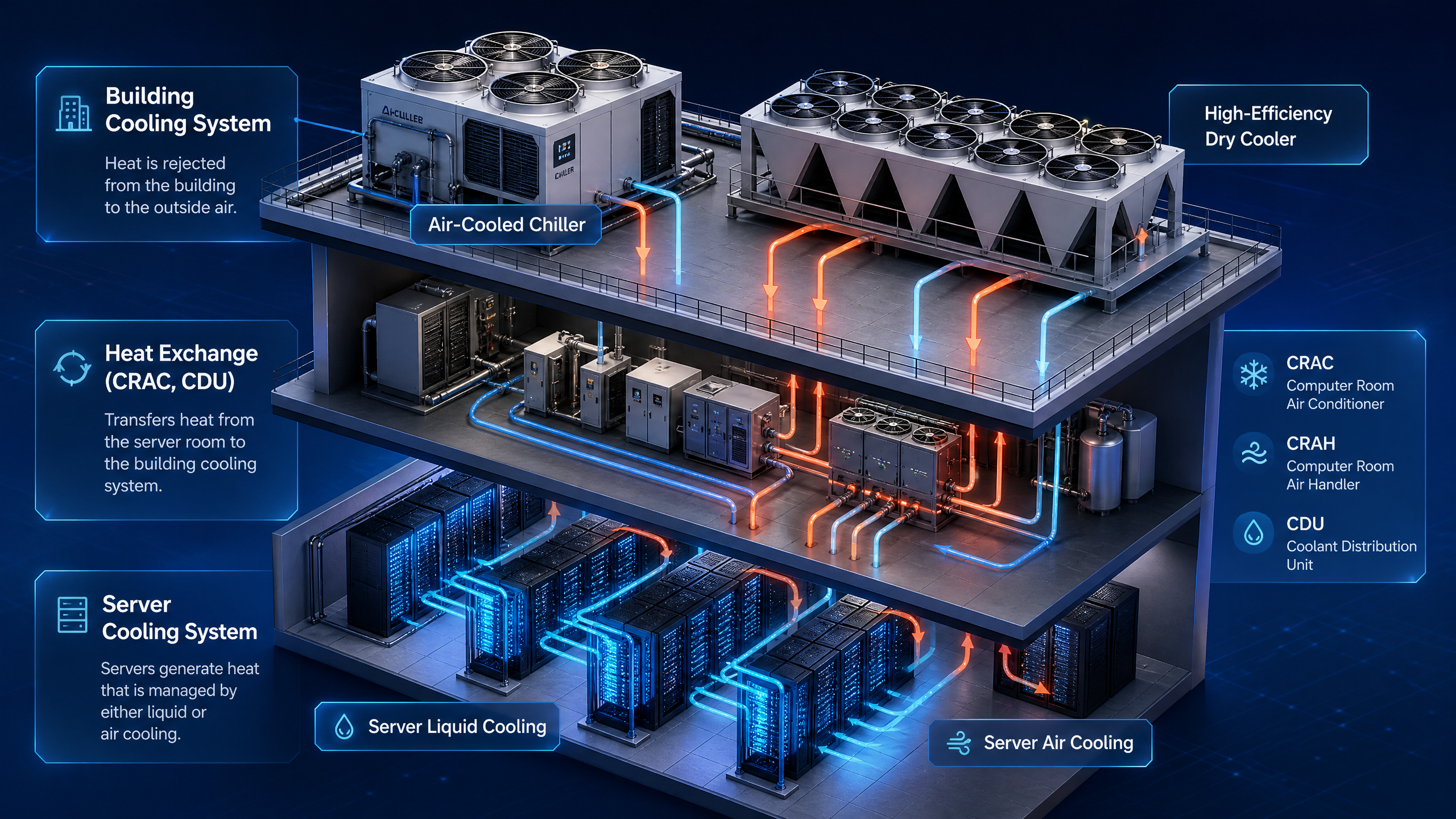
Pic.1 data center cooling
This means that to maintain design approach temperatures during scorching summer heatwaves or peak ambient conditions, systems must rely on powerful airflow to forcefully reject heat. Here, the fan is no longer a peripheral component—it is the beating heart of the installation. Coil resistance, protective louvers, safety screens, and compact layouts demand exceptional static pressure and aerodynamic performance. Choosing the wrong fan leads directly to soaring PUE and compromised heat rejection—or worse, server throttling during peak heat events.
The Breakthrough: High-Efficiency Fan Arrays and Smart Control
In modern data center design, simple "high airflow" is no longer enough to satisfy sophisticated operational demands. Operators and MEP engineers are actively seeking advanced solutions:
Full-Load and Part-Load Efficiency: Data center workloads are dynamic. Integrating intelligent fans with wide high-efficiency operating zones (such as advanced EC fan technology) automatically modulates speed under part-load conditions, unlocking massive energy savings.
Redundancy and Reliability: Fan arrays comprised of multiple units not only provide N+1 redundancy but also enable seamless cluster control and condition-based maintenance, eliminating catastrophic single points of failure.
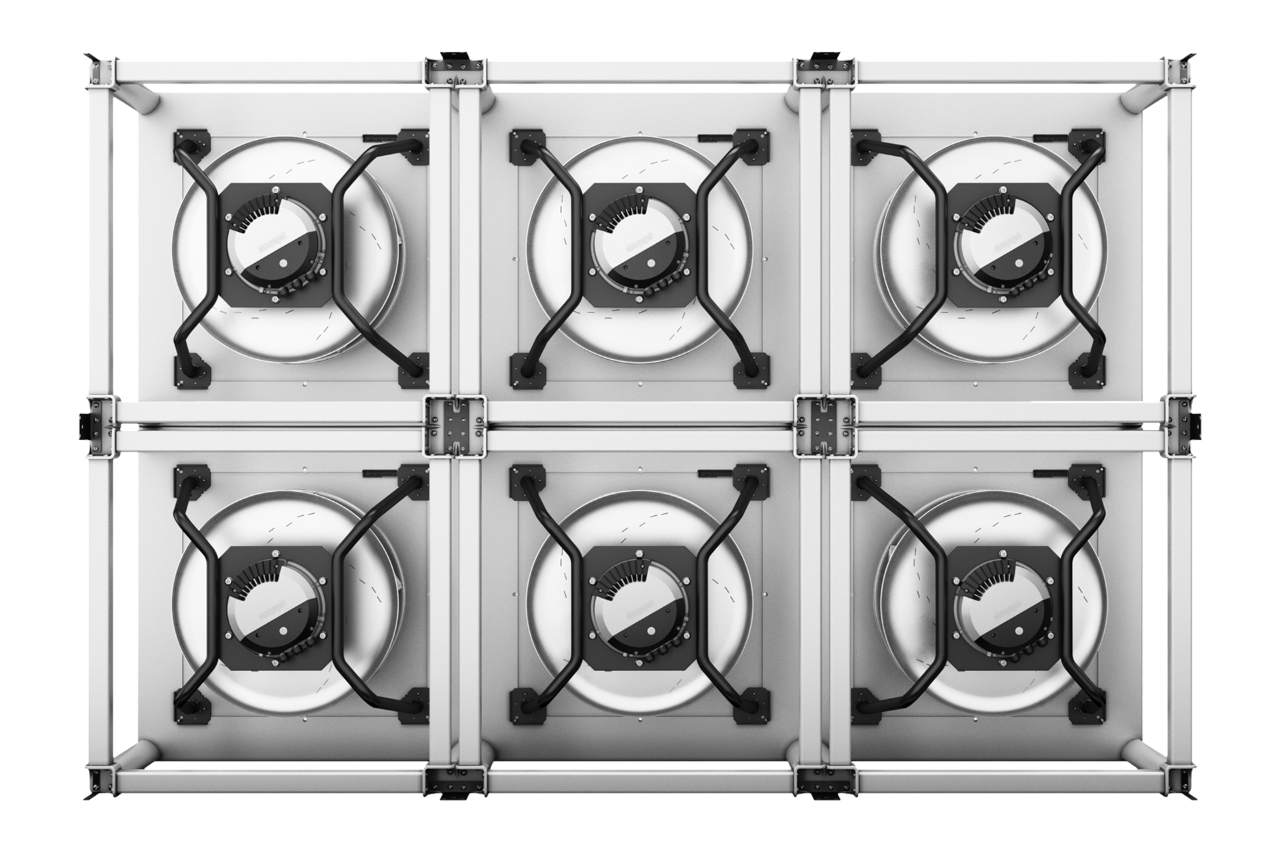
Pic.2 EC fan grid by using ebm-papst fans
The Art of Acoustic Compliance: As data centers push closer to urban boundaries and high-density campuses, boundary noise restrictions have become unprecedentedly stringent. Optimal aerodynamic design paired with low-RPM, large-diameter blades ensures stringent acoustic limits are met without sacrificing thermal performance.
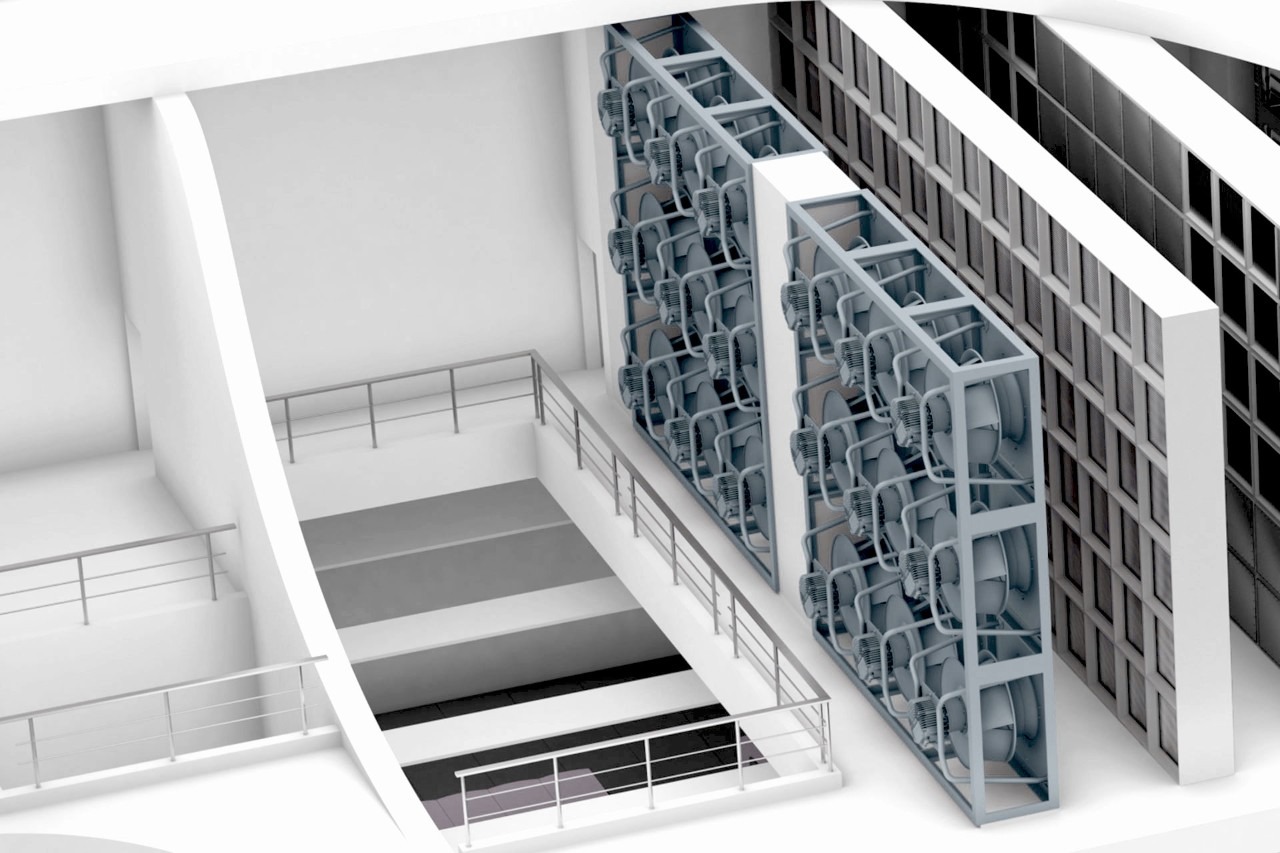
Pic.3 EC fan grid in data center
Expert Fan Selection: Turning Engineering Challenges into Your Competitive Advantage
Because waterless cooling transforms heat-rejection pressures into a rigorous test of fan performance, fan selection can never be reduced to mere diameter, voltage, and maximum airflow.
A truly world-class dry heat-rejection system requires more than simply selecting high-efficiency fans. It requires a holistic approach that brings together peak duty cycles, design ambient temperatures, coil pressure drops, precise acoustic targets, and advanced control interfaces such as 0–10V and Modbus within one optimized framework. This is where specialized engineering expertise can make a real difference.
Whether you are planning next-generation dry-cooling infrastructure or optimizing energy efficiency and acoustic performance in an existing system, Beijing Hengrui always open to exchanging ideas and exploring better engineering solutions. If dry cooling is part of your next project, let’s start the conversation.
 whatsapp


