
 English
 Français
 Deutsch
 Português
 Español
 русский
  한국어
한국어 العربية
 Italiano
 Indonesia
 Schweiz
 Polski
 Nederlands
 ישראל - עברית
 Perzisch
 ไทย
ไทย 日本語
日本語 ኢትዮ-አማርኛ
 Việt Nam
 Kiswahili
 Srpski
 Ελληνικά
 简体中文
简体中文How an EC Centrifugal Fan Reduced Inflatable Dock Shelter Energy Consumption by 35%
Beijinghengrui 3-Step Approach
01 — PROBLEM
02 — SOLUTION
03 — KEY RULE

In an inflatable dock shelter, the fan has to fill the air cushions quickly and maintain sufficient pressure throughout loading and unloading. But once the cushions are fully inflated, continuously running the fan at full output creates unnecessary energy consumption.
An industrial application case shows how an EC centrifugal fan with airflow feedback and speed control reduced application energy consumption by 35%.
The goal was not simply to move more air. It was to deliver the right amount of air, maintain stable pressure, and avoid wasting energy when full fan output was no longer needed.
The Challenge: Fast Inflation Without Continuous Full Output
Inflatable dock shelters are used to close the gap between a truck and a warehouse during loading and unloading. They help limit drafts, rain, wind, insects, and dust entering the building, which is particularly important in temperature-sensitive or hygienic environments.
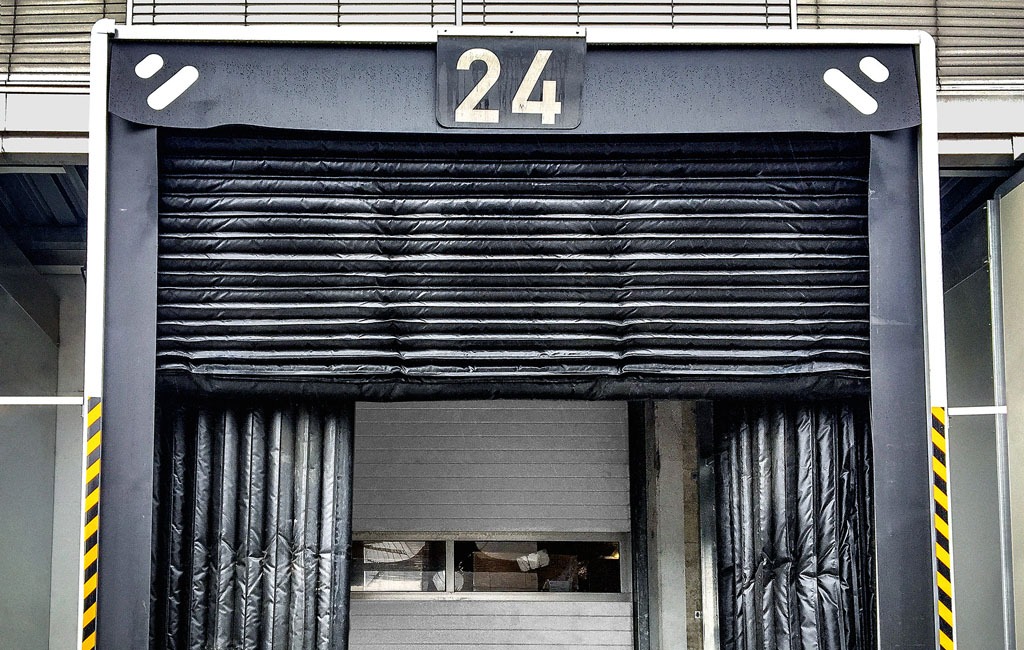
Pic.1 Inflatable dock shelter(Source|VanWijk Nederland bv)
The operating requirement is straightforward but demanding:
The challenge is therefore not simply achieving high airflow.The fan must respond to different stages of the operating cycle.
The Solution: EC Fan + Airflow Feedback
The application replaced the existing fan with an ebm-papst RadiCal EC centrifugal fan in scroll housing, model G3G190-RD45-11.
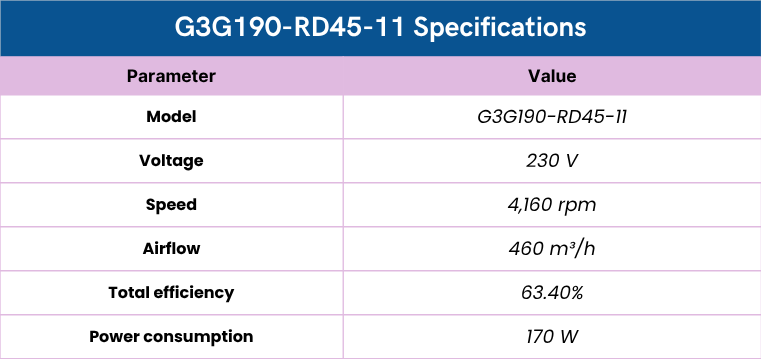
Pic.2 Specification parameters of G3G190-RD45-11
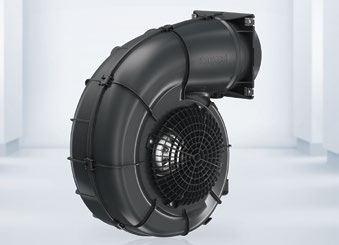
Pic.3 G3G190-RD45-11 (Source|ebm-papst)
The key improvement was not only the EC motor itself.
A vane anemometer measures the actual airflow inside the fan's scroll housing and sends the data to the integrated control electronics. The EC motor then adjusts its speed according to the required setpoint, regulating the air volume.
Once the cushions are completely filled, the fan shuts down. During loading, the system maintains cushion pressure while operating at low power.
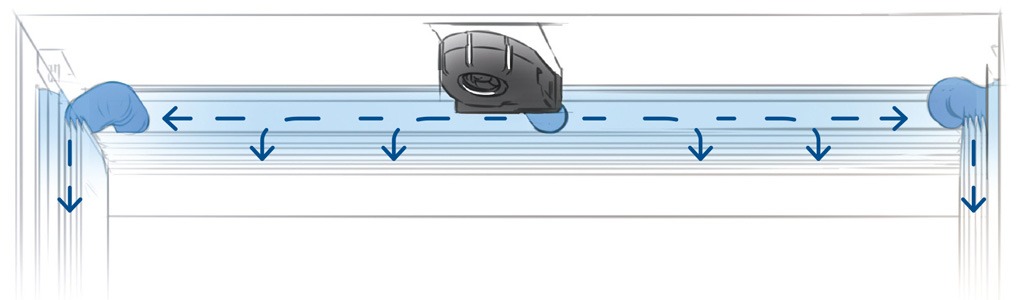
Pic.4 Schematic diagram of fan installation position (Source|ebm-papst)
This changes the control principle from:Run the fan → deliver continuous output
to:Measure the requirement → adjust fan speed → maintain the required condition
The Result: 35% Lower Application Energy Consumption
According to the original application case, the EC centrifugal fan solution achieved a 35% reduction in the application's energy consumption.
The important point is that the energy saving came from the combination of:
EC motor + airflow feedback + variable-speed control + application-based operation.
This is why simply comparing fan motor power or nominal efficiency may not be enough when evaluating an industrial fan.
The Engineering Takeaway
For applications with changing operating conditions, fan selection should consider more than maximum airflow.
Key factors include:
The right question is not:“How powerful is the fan?”
It is:“How accurately can the fan deliver what the application actually needs?”
This principle can also be relevant to other applications where airflow demand changes during operation, including ventilation equipment, refrigeration systems, air-handling equipment, and industrial cooling.
How Beijinghengrui Can Support Fan Selection
For an existing equipment replacement or new application, Hengrui can support the process from fan identification and operating-point analysis to model selection and supply coordination.
If you are evaluating an EC fan replacement, send us:
Beijinghengrui can help evaluate the application requirements, identify a suitable fan configuration, and check product availability and delivery requirements before order confirmation.
The right fan is not simply the one that moves the most air. It is the one that delivers the required airflow, pressure, control, and energy performance for the actual application.
Need to evaluate an EC fan replacement or energy-saving upgrade? Contact Hengrui for fan selection and technical support.
 whatsapp


