
 English
 Français
 Deutsch
 Português
 Español
 русский
  한국어
한국어 العربية
 Italiano
 Indonesia
 Schweiz
 Polski
 Nederlands
 ישראל - עברית
 Perzisch
 ไทย
ไทย 日本語
日本語 ኢትዮ-አማርኛ
 Việt Nam
 Kiswahili
 Srpski
 Ελληνικά
 简体中文
简体中文Case Study: Identifying Energy-Saving Potential in an Electronics Manufacturing Ventilation System
Beijinghengrui 3-Step Approach
01 — PROBLEM | Continuous Ventilation Can Mean Continuous Energy Consumption
The facility had existing ventilation fans operating at approximately 49 Hz. Based on the initial site data, two ventilation systems were consuming a combined 54.12 kW under the measured operating conditions.
Because these fans operate for long periods, even a moderate reduction in operating power could translate into meaningful annual energy savings.
02 — SOLUTION | Measure the Real Operating Point Before Retrofitting
Instead of selecting replacement fans directly from the original nameplate data, Beijinghengrui first assessed the actual operating conditions, including airflow, pressure, current, voltage, frequency, fan power, and operating hours.
The proposed EC fan configuration was then matched to the measured system requirements.
03 — KEY RULE | Retrofit Based on Actual Operating Conditions
Do not select a replacement fan based only on its nameplate airflow or motor power.
The actual operating point—airflow + pressure + system resistance + operating conditions—should be the starting point for an energy-efficiency retrofit.

In electronics manufacturing, ventilation is not optional. It is part of maintaining a stable production environment.
Many production ventilation systems operate for thousands of hours every year. Even when the system is running reliably, the fans can become a significant and often overlooked source of energy consumption.
The key question is not simply:“Can we replace the existing fan?”
It is:“What airflow and pressure does the system actually require today, and how much power is being used to deliver it?”
This was the starting point of a recent fan assessment project at an electronics manufacturing facility in China.
What Did the Site Survey Find?
The initial survey covered two ventilation systems.
The first system was originally rated at 74,000 m³/h and 1,350 Pa, with a 55 kW motor. However, field measurements showed an actual airflow of approximately 48,600 m³/h and an actual pressure of approximately 1,250 Pa.
Its measured electrical power was approximately 45.81 kW.
The second system had a rated airflow of 15,000 m³/h at 1,300 Pa. The measured operating condition was approximately 9,200 m³/h at 1,300 Pa, with an actual power consumption of approximately 8.30 kW.
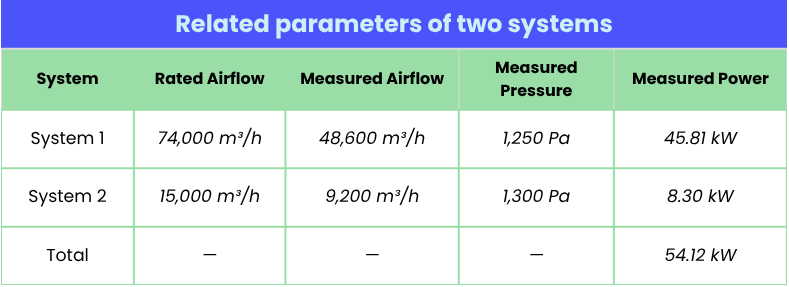
Pic.1 Related parameters of two systems
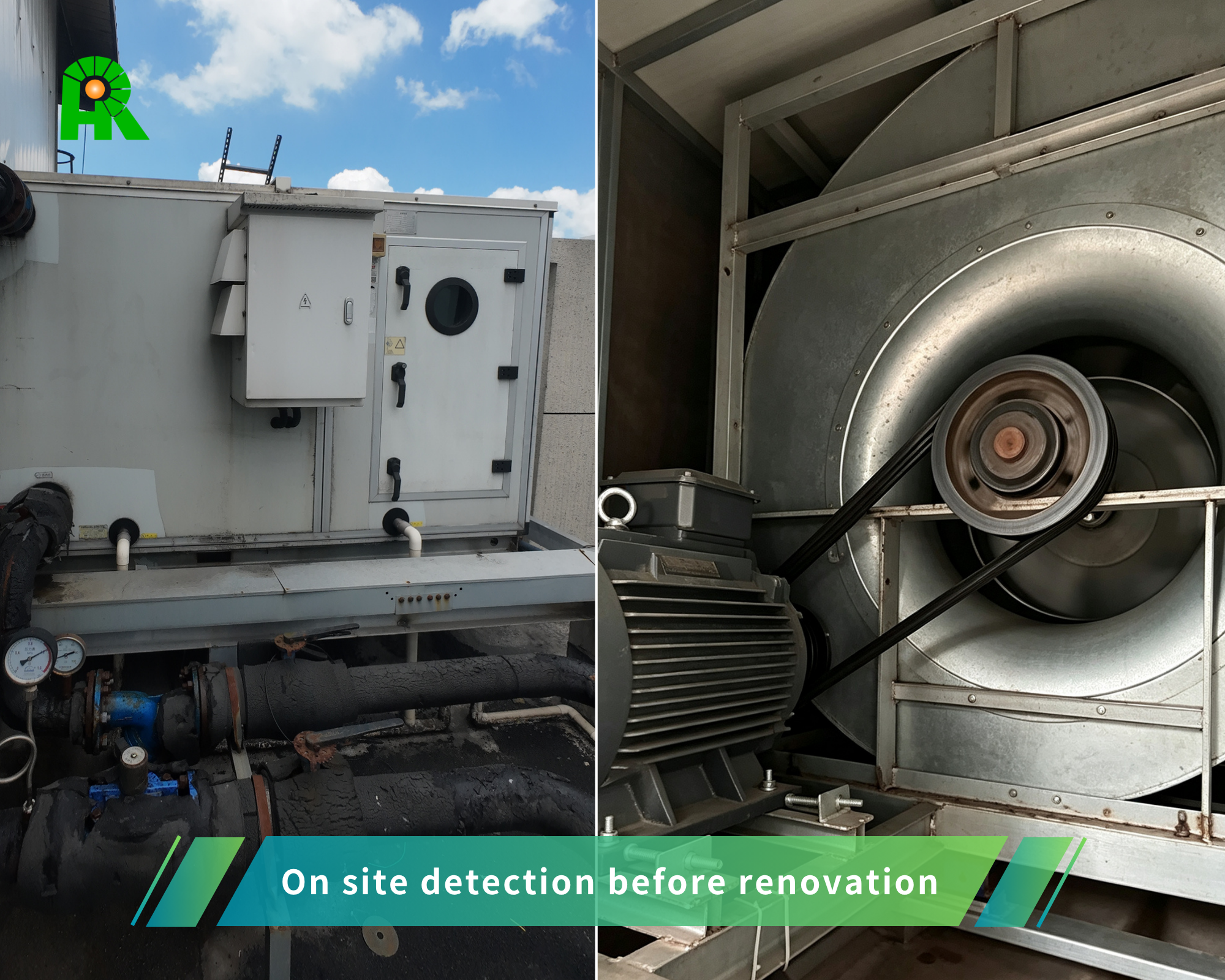
Pic.2 On site detection before renovation
The measurements highlighted an important engineering point:
The actual operating condition of a ventilation system may differ significantly from the original equipment nameplate data.
That difference creates an opportunity to reconsider fan sizing and operating efficiency.
Preliminary EC Fan Selection
Based on the measured operating conditions, Beijinghengrui carried out a preliminary EC fan selection.
For the first system, the proposed configuration was:
For the second system:
The objective was not simply to install a lower-power motor.
The objective was to match the fan configuration to the actual airflow and pressure requirements of the existing system.
What Is the Preliminary Energy-Saving Potential?
Based on the current measurements and preliminary fan selection, the two systems show an estimated reduction in operating power from 54.12 kW to 33.1 kW.
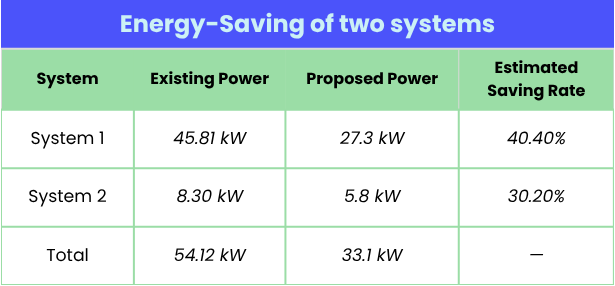
Pic.3 Energy-Saving of two systems
Based on the operating hours provided for the two systems, the preliminary calculation indicates potential annual electricity savings of approximately 66,686 kWh, equivalent to approximately RMB 67,431 per year at an electricity rate of RMB 0.60/kWh.
These figures represent preliminary estimates based on the site survey and proposed fan selection—not measured savings after a completed retrofit.
Final performance would need to be verified after detailed engineering confirmation, installation, commissioning, and actual operating measurements.
Why On-Site Measurement Matters
This case demonstrates why industrial fan retrofits should start with measurement rather than model replacement.
A nameplate tells you what the original fan was designed for.
A site survey tells you what the system is actually doing.
For an existing ventilation system, the assessment should consider:
Only after these factors are understood can a replacement fan be properly evaluated.
From Fan Replacement to System Optimization
For electronics manufacturers, ventilation reliability remains the first priority. Energy efficiency comes from optimizing the system without compromising its required airflow and pressure.
That means the retrofit process should follow a clear sequence:
Measure → Analyze → Select → Verify
The purpose of an EC fan retrofit is not simply to replace an old motor with a new one.
It is to determine whether the existing system can deliver the required ventilation performance with less unnecessary energy consumption.
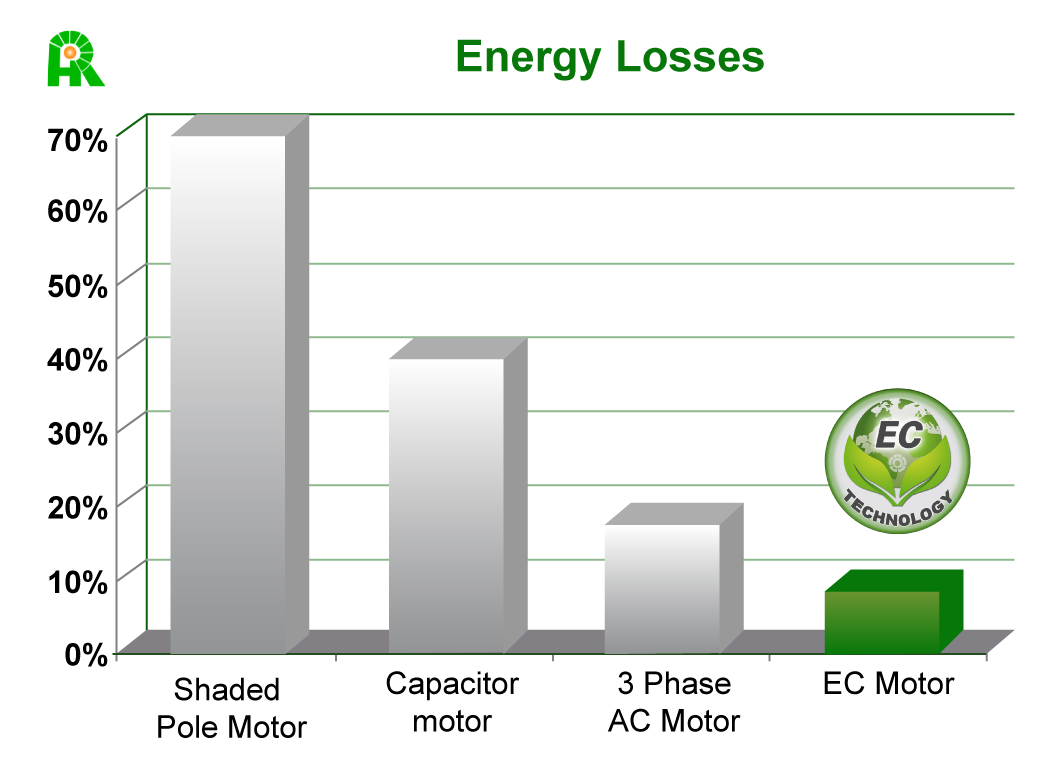
Pic.4 EC fans have lower energy consumption
The Project Is Now at the Assessment Stage
This project is currently in the preliminary assessment and fan-selection stage.
The next step is to further verify the proposed configuration against the actual installation conditions, system resistance, control requirements, and final operating points before implementation.
For electronics manufacturing facilities with continuously operating ventilation systems, this approach provides a practical way to identify potential efficiency improvements before committing to a full retrofit.
Looking at a similar ventilation system?
At Beijinghengrui, we support electronics manufacturers, industrial HVAC contractors, facility engineers, and system integrators with on-site fan assessment, operating-point analysis, EC fan selection, and retrofit planning.
If you have an existing ventilation system that consumes significant power, you can start by sharing the airflow, pressure, power, operating hours, and existing fan information.
We can help evaluate whether the system has a realistic opportunity for further optimization.
Measure first. Select based on the real operating point. Then retrofit with confidence.
 whatsapp


