
 English
 Français
 Deutsch
 Português
 Español
 русский
  한국어
한국어 العربية
 Italiano
 Indonesia
 Schweiz
 Polski
 Nederlands
 ישראל - עברית
 Perzisch
 ไทย
ไทย 日本語
日本語 ኢትዮ-አማርኛ
 Việt Nam
 Kiswahili
 Srpski
 Ελληνικά
 简体中文
简体中文Why Is Your Cold Room Still Too Warm? The Hidden Role of the Evaporator Fan
Beijinghengrui 3-Step Approach
01 — PROBLEM
02 — SOLUTION
03 — KEY RULE
The evaporator has enough cooling capacity. The compressor is running. But the cold room still does not reach the required temperature.
Could the problem be the evaporator fan?
In refrigeration systems, the evaporator fan is sometimes treated as a secondary component. The evaporator handles heat exchange, while the fan is expected to move air through the coil.
In reality, they work as part of the same heat-transfer system.
If the fan cannot deliver the required airflow at the actual system pressure, cooling air may not be distributed effectively—even when the evaporator and compressor have sufficient capacity.
Cooling Capacity Does Not Guarantee Effective Airflow
A refrigeration system can have sufficient nominal cooling capacity and still experience airflow-related problems.
Typical symptoms include:
This is why evaporator capacity and evaporator airflow should not be evaluated separately.

Pic.1 Airflow systems must be consistently monitored for issues to keep them running smoothly(Source|control.com)
The fan must overcome the resistance created by the evaporator coil and surrounding airflow path while delivering the airflow required by the application.
The key engineering question is therefore not simply:
“How much airflow can this fan provide?”
It is:“How much airflow does the system actually need at its operating pressure?”
What Should Be Considered When Selecting an Evaporator Fan?
Fan selection should start with actual operating conditions rather than fan diameter or motor power.
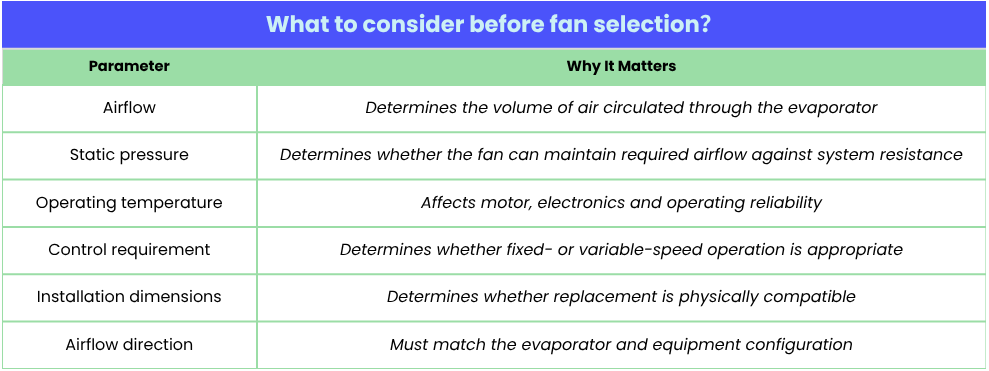
Pic.2 Things engineer should consider before fan selection
These parameters become especially important when replacing an existing or discontinued evaporator fan.
Don't Replace an Evaporator Fan by Size Alone
When an evaporator fan fails, replacing it with the same-size fan may seem like the simplest solution. But physical dimensions are only the starting point.
Check the existing model, voltage/frequency, power, dimensions and control method, then confirm the application, required airflow, system pressure and operating temperature.
This is especially important for discontinued models, cross-brand replacements and older refrigeration equipment. A fan that is too small may not provide enough airflow, while an unnecessarily large fan can increase energy consumption and noise.
The right replacement is the fan that delivers the required airflow at the required pressure under the actual operating conditions.
Where EC Fans Can Add Value
Refrigeration loads are not always constant. In applications with variable cooling demand, EC fans can provide variable-speed control instead of continuously operating at full speed.
This can help when the system requires variable airflow, lower fan speed during partial-load conditions, improved temperature control or lower fan energy consumption.
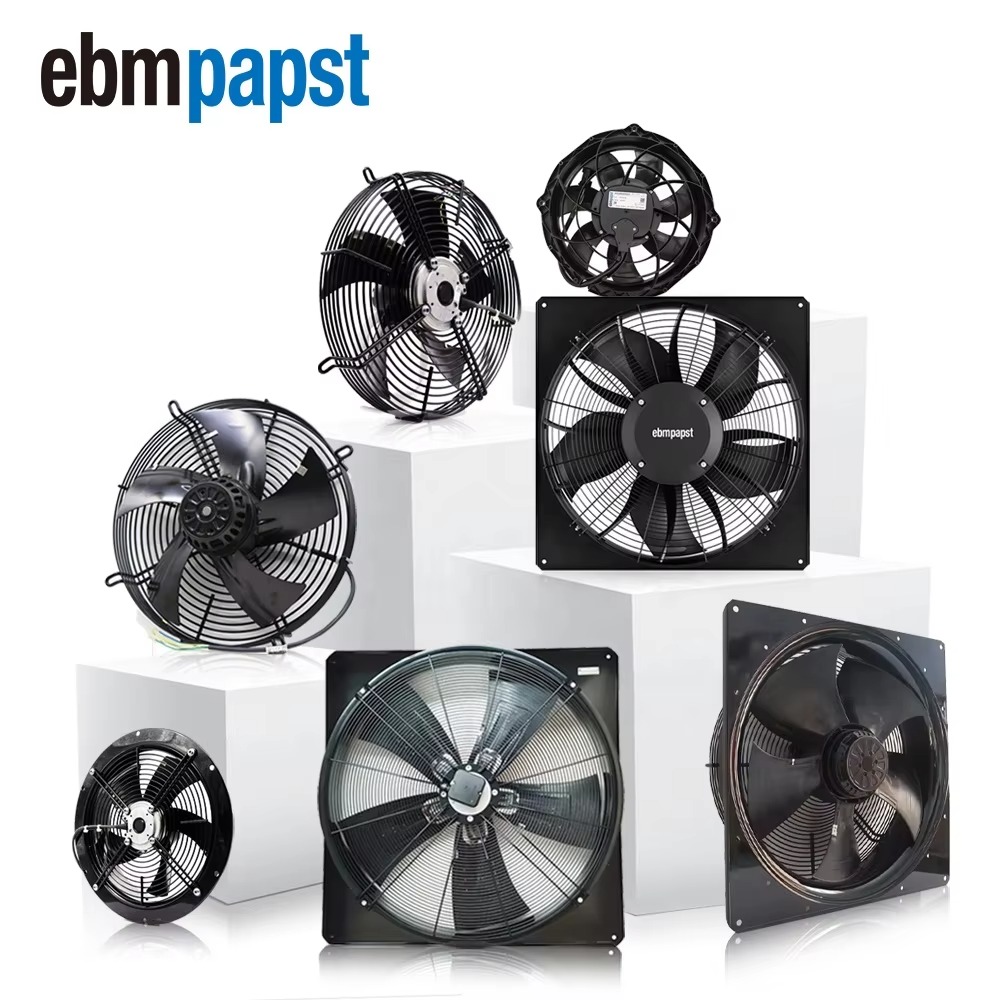
Pic.3 Beijinghengrui can provide multiple fans suitable for evaporators
Beijinghengrui has seen similar energy-saving potential in real fan retrofit projects. In one electronics manufacturing ventilation system, on-site measurements showed 54.12 kW of existing fan power. After evaluating the actual operating points, the proposed EC fan solution reduced the calculated power requirement to 33.1 kW, representing a preliminary estimated reduction of about 38.8%.
The key point is not simply choosing an EC fan. The saving potential came from measuring the actual operating condition and matching the EC fan to the required airflow and pressure.
The same principle applies to refrigeration:
EC technology can provide the control flexibility, but correct operating-point selection determines whether that technology creates real value.
From Fan Replacement to Engineering Selection
For refrigeration equipment manufacturers, cold-storage operators, HVAC contractors and service teams, evaporator fan replacement often starts with:“What can replace this fan?”
The more useful question is:“What fan should replace it for the way this system operates today?”
That distinction matters when the original model is discontinued, operating conditions have changed, or there is an opportunity to improve energy efficiency and control.
At Beijinghengrui, we support customers with evaporator fan model identification, replacement evaluation, cross-reference and engineering fan selection.
If you are replacing an existing evaporator fan, share the fan nameplate, dimensions, voltage/frequency, operating temperature and application information. These details provide a practical starting point for evaluating the replacement against the actual system requirements.
Need to identify a replacement evaporator fan or evaluate a refrigeration fan selection? Share your existing fan model or nameplate information with Beijinghengrui for a technical assessment.
 whatsapp


