
 English
 Français
 Deutsch
 Português
 Español
 русский
  한국어
한국어 العربية
 Italiano
 Indonesia
 Schweiz
 Polski
 Nederlands
 ישראל - עברית
 Perzisch
 ไทย
ไทย 日本語
日本語 ኢትዮ-አማርኛ
 Việt Nam
 Kiswahili
 Srpski
 Ελληνικά
 简体中文
简体中文Case Study: How EC Fans Support High-Performance Deep-Freezing in Pork Processing
Beijinghengrui 3-Step Approach
01 — PROBLEM
Deep-freezing tunnels require high airflow under demanding low-temperature conditions.
02 — SOLUTION
Use efficient fan technology matched to the actual refrigeration system requirements.
03 — KEY RULE
In industrial refrigeration, fan selection affects both airflow performance and overall cooling efficiency.
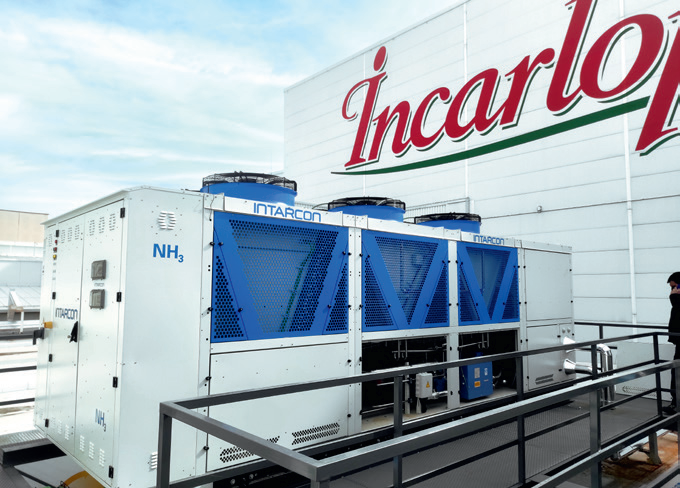
A food processing factory in Spain expanded its facilities with two new deep-freezing tunnels to meet growing international demand for pork.
The project was handled by refrigeration specialist INTARCON. The new tunnels were designed to process an additional 50,000 kg of pork per day.
The pork was transported through the tunnel on pallets arranged over a length of 12 meters. For rapid freezing, air at approximately -30°C was blown through the pallets at a velocity of around 5 m/s.
This created a demanding operating environment for the ventilation and refrigeration system.
The Engineering Challenge
The freezing tunnel required a large and continuous airflow while operating at very low temperatures.
Three high-pressure centrifugal fans supplied approximately 50,000 m³/h of air with more than 500 Pa available pressure. The fans also needed to operate continuously under low-temperature conditions.
At the same time, fan power cannot be considered separately from refrigeration performance.
The case notes that fan motor power inside freezer tunnels can represent around 25% of the evaporator's cooling capacity. Lower EC motor power consumption can significantly reduce this additional refrigeration load.
This makes fan efficiency an important part of the overall refrigeration equation.
The Fan Solution
The system used a combination of ebm-papst EC centrifugal and axial fans:
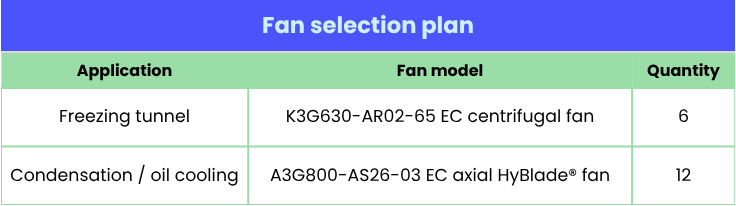
Pic.1 Fan selection plan
The centrifugal fan has a 630 mm size and a maximum back pressure of 1,235 Pa according to the case data. The axial fan has an air volume of up to 26,060 m³/h.For the freezing tunnels, three centrifugal fans provided the required 50,000 m³/h airflow at more than 500 Pa.
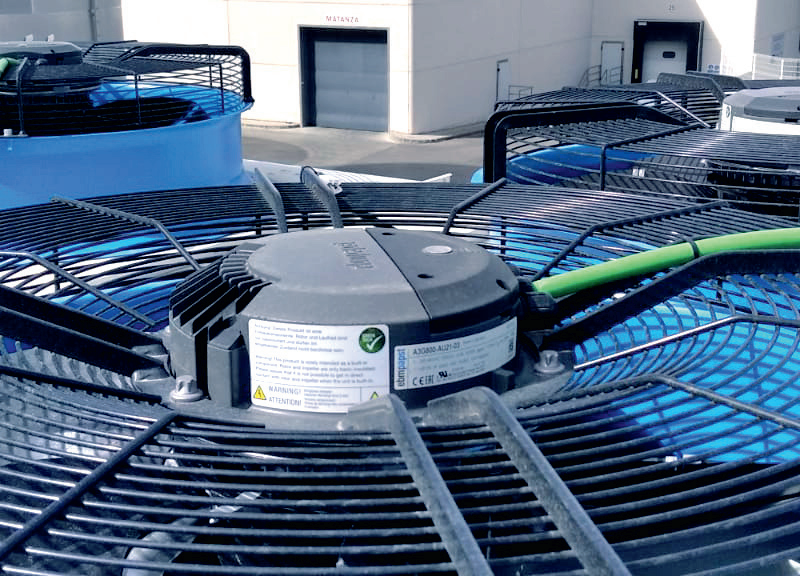
Pic.2 A3G800-AS26-03 EC axial fan(Source|INTARCON&ebm-papst)
According to the case, airflow and pressure suitability, low-temperature capability and delivery time were key factors in the selection of ebm-papst.
Why EC Fan Efficiency Matters in Freezing Systems
In a conventional refrigeration system, fan power is often viewed simply as electrical consumption.But in a freezer tunnel, the relationship is more direct:
Fan motor power → heat generated inside the refrigeration system → additional cooling load
Therefore, reducing fan power can also reduce the cooling burden placed on the refrigeration system.
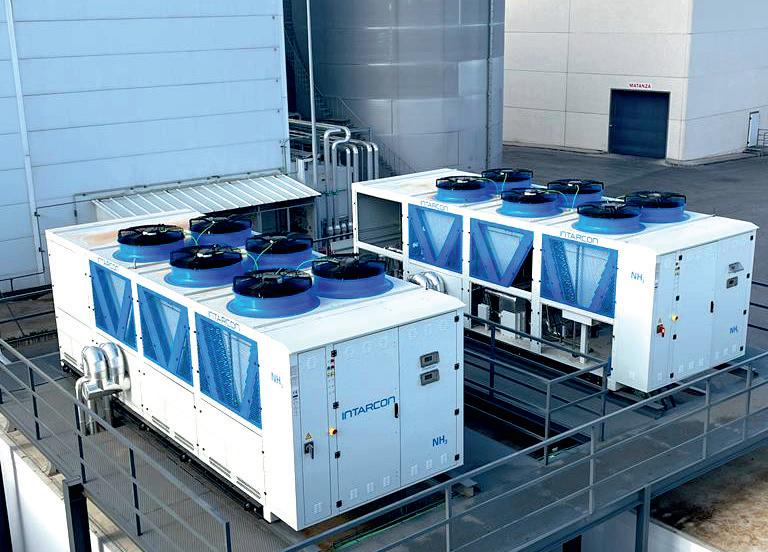
Pic3 Specially modified condenser by using ebm-papst EC fans(Source|INTARCON&ebm-papst)
The case specifically notes that the approximately 25% fan-motor-power ratio relative to evaporator cooling capacity could be reduced by half through the lower power consumption of EC motors.This is why EC fan selection should be evaluated from a system-level refrigeration perspective, rather than only by comparing motor ratings.
EC Axial Fans for Condensation and Oil Cooling
The refrigeration plant also used EC axial fans for direct ammonia condensation and oil cooling.
The micro-channel ammonia condenser required significantly higher airflow than an evaporative cooling tower, while eliminating water consumption—even at ambient temperatures of up to +47°C.
This demonstrates how fan technology can influence different parts of an industrial refrigeration system—not only the freezing tunnel itself.
Beijinghengrui also provides EC fan options for condensers and other refrigeration equipment.
Beijinghengrui Engineering View
For deep-freezing and industrial refrigeration applications, fan selection should start from the actual operating point.
The key parameters include:
The goal is not simply to find a fan with sufficient airflow.
It is to find a fan that can deliver the required airflow and pressure under the actual temperature and operating conditions, while keeping the overall refrigeration load under control.
This is where practical fan selection becomes part of refrigeration system engineering.
Key Takeaway
The project demonstrates an important principle:
In a deep-freezing system, the fan is part of the refrigeration load—not just an airflow component.
For industrial refrigeration projects, Measure → Analyze → Select → Verify remains a practical way to evaluate fan requirements.
Beijinghengrui supports refrigeration equipment manufacturers, system integrators and engineering contractors with ebm-papst fan identification, replacement selection, operating-point analysis and technical fan selection.
Have an existing refrigeration fan model or a new project requirement? Share the airflow, pressure, temperature and nameplate information for an engineering-based evaluation.
 whatsapp


