
 English
 Français
 Deutsch
 Português
 Español
 русский
  한국어
한국어 العربية
 Italiano
 Indonesia
 Schweiz
 Polski
 Nederlands
 ישראל - עברית
 Perzisch
 ไทย
ไทย 日本語
日本語 ኢትዮ-አማርኛ
 Việt Nam
 Kiswahili
 Srpski
 Ελληνικά
 简体中文
简体中文From PAPR to Cold Cabinets: Why High-Static-Pressure Applications Need the Right Centrifugal Fan
Beijinghengrui 3-Step Approach
01 — PROBLEM
02 — SOLUTION
03 — KEY RULE
A PAPR, a filtration unit, a boiler combustion-air system, a refrigerated cabinet and a clean workbench may look completely different.
But from a fan-selection perspective, they can share the same engineering challenge:
The system creates resistance, and the fan must maintain the required airflow against that resistance.
This is where centrifugal fans can become a practical solution.Rather than asking only how much air a fan can move, engineers need to consider the complete operating point: airflow, pressure, temperature, control requirements and installation conditions.
Why Does Static Pressure Matter?
A fan does not operate in isolation.
Once installed in a real system, airflow encounters resistance from components such as filters, coils, grilles, ducts and other airflow-path restrictions.
As system resistance increases, the fan operating point changes.
This is why a fan's maximum airflow does not tell engineers how it will perform after installation.
For high-static-pressure applications, the important question is:
Can the fan deliver the required airflow at the pressure generated by the actual system?
Centrifugal fans are often considered in these applications because their operating characteristics can provide the pressure capability needed to overcome system resistance while maintaining the required airflow.
Five Applications Where This Matters
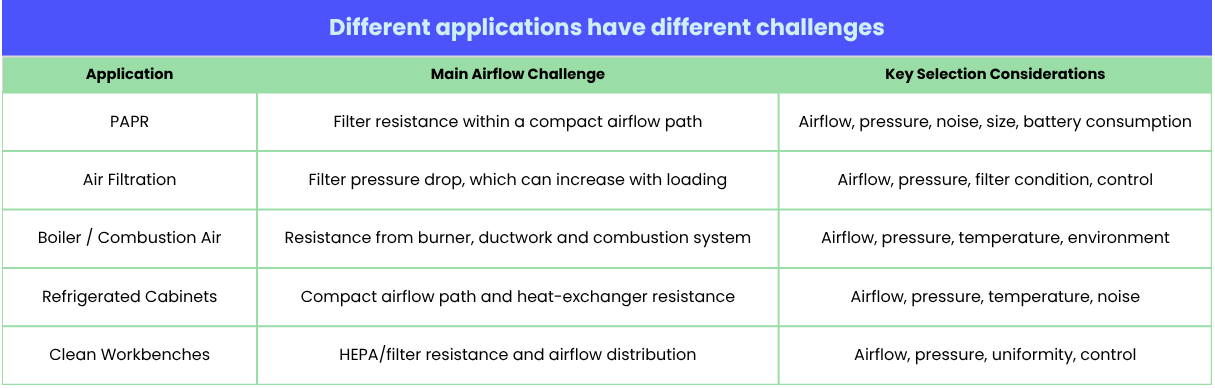
The application may change, but the selection logic remains similar:Determine the required airflow → understand the system resistance → select the fan at the actual operating point.
PAPR: Pressure, Airflow, Noise and Battery Life

PAPR systems need to deliver a controlled airflow through a filtration system while remaining compact and wearable.
The fan therefore has to balance several requirements:
Required airflow + filter resistance + low noise + compact size + energy consumption
Filter resistance can also change as the filter becomes loaded.
This means the fan should not simply be selected according to its maximum airflow.
Centrifugal fan technology can be considered where compact size, pressure capability and controllability are required.
However, for PAPR and other personal protective equipment, fan suitability does not equal product certification.
The complete device must be evaluated against the applicable safety and certification requirements.
Filtration and Clean-Air Equipment

Filtration systems provide another clear example of why static pressure matters.
As air passes through a filter, pressure drop is introduced into the system. Depending on the filter type and operating condition, resistance can become an important part of the total system pressure.
For clean workbenches and similar equipment, the objective is not simply maximum airflow.
The system may also require:
The fan therefore needs to be selected together with the filter and airflow architecture, rather than treated as an independent component.
Boiler and Combustion-Air Applications
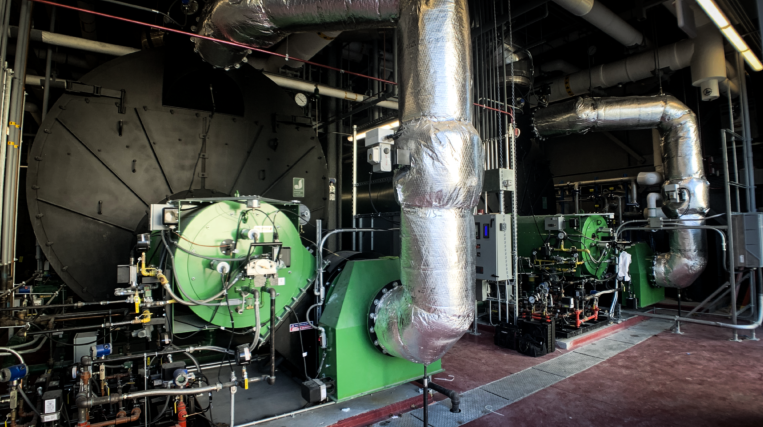
In boiler-related applications, centrifugal fans may be used where forced combustion air or other pressure-driven airflow is required.
Here, the operating environment becomes particularly important.
Engineers may need to consider :
The same fan-selection principle still applies: the required airflow must be evaluated against the actual system pressure and operating conditions.
The term “boiler application” alone is not sufficient to select a fan.
Refrigerated Cabinets: Small Equipment, Real System Resistance

Refrigerated cabinets and compact refrigeration equipment may have limited installation space but still require effective air circulation through an evaporator and internal airflow path.
The fan therefore needs to balance:
Airflow + pressure + compact dimensions + temperature + noise
A larger fan is not automatically better.
A fan that delivers excessive airflow may increase noise or energy consumption, while insufficient airflow can affect temperature distribution and cooling performance.
This is another situation where the actual operating point matters more than the fan's nominal maximum airflow.
Certification Is Not the Same as System Validation
This distinction is particularly important in medical, safety and regulated applications.
A fan may have applicable component-level compliance or certification, but that does not automatically mean the final equipment is certified.
Engineers should distinguish between:
Component level:Fan, motor, electronics and applicable product requirements.
Equipment level:The complete PAPR, filtration system, boiler, refrigeration equipment or clean-air device.
System level:Fan + filter + housing + controls + power supply + airflow path + operating environment + end-use requirements.
Final compliance depends on the complete system design and the applicable standards for that specific application.
Therefore, statements about certification should always be made within the correct scope.
How Should Engineers Select the Fan?
For a high-static-pressure application, a practical selection process is:
Application → Required airflow → System pressure → Temperature → Control → Dimensions → Applicable requirements → Verification
The existing fan model or nameplate can provide a useful starting point, but it should not replace operating-point analysis.
This is especially important when replacing discontinued models or evaluating an alternative fan.
The goal is not to find the fan with the highest airflow.
It is to find the fan that can reliably deliver the required airflow at the required pressure under the actual operating conditions.
Engineering Takeaway
PAPR systems, filtration equipment, boiler combustion-air systems, refrigerated cabinets and clean workbenches may serve very different purposes.
But they can share one fundamental fan-selection challenge:
When system resistance matters, fan selection must start with the operating point—not the application name or maximum airflow.
At Beijinghengrui, we support customers with ebm-papst centrifugal fan identification, model replacement, cross-reference and engineering selection for applications where airflow, pressure, temperature and installation conditions all need to be considered.
If you are evaluating a centrifugal fan for a new project or replacing an existing model, sharing the existing model or nameplate, required airflow, pressure, operating temperature, dimensions and application conditions gives us a practical basis for evaluating the appropriate fan solution.
The right fan starts with the right system data.
 whatsapp


