
 English
 Français
 Deutsch
 Português
 Español
 русский
 한국어
 العربية
 Italiano
 Indonesia
 Schweiz
 Polski
 Nederlands
 ישראל - עברית
 Perzisch
 ไทย
 日本語
 ኢትዮ-አማርኛ
 Việt Nam
 Kiswahili
 Srpski
 Ελληνικά
 简体中文
Why Do Industrial Fan Quotes Differ So Much? 5 Things Buyers Should Check
BeijingHengrui 3-Step Approach
01 — PROBLEM
Two quotations may show the same industrial fan model but differ in product condition, supply terms, or service coverage.
02 — SOLUTION
Verify the complete model, product status, stock availability, delivery conditions, and warranty scope before comparing prices.
03 — KEY RULE
Don't choose based on the price alone. First, make sure both quotations cover comparable products and purchasing terms.
Verify the Complete Model and Configuration
One common purchasing mistake is assuming that similar model numbers always refer to identical products.
Industrial fans may have model suffixes or configuration differences that affect voltage, control method, mounting arrangement, or other specifications. Even a small difference may matter when a fan is intended to replace an existing unit.
Before comparing quotations, check:
If you are sourcing a replacement fan, provide the original nameplate information and application details. This helps suppliers identify the intended model and reduces the risk of comparing different configurations.
Don't assume two fans are interchangeable simply because their model numbers look similar.
Clarify Product Condition and Sourcing Information
A quotation should clearly identify the condition of the product being offered.
A new product, a used unit, and a refurbished product are not necessarily equivalent purchasing options. Their prices may differ because their condition, supporting documentation, testing history, and warranty terms may differ.
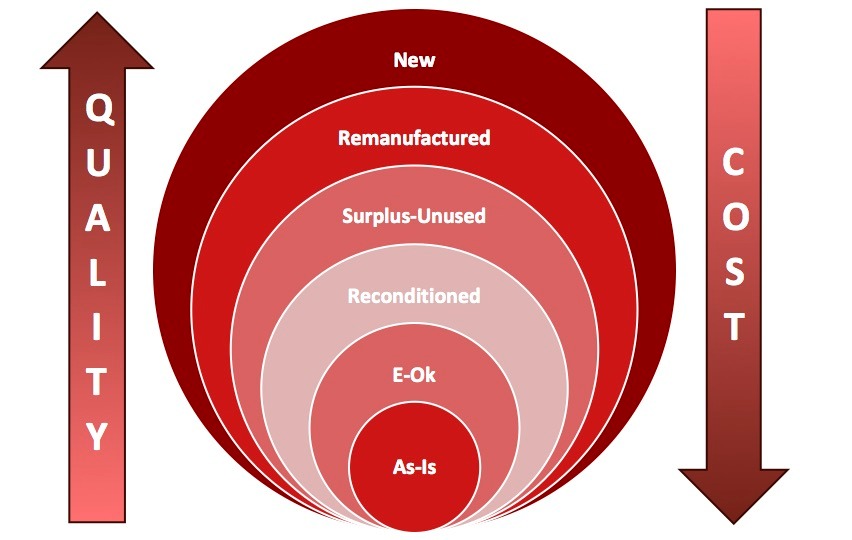
Pic.1 Understand the Different Product Conditions
For a product described as new, ask what sourcing documentation is available to support that description. For a refurbished unit, clarify what work has been carried out, whether components have been repaired or replaced, what testing was completed, and what warranty is offered.
Useful information may include:
Keep in mind that nameplate photos, packaging, and accompanying documents can support a product review, but no single item should be treated as conclusive proof of authenticity. When a supplier is an authorized channel for the brand, the sourcing trail is usually easier to verify.
Don't compare prices until you know what product condition and sourcing information each supplier is actually offering.
Check Stock Availability and Stock Age
“Ready stock” describes supply availability. It does not, by itself, establish a product's condition, manufacturing date, or authenticity.

Pic.2 Don't treat “in stock” as a complete product-quality statement
One supplier may have the required product physically available, while another may need to arrange a new shipment. This can affect delivery timing and the purchasing decision.
Before relying on a stock claim, confirm:
Older stock is not automatically defective, and newer stock is not automatically the better choice for every application. The assessment should consider product condition, storage history where relevant, and applicable manufacturer requirements.
For urgent maintenance or replacement projects, available stock may help reduce waiting time and support a faster return to operation. However, availability and dispatch commitments should be confirmed for the specific order.
Don't treat “in stock” as a complete product-quality statement. Verify both availability and the information relevant to product condition.
Compare Delivery Terms, Order Quantity, and Total Cost
The quoted unit price is only one part of the purchasing cost.
Order quantity may affect pricing. Shipping arrangements and delivery lead times can influence the overall procurement decision. Taxes, duties, freight, insurance, and other charges may also be included differently across quotations.

Pic.3 Sometimes, logistics costs are more expensive than the value of the goods
To make a fair comparison, check:
A lower unit price may not represent the lower total cost if additional charges apply or the delivery schedule does not meet project requirements. Conversely, a higher quotation is not automatically better simply because it includes more services.
Ask suppliers to clarify the quotation scope so that you can compare offers on a consistent basis.
Don't judge a quotation by its unit price alone. Compare the full cost and delivery conditions relevant to your order.
Review Warranty and After-Sales Support
Warranty and after-sales support can vary depending on the supplier and purchasing arrangement. These differences may affect the overall value of a quotation, particularly when the fan is a critical component in an operating system.

Pic.4 Hengrui has reliable after-sales service
Before placing an order, confirm:
Do not assume that a higher price guarantees better support, or that a lower price necessarily means there is no support. Ask for the relevant terms and responsibilities in writing.
For industrial applications, clear warranty conditions and access to appropriate technical information can help buyers assess procurement risks more accurately.
Don't assume after-sales support is included. Confirm what the supplier will provide and who is responsible if an issue arises.
A Practical Checklist Before You Choose a Quotation
Before selecting a supplier, make sure you can answer these five questions:
If any of these details remain unclear, request clarification before making a decision.
The goal is not simply to find the lowest price. It is to understand what you are buying, what the quotation covers, and whether the offer meets your application and delivery requirements.
How BeijingHengrui Supports Industrial Fan Purchasing
Comparing industrial fan quotations requires more than checking unit prices. Buyers need to confirm model details, product status, availability, delivery conditions, and the scope of after-sales support.
BeijingHengrui is an authorized ebm-papst distributor, supporting industrial and HVAC customers with fan model identification, product availability checks, application-oriented selection assistance, and sourcing coordination. For replacement requirements, the original fan model or a clear nameplate photo can help establish the starting point for verification.
Comparing quotations for an industrial fan?
Send BeijingHengrui the complete model number or a nameplate photo, together with your required quantity and delivery destination. We can help check model details, clarify availability, and identify the information needed to evaluate your purchasing options — typically with initial feedback within 1–2 working days.
A reliable purchasing decision starts with a clear comparison of the product and the terms — not the price alone.
FAQ
Q1: Why can the same fan model be quoted at very different prices?
Price differences may reflect product condition (new, used, or refurbished), sourcing channel, stock age, included services such as freight and insurance, or warranty coverage. A lower price does not automatically mean a worse product — but the quotation scope should be clarified before comparing.
Q2: How can I check whether a fan is new or refurbished?
Ask for a written description of the product's condition, sourcing documentation, nameplate and product photos, and any testing or refurbishment records. For refurbished units, ask what work was performed and what warranty applies. Purchasing through an authorized channel makes the sourcing trail easier to verify.
Q3: Does “in stock” mean the product is genuine?
No. Stock status only describes availability. Condition, manufacturing date, and authenticity need to be verified separately through documentation and product information.
Q4: What should a complete industrial fan quotation include?
At minimum: the complete model number with suffixes, product condition, quantity and unit price, lead time or dispatch date, shipping terms and destination, charges included or excluded (freight, insurance, taxes, duties), payment terms, and warranty coverage.
 whatsapp


